

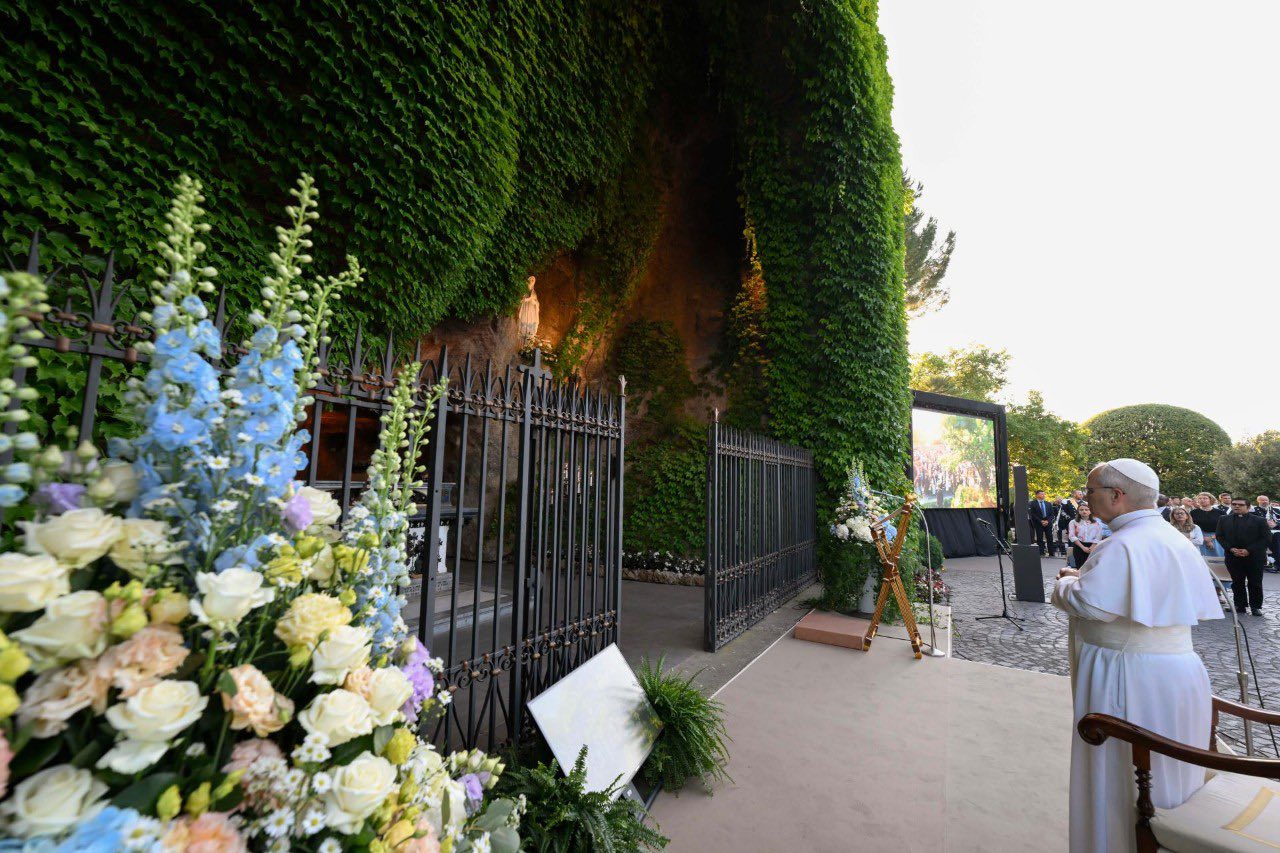
(ZENIT News / París, 08.27.2026).- Pope Leo XIV’s first formal visit to France is rapidly becoming an event of extraordinary proportions. A journey originally budgeted at €12 million is now expected to cost close to €20 million, while hundreds of thousands of people are preparing to gather for the Pope’s Masses and encounters in Paris, Lourdes and Metz. The scale of the response is already most striking at Lourdes.
When registrations opened on August 10 for Leo XIV’s September 26-27 visit to the Marian sanctuary, organizers initially regarded registration as advisable rather than compulsory. Within less than ten days, however, 100,000 pilgrims had registered. The sanctuary subsequently made registration mandatory and has now closed it after reaching its estimated capacity of 150,000 people.
“We had never seen anything like it,” said David Torchala, the sanctuary’s communications director.
The numbers offer an early indication of the extraordinary popular interest surrounding the Pope’s French journey. Lourdes will not impose an attendance limit in the same way as some other events, but the physical capacity of the sanctuary means that the practical ceiling has already been reached.
Paris is facing an even larger logistical challenge.
Up to 500,000 people are expected for the Mass Leo XIV will celebrate on September 26 in the Place de la Concorde and along the Champs-Élysées. More than 200,000 people had registered by mid-August, while places for the youth vigil at the Stade de France were already full.
The journey will begin in Paris, where the Pope is scheduled to be officially received by President Emmanuel Macron. His program includes a visit to UNESCO, Vespers at Notre-Dame and the youth vigil before the huge Saturday Mass. From Paris, Leo XIV will travel to Lourdes and then to Metz, where the visit will conclude on September 28.
The sheer size of the program helps explain why the original €12 million estimate has risen toward €20 million. The Church in France has launched a dedicated fundraising campaign to cover the organization of the visit, with donations available for the overall national operation or specifically for Paris, Lourdes or Metz.
The religious events themselves are free to those attending. Registration is nevertheless strongly encouraged because the authorities and organizers must manage access, transportation and security on a scale far beyond an ordinary papal liturgy.
A papal visit, however, is not exclusively a Church event.
Leo XIV is also the head of state of Vatican City, and French public authorities are consequently expected to bear costs connected with policing, public order, transportation, crowd management and institutional reception. That distinction has become particularly important in Metz, where a local controversy has turned the Pope’s arrival into a debate about the limits of public spending in a strictly secular state.
Metz, a city of approximately 120,000 inhabitants, has set aside up to €500,000 in its supplementary budget for expenses associated with the visit. Half of that amount is earmarked for investment and the other €250,000 for operating expenses.
The money is a budgetary provision rather than an indication that the entire sum has already been spent. City authorities say the extraordinary allocation is intended to cover the demands created by the arrival of thousands of pilgrims and visitors, including reception, information, mobility and security.
Criticism has nevertheless followed.
Jérémy Roques, a municipal councillor representing a left-wing and environmentalist group, questioned whether Metz taxpayers should shoulder the cost and argued that the amount was excessive. On August 25, the Union of Secular Families of Moselle went further, referring a specific €250,000 allocation connected with the broadcasting of the Mass to the prefecture.
The organization argues that this particular expenditure could raise questions under France’s rules governing public funding of religion.
The French state is simultaneously dealing with a religious leader and a sovereign official. A Mass is an act of worship, but the person presiding over it is also the head of a state with which France maintains diplomatic relations. Security surrounding such an event, for example, cannot easily be separated from the protection afforded to a foreign head of state.
The dispute illustrates how unusual the modern papacy can appear from a constitutional perspective. The Pope’s pastoral mission is explicitly religious, yet his international role gives his journeys a diplomatic and institutional dimension that cannot simply be reduced to an ordinary religious gathering.
In Metz, that dual identity will be visible throughout September 28. Leo XIV is scheduled to participate in an interreligious meeting at the Robert Schuman Congress Center at 10 a.m., followed an hour later by an encounter focused on Europe, peace and unity. He will later travel through the city in the popemobile before celebrating Mass at St. Stephen’s Cathedral at 4 p.m. and departing for Rome.
The itinerary itself reflects the character of the entire journey: pastoral, diplomatic and European at the same time.
It will also be the first formal papal visit to France since Benedict XVI traveled there in 2008, giving the September journey an importance beyond the individual events on the schedule.
Thank you for reading our content. If you would like to receive ZENIT’s daily e-mail news, you can subscribe for free through this link.

Publicaciones relacionadas:
 US Bishop joins Gaza peace protest outside White House
 9 interesting and curious facts you may not have known about U.S. Catholics
 USA: Pope Francis Sends Cardinal Tagle as Special Envoy to the National Eucharistic Congress
 England’s Cathedrals See Post-Pandemic Revival in Visitors, but Worship Attendance Tells a More Complex Story
