

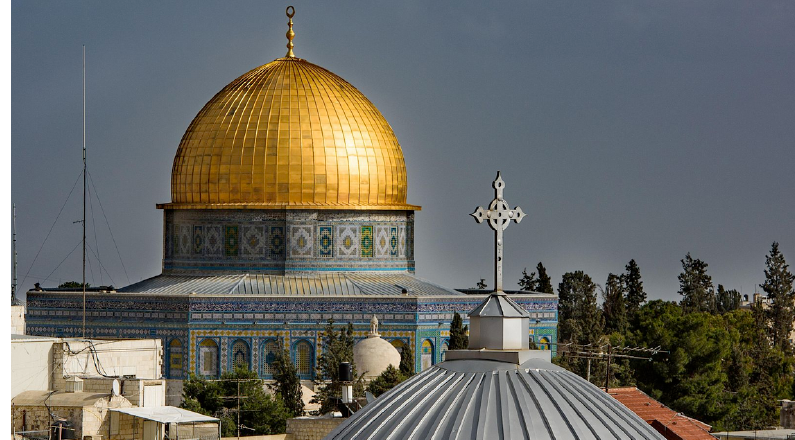
(ZENIT News / Jerusalem, 07.07.2026).- A series of recent developments across Israel, the Palestinian territories and neighboring countries has heightened concern over the security and long-term future of Christian communities in the Holy Land, where local Church leaders, civil society organizations and the Holy See are warning of a convergence of threats ranging from religiously motivated harassment to settlement expansion and the humanitarian consequences of ongoing conflict.
One of the clearest warning signs comes from Israel itself, where organizations dedicated to protecting religious freedom have documented a sharp increase in anti-Christian incidents. The Israel Religious Action Center (IRAC), affiliated with Israel’s Reform Jewish movement, has formally urged police and state prosecutors to investigate online content that it says incites violence against Christian holy sites. The complaint focuses on Google Maps reviews attached to churches and monasteries that quote biblical passages calling for the destruction of pagan shrines, presenting them in a contemporary context that, according to IRAC, risks encouraging attacks against existing Christian places of worship.
The comments appeared alongside some of Christianity’s most revered sites, including the Church of the Dormition in Jerusalem, the Basilica of the Nativity in Bethlehem, St. Alexander Nevsky Church near the Church of the Holy Sepulchre, Jacob’s Well Monastery in Nablus and the Milk Grotto in Bethlehem. IRAC argues that, when linked directly to real locations visited by thousands of pilgrims each year, such messages cannot simply be dismissed as offensive rhetoric but may constitute unlawful incitement under Israeli law.
The complaint reflects a broader pattern. According to the Rossing Center for Education and Dialogue, 155 incidents targeting Christians and Christian institutions were documented in Israel and East Jerusalem during 2025, up significantly from 111 cases the previous year. These included physical assaults, vandalism, desecration of churches, verbal abuse and the increasingly reported phenomenon of clergy being spat upon in public.
Fresh data released by the Religious Freedom Data Center suggests that the trend has continued into 2026. Between April and June alone, researchers recorded 83 separate incidents, most of them in Jerusalem’s Old City. Beyond verbal harassment and physical aggression, the report describes vandalism, objects thrown into monastery courtyards and online provocations mirroring those highlighted by IRAC. Particularly troubling, researchers say, is that some attacks are carried out openly by minors, sometimes encouraged by adults accompanying them.
The report also argues that educational shortcomings contribute to the problem. Many Israeli school groups and military visitors reportedly receive little or no instruction about the living Christian communities that remain part of Jerusalem’s social fabric. In response, religious freedom advocates have begun cooperating with Israeli institutions to develop educational material for military guides and have called for broader efforts to improve awareness of Christianity’s continuing presence in the country. Following an assault on a nun at Mount Zion in April, a protective escort service was also established for clergy and religious personnel moving through Jerusalem’s Old City.
Beyond questions of religious intolerance, Christian communities in the Palestinian territories are expressing growing alarm over developments affecting their physical presence on the land.
In Taybeh, widely recognized as the last entirely Christian Palestinian town in the West Bank, parish priest Father Bashar Fawadleh has appealed to diplomats, churches and international organizations after residents reported repeated visits by groups of Israeli settlers to the Jabal Al-Massis area since July 5. Local witnesses believe preparations are underway for the establishment of a new settlement outpost following months of escalating attacks that have included arson, armed intimidation, assaults on farmers and repeated efforts to prevent residents from accessing their agricultural lands.
According to local accounts, armed settlers recently set fire to a residential building, ignited farmland on nearby hillsides and allegedly fired toward residential areas while residents attempted to extinguish the flames. Father Fawadleh warned that failure to intervene promptly could create irreversible realities on the ground, further undermine hopes for peace and accelerate the erosion of Christianity’s historic presence in the Holy Land.
A similar appeal has come from nearby Beit Sahour, the predominantly Christian town adjacent to Bethlehem. Mayor Laith Hazim Qumsieh has condemned Israeli plans involving approximately 92 dunams (9.2 hectares) in the Ush Ghurab area, arguing that the project threatens the city’s only remaining corridor for eastward development. Located barely 1.5 kilometers from the Basilica of the Nativity, the disputed site has long been contested after decades of military use.
Municipal leaders fear that additional settlement construction would not only restrict urban growth and economic development but also increase security risks, encourage further Christian emigration and deprive residents of one of their principal recreational and community spaces. Beit Sahour, traditionally known for its religious significance as the location associated with the Shepherds’ Field and for its longstanding culture of coexistence, now sees its future increasingly linked to broader political developments across the West Bank.
Regional instability continues to deepen these anxieties. Israeli security forces recently stopped more than 100 settlers reportedly attempting to enter southwestern Syria to establish new settlements in territory currently controlled by the Israel Defense Forces. Meanwhile, Palestinian authorities reported the death of a 16-year-old during an Israeli military operation near Ramallah, alongside additional casualties elsewhere in the West Bank and Gaza.
Across the northern border, Lebanon continues to grapple with the aftermath of war despite a fragile ceasefire. UNICEF estimates that roughly 100,000 children risk missing the beginning of the next school year unless damaged educational facilities are repaired before September. Assessments conducted with Lebanon’s Ministry of Education identified damage to 340 public and private schools, including 17 that were completely destroyed. Although more than 640,000 displaced people have returned home since the June ceasefire agreement, approximately half a million remain displaced, while United Nations peacekeepers continue to report ceasefire violations and military activity along the southern frontier.
Amid these overlapping crises, the Holy See has reaffirmed its support for the United Nations Relief and Works Agency for Palestine Refugees (UNRWA). Addressing the UN General Assembly, the Vatican’s Permanent Observer Mission emphasized that obstructing humanitarian assistance to Palestinian refugees constitutes a serious violation of international humanitarian law. The Holy See reiterated both its financial commitment to the agency—which for more than seven decades has provided education, healthcare, food assistance and social services to millions of Palestinian refugees—and its concern over attacks on UNRWA personnel and facilities sheltering civilians.
Taken together, these developments illustrate that the challenges confronting Christians in the Holy Land extend well beyond isolated incidents. Religious hostility, unresolved territorial disputes, humanitarian emergencies and persistent insecurity increasingly intersect, threatening not only individual communities but also the historic religious diversity that has characterized the region for centuries. For many local Christian leaders, protecting that fragile heritage will require not only stronger security measures but also sustained educational efforts, respect for religious freedom, adherence to international humanitarian law and renewed diplomatic engagement aimed at preventing further deterioration.
Thank you for reading our content. If you would like to receive ZENIT’s daily e-mail news, you can subscribe for free through this link.

Publicaciones relacionadas:
 Israel Denies Killing Catholics, Catholic Patriarchate of Jerusalem Shows Photos
 The Jewish State of Israel Bombs Catholic Church in Gaza: Parish Priest Wounded, Pope Leo XIV Speaks Out
 Terrorists slit the throats of three Christians
 From Castel Gandolfo, Pope Leo XIV Calls for Peace Amid Gaza’s Agony and UN Genocide Allegations
