

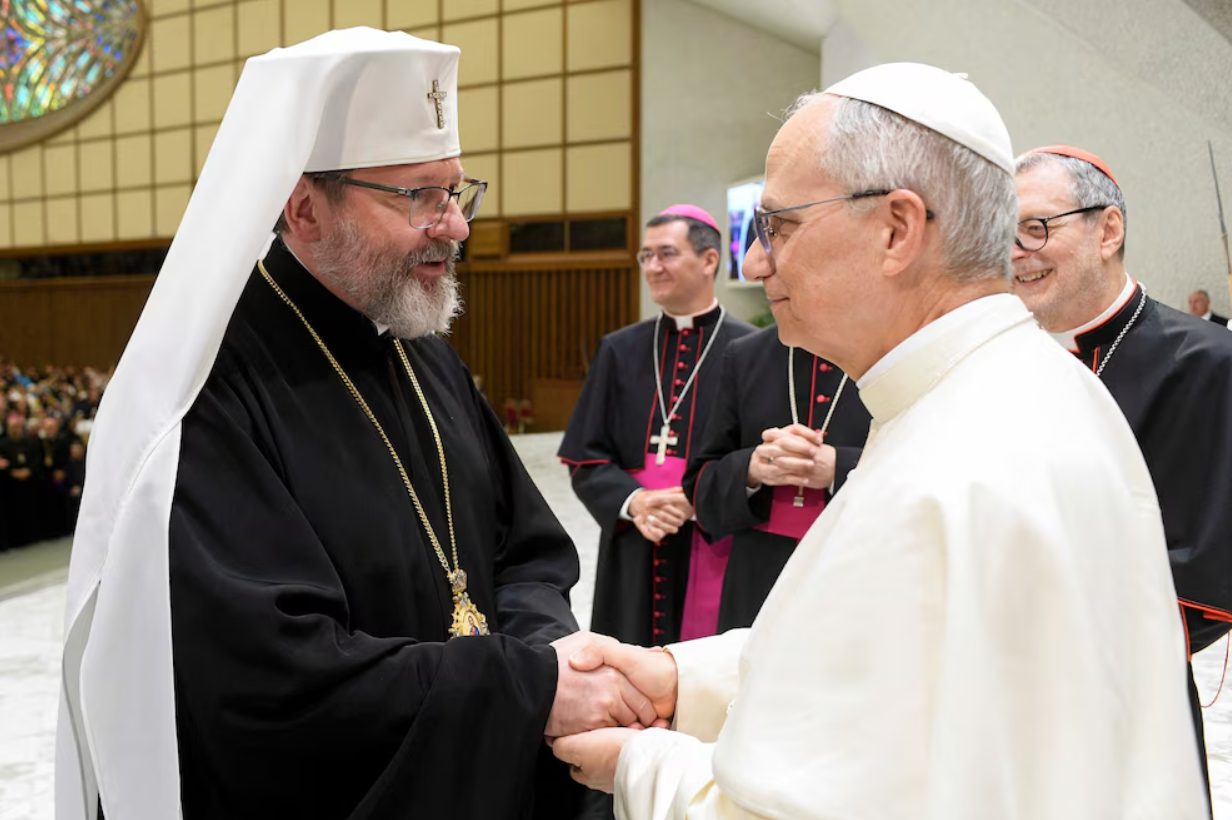
(ZENIT News / Vatican City, 08.31.2026).- Pope Leo XIV has rewritten an important part of the legal architecture governing the Eastern Catholic Churches, giving their bishops a power they did not previously possess in explicit canonical form: under grave circumstances, a synod may initiate the removal of its own patriarch or major archbishop when communion between the church’s head and its bishops has become irreparably damaged.
The reform, contained in the apostolic letter issued on August 29 under the title Mutua Concordia, changes canons 106 and 126 of the Code of Canons of the Eastern Churches. It took effect immediately.
The measure is significant not because Leo has transferred final authority away from the papacy, but because he has placed greater responsibility in the hands of the churches most directly affected by an internal crisis.
Under the new rules, if a patriarch fails to fulfill his obligations and does not convene the bishops’ synod when required, the bishop senior by episcopal ordination and entitled to vote may convene it instead. If necessary, that responsibility passes to the next eligible bishop in seniority.
The synod may then ask the patriarch to resign when it recognizes a grave cause. If he refuses, the bishops can proceed to a secret ballot. Removal requires the support of at least two-thirds of the members entitled to vote, while the patriarch must be given a full opportunity to defend himself.
There is, however, a decisive safeguard: the synod’s decision does not by itself remove the patriarch. The Pope must give his consent.
Leo describes this papal role not as an invitation to override the Eastern bishops, but as a guarantee that their judgment is made freely, without improper internal or external pressure. Rome therefore remains the final guarantor while the local synod assumes the primary responsibility for diagnosing and addressing its own crisis.
That arrangement reflects a distinctive feature of Catholicism that is often poorly understood outside the Church. The Eastern Catholic Churches are not simply Eastern versions of Latin Catholic dioceses. They are churches with their own traditions, liturgical patrimony and canonical structures, while remaining fully united with the Bishop of Rome.
There are currently six patriarchal Eastern Catholic Churches: the Maronite, Chaldean, Syriac Catholic, Melkite Greek Catholic, Armenian Catholic and Coptic Catholic Churches. Four additional Eastern Catholic Churches have the status of major archiepiscopal churches: the Ukrainian Greek Catholic, Romanian Greek Catholic, Syro-Malabar and Syro-Malankara Churches. The new provisions apply to these major archiepiscopal churches as well.
For Leo, that structure matters. In June, he described the Eastern Catholic Churches as a “great gift” to the universal Church and warned that failing to understand their traditions impoverishes Catholicism itself. The reform can therefore be read as part of a broader effort to ensure that Eastern Christians are not merely governed from Rome but are able to exercise the responsibilities proper to their own ecclesial traditions.
The immediate issue addressed by Mutua Concordia is more precise: what happens when the relationship between a patriarch, described in Eastern canon law as the “father and head” of his patriarchal church, and the bishops of his synod becomes so damaged that normal governance can no longer function?
Until now, the Eastern canonical code did not clearly provide a procedure for that particular breakdown. The new legislation fills that gap with a defined sequence: convene the synod, establish the grave cause, request resignation, allow a full defense, hold a secret vote if resignation is refused, obtain a two-thirds majority, and finally submit the decision to the Pope.
The reform did not emerge in a vacuum. Recent years have seen serious internal disputes in some Eastern Catholic communities, including a particularly difficult conflict within the Syro-Malabar Church in India that culminated in the resignation of Major Archbishop Cardinal George Alencherry in 2023. Or the resignation of the Chaldean patriarch. The new legislation does not identify that episodes as its sole cause, but the experience illustrates the kind of institutional crisis for which a clearer mechanism may be needed.
The importance of the reform, however, should not be exaggerated. It does not create an easy mechanism for removing a patriarch because of ordinary disagreement, theological differences or political pressure. The threshold is deliberately high: the cause must be grave, the rupture must be irreparable, the patriarch has a right to defend himself, and two-thirds of the voting synod must support removal.
Nor does the measure turn the synod into an authority independent of the Pope. Rome retains the final consent.
What Leo XIV has changed is the balance of responsibility. Instead of requiring every such crisis to be resolved principally through intervention from the center, the law recognizes that Eastern bishops may possess a unique understanding of the circumstances within their own church and should have the canonical means to act when communion itself has been seriously wounded.
Mutua Concordia therefore sends two messages simultaneously. To the Eastern Catholic Churches, it says that their synods carry real responsibility and authority. To Rome, it says that this autonomy remains within a communion whose ultimate safeguard belongs to the Pope.
Thank you for reading our content. If you would like to receive ZENIT’s daily e-mail news, you can subscribe for free through this link.

Publicaciones relacionadas:
 Which Is The First Document Signed by Leo XIV? Here is the Video and First Selfie (with Women)
 [PHOTO GALLERY] Leo XIV at the tomb of Pope Francis
 Lion XIV inherits 52 million followers on X and opens Instagram surpassing 400 thousand followers first day
 Leo XIV Reveals The Four Things He Will Do While on Vacation, Which Might Also Inspire Other Catholics’ Vacation
