

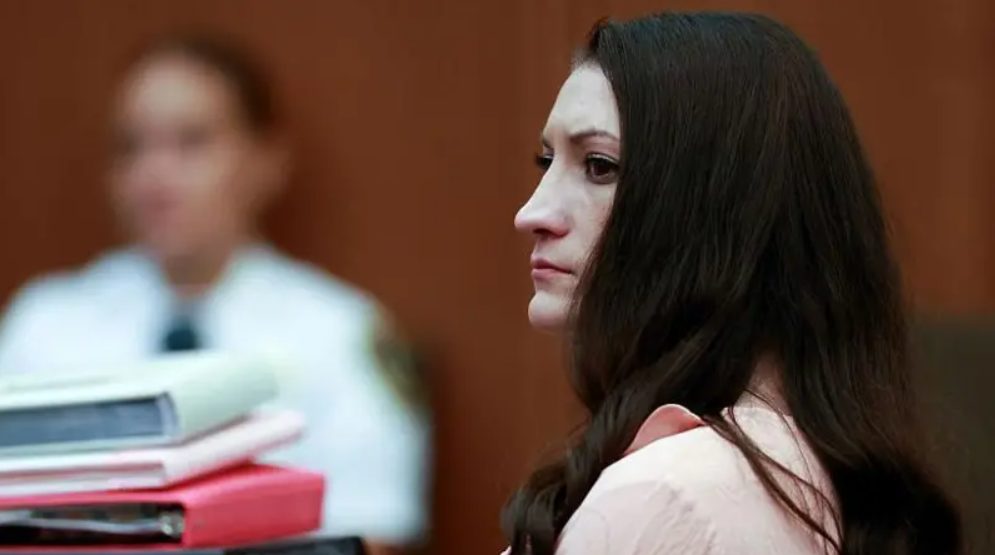
(ZENIT News – Caffe Storia / Rome, 09.02.2026).- Nine women and three men, confined in a room, called upon to choose from five options across three verdict forms, one for each deceased child: Not guilty. Not guilty due to an inability to understand or form intent. Guilty of first-degree murder. Second-degree murder. Involuntary manslaughter. For days now, this has been the task facing a jury in Plymouth, Massachusetts.
Before sending them to deliberate, Judge William Sullivan warned the jury: the verdict must not be influenced by the gruesome autopsy images, nor by feelings of guilt, compassion, or faith. Indeed, Catholicism, the faith of the accused and of more than a third of the state’s residents, has already made a strong presence felt in the courtroom. Meanwhile, outside, hundreds of women have been gathering in a circle for weeks to pray for the accused.
To recap the facts: on January 24, 2023, in Duxbury, while her husband Patrick was out buying dinner, Lindsay Clancy strangled her three children, Cora (5), Dawson (3), and Callan (8 months), using elastic exercise bands. She then slashed her own wrists and throat and threw herself from a second-story window.
She survived. From the hospital, paralyzed and unable to speak, she asked for a lawyer. In the days that followed, she told her husband and a chaplain that she had heard a male voice commanding her to kill her children and then take her own life. The defense maintains that Lindsay Clancy was suffering from postpartum psychosis, a rare but real diagnosis, and is therefore not criminally responsible.
Then, in August, the pink shirts arrived. Hundreds of people, almost all women, gathered outside the Plymouth courthouse bearing messages such as «I needed help» and «Peace for Lindsay.» They brought their children along to support a woman who had killed her own, recited the Our Father together, and formed heart shapes with their hands. The reason for such solidarity lies in the words of Renee Kimball, the rally’s organizer: any woman who has suffered from anxiety, depression, or postpartum disorders could find herself in Lindsay’s shoes.
Some have dubbed the phenomenon the «Lindsay Clancy feminists,» accusing the protesters of turning compassion into a license for impunity and of finding in feminism the perfect ideology to evade all responsibility. It marks a resurgence of #MeToo, albeit one weakened by political silence surrounding the Epstein case and by exhaustion following the wake of disasters left by «woke» ideology.
Who tightened the elastic bands around the children’s necks: their mother, or a healthcare system that failed to do enough? Everyone involved holds an overly certain opinion on the matter.
No, it is not just about the partisan crowds that gather around any news story bloody enough to earn a hashtag. Nor is it solely about judicial proceedings so intertwined with sensationalism that it is no longer clear who deliberates first: the courts or the public watching live.
It is, rather, about the dramatic effect: a disorienting asymmetry that we must nonetheless confront. It is the inability to keep things in order, above all, within oneself. What stands out in this tragedy, and in so many others, is the habit of shifting the margins to the center, while pushing the center itself out of our attention, our minds, and our hearts. They call it «debate» and «points of view,» but it looks more like confusion and delirium.
One need not believe Lindsay Clancy is a monster to realize that her children, three defenseless human beings whose voices were first reduced to a whisper and then silenced, are also the ones for whom very few people take to the streets. It is a mobilization rooted in compassion, stripped of ideological connotations and therefore lacking resonance; misunderstood and unpopular among a public that chooses a side every day without having to get its hands too dirty. All it takes is a flick of the fingers or opening one’s mouth.
What should be of greatest concern is not the degree of culpability attributed to Lindsay Clancy, but rather a society that can precisely identify the margins, neglected mental illness, potential healthcare system failures, social pressure on mothers, yet fails to keep at the center (and above all, within itself) what ought to matter most: the lives of Cora, Dawson, and Callan.
The more the boundaries of understanding expand, the more the core, our responsibility toward those who cannot defend themselves, becomes an uncomfortable detail. This happens in cases of multiple infanticide, abortion, euthanasia, war, and any violation of human dignity. The geometry inverts: the margin devours the center, and the center, consumed, fades from view. Yet it does not cease to exist, nor does it stop proclaiming the truth in a whisper.

Publicaciones relacionadas:
 Ecclesiology today: the crisis of Christianity and what we need now
 Religious Freedom Under Siege: ACN Report Highlights Escalating Persecution
 Russia Calls Patriarch Bartholomew “Antichrist in a Cassock”
 Holy Shroud, medieval painting? The response of three Italian scientists to a Brazilian “researcher”
