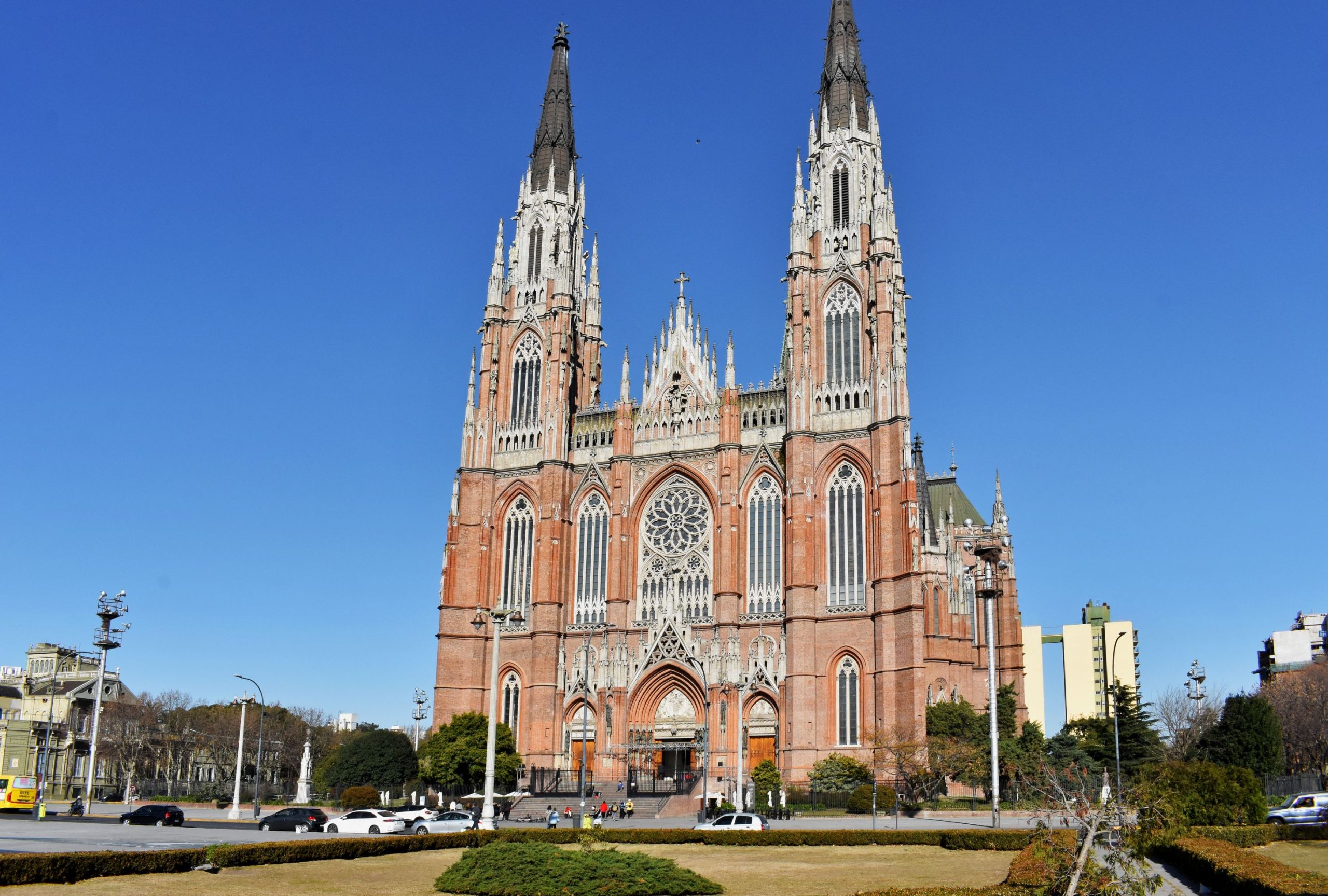
(ZENIT News / Guadalajara, 09.07.2026).-The Cathedral of the Immaculate Conception in La Plata, Argentina, was crowned champion of the «Cathedral World Cup», a virtual competition organized via Instagram that pitted renowned churches from around the globe against one another. In the final, the La Plata cathedral defeated the Cathedral of Florence, Italy, securing 93% of the vote.
The contest, organized by the social media account @documentales_de_bolsillo, invited thousands of people to vote for their favorite cathedral. The La Plata Cathedral had an impressive run, surpassing some of Europe’s most renowned cathedrals along the way, including Notre-Dame of Paris, the Duomo of Milan and the Cathedral of Cologne.
The final showdown against the Florentine Cathedral once again demonstrated the strong support the La Plata Cathedral enjoys. Over 54,000 users participated in the final round, with the Argentine Cathedral garnering 93% of the votes compared to 7% for its Italian rival.
A Symbol of La Plata
The Cathedral of the Immaculate Conception, located facing Plaza Moreno, stands as one of the city’s key religious, historical, and architectural symbols.
Built in the Neo-Gothic style, construction began in 1884, and the Cathedral was inaugurated in 1932.
Standing 112 meters tall, it has become one of Argentina’s most iconic religious buildings and was declared a National Historic Monument in 1997.
But what was it that allowed an Argentine cathedral to capture the admiration of so many people?
Beauty That Catches the Eye
The first answer likely lies in its striking silhouette. The La Plata Cathedral is a prime example of Neo-Gothic architecture in Latin America. Its façade is adorned with arches, pinnacles, spires, sculptures, and large rose windows.
Built primarily of brick, it also features a reddish hue that sets it apart from many great European cathedrals, which are typically constructed of stone.
It is a church that is instantly recognizable. And in a social media vote, where visual appeal carries immense weight, this characteristic can prove decisive. Its architecture yields a spectacular photograph from practically any angle.
A Piece of Europe in Argentina
The Cathedral’s history is closely linked to the birth of the city of La Plata itself. The foundation stone was laid in 1884, just two years after the city was founded. The project was conceived by architect and urban planner Pedro Benoit, who drew inspiration from the great Gothic cathedrals of Europe.
Yet, La Plata did not simply want to copy Europe. The result was a Latin American interpretation of the Neo-Gothic style. Local brick replaced stone, and European monumentality took on a new identity on Argentine soil.
Perhaps therein lies one of the reasons for its appeal: it is a cathedral that looks toward tradition while remaining deeply rooted in its own land.
The Beauty of Light
But a cathedral is not viewed solely from the outside. Upon entering the La Plata Cathedral, one’s perspective shifts. Light streams through the stained-glass windows, transforming the interior space. The colors cast by the glass create an atmosphere that is difficult to capture in a photograph.
This is precisely one of the great insights of Christian architecture: beauty is not merely decoration. Light holds meaning.
Since the early centuries of Christianity, places of worship have sought to express, through architecture, a reality that transcends the visible. The church thus becomes a form of catechesis composed of stone, glass, light, and silence
Why Did It Win Right Now?
One must also consider the phenomenon of social media. A poll of this kind does not necessarily measure which cathedral is the most architecturally significant, the oldest, or the one possessing the greatest artistic heritage. Above all, it measures an image’s ability to inspire admiration and mobilize a digital community.
And La Plata has an extraordinary advantage: its beauty is immediately apparent. You do not need to know the history of Gothic architecture to be impressed by its towers.
You do not need to be an art expert to pause before its stained-glass windows. You do not need to be Argentine to recognize that this is a monumental structure.
A photograph opens the door to admiration; history then allows one to discover everything that lies behind it.
A Victory That Speaks of Beauty
There is, however, something deeper. In an age accustomed to functional buildings, quick to construct and often designed with utility in mind, a cathedral continues to remind us that human beings also need to create beauty.
Cathedrals were not built merely to shelter people; they were built to lift the gaze. Their towers point toward the heavens. Their stained-glass windows transform the light. Their naves draw the eye toward the altar. Everything within them can become a language that speaks of God.
From Wonder to God
For a Christian, beauty is never merely aesthetic. Saint John Paul II wrote in his Letter to Artists that beauty has the power to awaken in the human heart a longing for the infinite.
This largely explains why cathedrals continue to fascinate even those who are not believers. A magnificent cathedral inspires wonder. And wonder can give rise to questions: Who built this? Why did they dedicate entire generations to a work that, perhaps, they themselves would never see finished? What did they seek to express? Toward what did this beauty point?
Perhaps the deepest secret of cathedrals lies right there: they do not want us to simply stand and stare at them; they want us, through them, to lift our gaze toward something greater. The La Plata Cathedral may have won a social media poll, but its true triumph does not lie in having bested Notre-Dame, Milan, or Florence.
It lies in having succeeded, if only for a few minutes, in making thousands of people stop to contemplate a church.
And perhaps that is a small victory for beauty. For when a cathedral moves a person to lift their eyes, to admire, to fall silent, and to wonder about the meaning of what they are beholding, architecture ceases to be merely architecture and begins to become evangelization.