

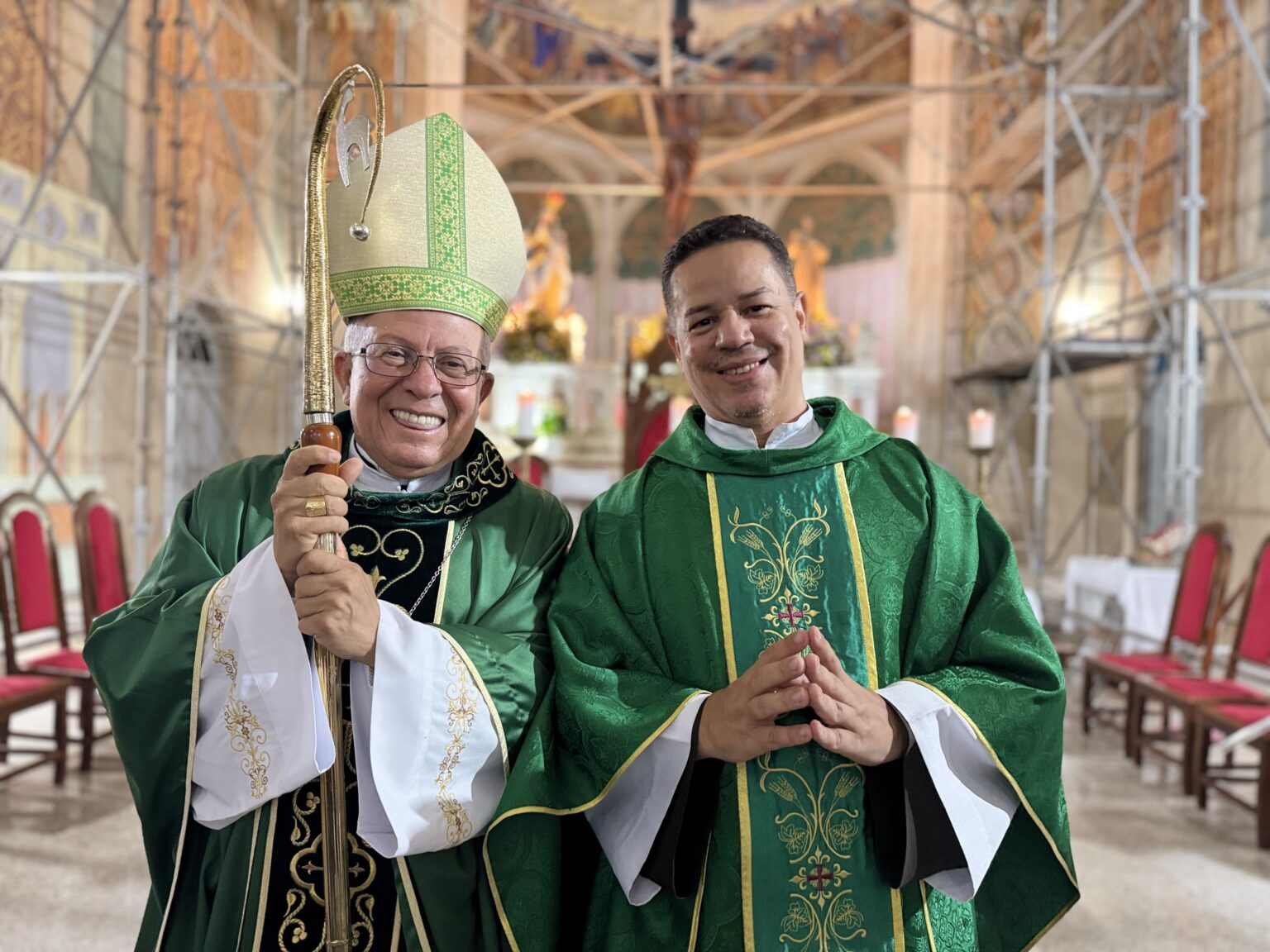
(ZENIT News / Aracaujo, 09.07.2026).- What happens when a priest appears to deliver a sermon he never preached, speaks in a voice that is not his own, or is shown in a photograph depicting an event that never happened?
For the Archdiocese of Aracaju in Brazil, the answer is increasingly clear: the problem is not merely technological. It is a question of truth, human dignity and the credibility of the Church itself.
Archbishop Josafá Menezes da Silva has issued new rules governing the use of artificial intelligence in archdiocesan communications, establishing one of the clearest attempts yet to translate the Vatican’s growing reflection on AI into concrete rules for diocesan life.
The underlying principle is simple but increasingly urgent in the age of synthetic images and cloned voices: technology may assist the Church’s mission, but it must never falsify reality.
The guidelines apply broadly to bishops, priests, deacons, ministers, pastoral workers, communicators and the wider Catholic community of the Archdiocese of Aracaju. They draw on recent Church teaching concerning human dignity, communication and artificial intelligence, including Pope Leo XIV’s message for the 60th World Communications Day and his encyclical Magnifica Humanitas, as well as Antiqua et Nova, the joint reflection of the Dicastery for the Doctrine of the Faith and the Dicastery for Culture and Education approved under Pope Francis.
At the center of the new policy stands what Archbishop Menezes describes as the Church’s starting point in every discussion of artificial intelligence: the unconditional defense of human dignity.
That principle has led the Brazilian archdiocese to establish two fundamental requirements for AI-assisted communication.
First, human beings must review material before publication. Any artistic work produced with the assistance of artificial intelligence is subject to mandatory human oversight.
Second, transparency is required. Content generated or manipulated by AI must be clearly identified and distinguished from material created directly by human beings, particularly when the technology could affect the public’s understanding of what is real.
The rules are especially strict when artificial intelligence is used to reproduce human identity.
The archdiocese prohibits the reconstruction of a real person’s face in place of an authentic photograph, significant alterations of a person’s physical features, and the creation of artificial appearances presented as genuine. It also forbids synthetic images that could be mistaken for real photographs.
For clergy, the restrictions are even more explicit.
Artificial intelligence must not be used to simulate the appearance of a bishop, priest or deacon when the result replaces a real photograph or could reasonably be interpreted as an authentic representation of that person or of an event in which he supposedly participated.
The same principle applies to voices.
A bishop, priest or deacon cannot be made to appear to deliver a message or speech through AI-generated audio if he never actually spoke those words. Nor may technology attribute to a real person an appearance, action, statement or situation that does not correspond to reality.
The concern is far from theoretical.
Artificial intelligence has already created serious problems online through fabricated videos and cloned voices involving recognizable religious figures. In 2024, Father Chad Ripperger warned about videos circulating under his name and image that allegedly used artificial intelligence to imitate his voice while inventing claims and stories he had never made, including false assertions concerning supposed visions.
Such cases illustrate why the Aracaju guidelines focus so strongly on faces and voices.
A manipulated image can deceive. A cloned voice can create an even deeper illusion of authenticity. When the person involved is a priest, bishop or other religious figure, the consequences may extend beyond ordinary reputational damage. False statements can mislead believers, generate confusion about Church teaching and exploit the trust that Catholics naturally place in pastoral figures.
The archdiocese is not, however, calling for the rejection of artificial intelligence.
On the contrary, the new rules explicitly recognize its legitimate value as an auxiliary tool. AI may assist with creating backgrounds, textures, abstract elements and illustrations; suggesting layouts; working with colors; helping with composition and writing; and developing visual concepts.
The distinction is therefore not between technology and faith, but between assistance and substitution.
Artificial intelligence may help a communicator work. It may not replace the human capacity to judge, verify, create responsibly and accept moral accountability for what is published.
That distinction reflects a broader concern expressed by Pope Leo XIV about the extraordinary power of AI to construct what have been described as “parallel realities.” As synthetic technology becomes more convincing, the line separating reality from fabrication can become increasingly difficult to recognize.
The danger is not confined to sophisticated fraud. Manipulated content can facilitate digital deception, harassment, violations of privacy and other forms of abuse. The Church’s concern, therefore, is ultimately personal: behind every face and every voice stands someone whose identity cannot simply become raw material for technological manipulation.
The Aracaju policy also contains an important lesson for Catholic communication more broadly.
Evangelization depends upon trust.
The Church can use the most advanced tools available to communicate the Gospel, but the credibility of its message would be weakened if those same tools were used to manufacture images, voices or events that never existed. The more closely a digital representation resembles a real person or real event, the greater the obligation to ensure that it corresponds to reality.
This is why transparency and human responsibility form the backbone of the new rules.
Artificial intelligence does not bear moral responsibility for a deceptive publication. The person who chooses to create, approve and distribute it does.
In this sense, the guidelines are not fundamentally a technical manual. They are an attempt to defend a principle that has always been essential to Christian communication: truth cannot become secondary to effectiveness.
The Archdiocese of Aracaju has therefore chosen neither technological enthusiasm without limits nor fear-driven rejection. Its approach is one of discernment.
Artificial intelligence can create useful images, improve communication and assist human creativity. But it cannot be permitted to invent a priest’s sermon, manufacture a bishop’s voice or place a clergyman inside a fictional event and then present the result as reality.
The final responsibility remains human.
As Archbishop Menezes reminded pastoral workers, communicators and the faithful, technology must serve the Church’s mission and never distort it. What the Church communicates, the guidelines insist, must be truthful not only in its content but also in the way reality itself is represented.
Thank you for reading our content. If you would like to receive ZENIT’s daily e-mail news, you can subscribe for free through this link.

Publicaciones relacionadas:
 Canada: Courageous Bishop Challenges Law in Favour of Euthanasia
 Ukraine: Greek-Catholics open process of beatification of the predecessor of their current major archbishop: Ljubomyr Husar
 Ordinations Across a Shifting Continent: A Fragmented Yet Revealing Portrait of Catholic Priesthood in Europe, 2025
 These are the dioceses with the most and fewest baptisms in the U.S.
