

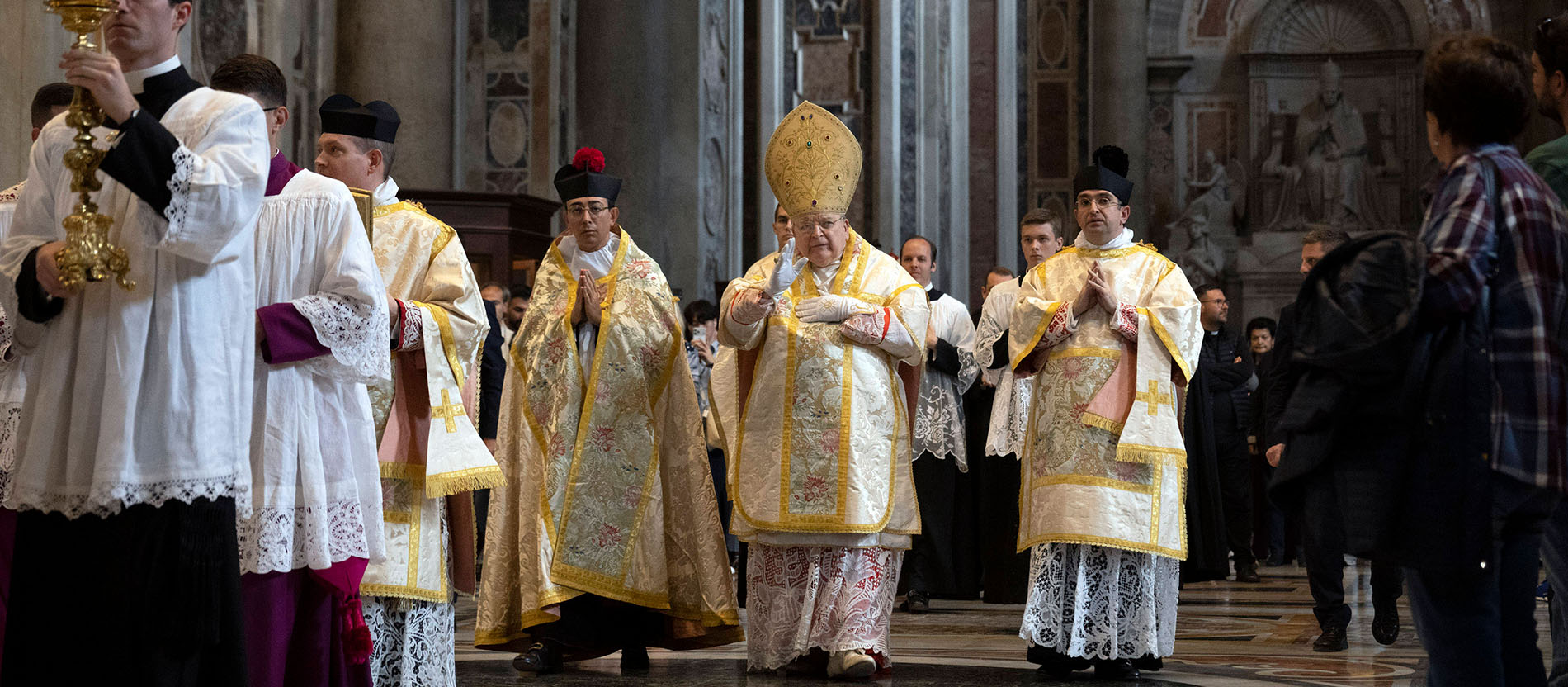
(ZENIT News / Rome, 09.13.2026).- The traditionalist Catholic movement will return to Rome in October 2026, but its most visible liturgical moment will take place outside St. Peter’s Basilica. The decision not to authorize this year’s traditional Roman rite Mass inside the Vatican basilica has revived questions about how Pope Leo XIV intends to manage one of the most delicate legacies of Pope Francis, while a separate confrontation with the Society of St. Pius X in Assisi illustrates that Rome’s opening toward traditionalist Catholics has firm canonical boundaries.
The 15th International Summorum Pontificum Pilgrimage, known as Ad Petri Sedem, will take place from October 23 to 25. Unlike last year, when the pilgrims received permission to celebrate their principal Mass in St. Peter’s for the first time since 2022, this year’s Pontifical Mass will be celebrated at 3 p.m. on October 24 at the Papal Basilica of St. Mary Major, with Bishop Athanasius Schneider presiding.
The distinction matters. The organizers have not been barred from entering St. Peter’s. Their procession will arrive there on Saturday morning, pass through security and gather inside the basilica at 1 p.m. for prayer. What they have not received is authorization to celebrate their pilgrimage Mass there.
According to a letter sent to the organizers through the Apostolic Nunciature and dated August 7, the authorization was denied specifically “this year,” rather than as a permanent prohibition. That wording leaves open the possibility that a future request could receive a different response. The organizers had reportedly made several attempts during the preceding months to obtain permission to repeat the 2025 celebration, approaching the Pontifical Household in December, April and June without success.
The change is particularly significant because last year’s permission was interpreted in traditionalist circles as an indication that Leo XIV might cautiously modify the course established under Francis. Francis had sharply restricted the celebration of the pre-conciliar Roman Missal through his 2021 motu proprio Traditionis Custodes. At St. Peter’s, restrictions on private celebrations had already been introduced in 2021, with celebrations according to the 1962 Missal subsequently confined to designated times and to the Clementine Chapel in the basilica’s grottoes.
The decision this year therefore does not amount to a reversal of Francis’s policy, but neither does it establish a definitive closure. Instead, it points to a more carefully calibrated approach in which the traditional liturgy remains possible in specified circumstances while Rome retains control over where and how it is celebrated.
That tension will be visible in an unusually symbolic setting. St. Mary Major, where Schneider will celebrate the main Mass, is also the basilica where Francis chose to be buried. For traditionalists, the juxtaposition inevitably carries a historical resonance: the pilgrimage devoted to the older liturgical tradition will celebrate its central Mass in the same church that now contains the remains of the pope most closely associated with restricting that tradition.
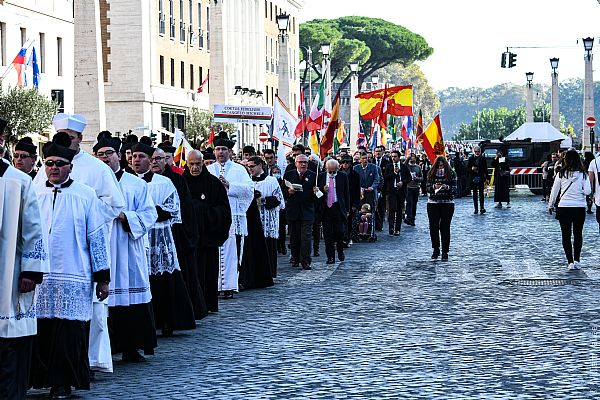
The pilgrimage itself will nevertheless retain a strong Roman character. Schneider will preside over Pontifical Vespers at 6:30 p.m. on October 23 at the Basilica of St. Mary and the Martyrs, better known as the Pantheon. On October 24, the procession will begin after the Rosary at the Basilica of Saints Celsus and Julian and proceed toward St. Peter’s. The final day, October 25, will include Masses at St. John the Baptist of the Florentines, the Most Holy Trinity of the Pilgrims and St. Anne in the Lateran.
The organizers have expressed disappointment at not returning to St. Peter’s for Mass but have also thanked Leo XIV and Cardinal Rolandas Makrickas, archpriest of St. Mary Major, for allowing the celebration to take place there. They have framed their pilgrimage around the hope for “liturgical peace,” a phrase that acquires particular significance under a pope whose first public words after his election emphasized peace.
Yet the Vatican’s treatment of the Summorum Pontificum pilgrims should not be confused with the Church’s position toward the Society of St. Pius X. The episode in Assisi shows a much harder canonical line.
On September 6, members of the Italian district of the Society attempted to conclude their annual pilgrimage at the Basilica of St. Francis. They were not permitted to enter the church as a group for their communal celebration and recitation of the Creed, although individual members could enter and pray in smaller groups. The district superior, Father Gabriele D’Avino, responded by delivering his concluding address outside the basilica and leading the public recitation of the Creed in the atrium.
The confrontation follows the Vatican’s canonical penalty imposed in July after the Society proceeded with episcopal ordinations without a pontifical mandate despite Vatican warnings. As a result, members of the organization are prohibited from conducting ceremonies and processions in Catholic churches and other places belonging to the Church, although the restrictions do not prevent individual prayer and entry as private worshippers.
D’Avino portrayed the Assisi decision as evidence of what he considers an inconsistency: religious representatives from other traditions, he argued, would be welcomed for public prayer in the city while Catholics attached to the traditionalist movement were being denied a communal celebration. His remarks reflect the Society’s longstanding conviction that it represents an uncompromising continuity with Catholic tradition.
But the canonical distinction is crucial. The Society of St. Pius X occupies a fundamentally different position from Catholics attached to the traditional Roman liturgy who remain within the canonical structures of the Catholic Church. The controversy over the October pilgrimage concerns authorization for a particular liturgical celebration; the confrontation in Assisi concerns an organization already under serious canonical penalties following unauthorized episcopal ordinations.
Taken together, the two episodes offer a more nuanced picture than either a supposed Vatican “opening” to traditionalists or a simple continuation of Francis’s restrictions. Under Leo XIV, traditionalist Catholics can still organize a major international pilgrimage, enter St. Peter’s for prayer and celebrate the traditional liturgy in a papal basilica. At the same time, Rome is signaling that access to prominent Catholic spaces and the exercise of public ecclesial ministry remain subject to ecclesial authority.
The question, therefore, may be less whether Leo XIV is “for” or “against” the traditional Mass than whether he can prevent the liturgical dispute from becoming another source of division within the Church. The choice of words in the Vatican’s August letter — “this year” — leaves the door neither fully open nor permanently closed.
For traditionalists arriving in Rome in October, that ambiguity may itself be the most significant message: the search for liturgical peace continues, but it will take place within limits that Rome still intends to define.
Thank you for reading our content. If you would like to receive ZENIT’s daily e-mail news, you can subscribe for free through this link.

Publicaciones relacionadas:
 New Brazilian cardinal confirms: new Amazonian rite and viri probati are on the table
 Pope Francis to meet with Roman clergy over 40 years ordained to the priesthood
 For a synodal youth ministry: new styles and leadership strategies: congress in Rome sponsored by the Vatican
 Pope face to face with more priests in Rome: from gays to ideologies, these were the topics discussed
