

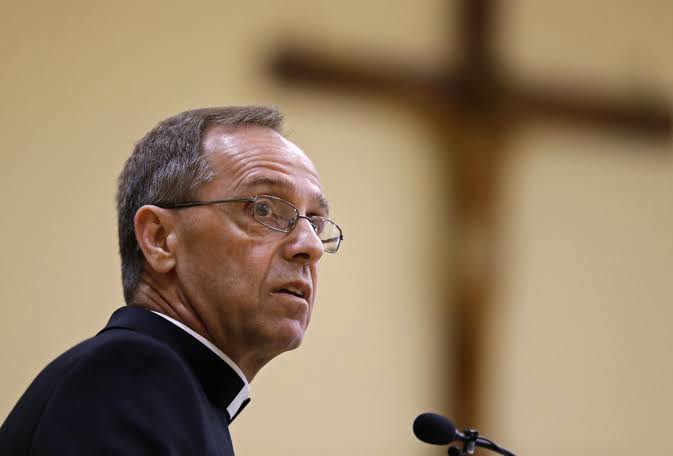
(ZENIT News / Indianapolis, 09.16.2026).- For Catholics, Sunday Mass is not ordinarily a matter of personal preference. Yet in Indianapolis, Archbishop Charles C. Thompson has temporarily suspended that obligation for people who fear that going to church could expose them to immigration enforcement.
The decree, issued September 4, is an unusually concrete pastoral response to an atmosphere of anxiety surrounding the intensified immigration crackdown in the United States. It applies through September 30, unless extended, to people in the Archdiocese of Indianapolis who have reasonable grounds to fear detention, family separation or intimidation because of immigration enforcement. Significantly, the provision also covers people who have lawful immigration documentation.
Thompson’s decision does not amount to a rejection of the Sunday obligation. Rather, it uses a provision of canon law to address circumstances in which fulfilling it may expose the faithful to what the archbishop regards as a serious and immediate pastoral concern. The measure also illustrates how immigration enforcement has moved beyond the political arena and into the ordinary sacramental life of Catholic communities.
Those who make use of the dispensation are encouraged to follow Mass through television or livestreaming, pray with the Sunday Scripture readings and recite the Rosary. Thompson has also instructed priests and pastoral workers to maintain contact with people unable to leave their homes, paying particular attention to access to Confession, the Anointing of the Sick and Holy Communion for the sick and homebound.
The scale of the enforcement campaign helps explain the concern. More than 43,000 people were booked into immigration detention in June, according to newly released Immigration and Customs Enforcement data, the highest monthly figure since President Donald Trump returned to office. Sources cited by CBS News said ICE had faced pressure to reach 2,000 arrests a day, although the Department of Homeland Security has denied that the agency operates formal arrest quotas.
The numbers continued rising. More than 46,000 people were taken into ICE custody in July, according to preliminary federal figures reported by CBS News, surpassing June’s total.
The composition of the detention population is also significant. Data from Syracuse University’s Transactional Records Access Clearinghouse showed that, as of July 11, 46,436 of 65,765 people in ICE detention — 70.6 percent — had no criminal conviction. That figure does not mean that those detainees had no immigration violations or pending criminal allegations, but it does underline the breadth of the current detention system beyond people convicted of crimes.
Catholic concern has consequently extended well beyond Indiana. Bishops in Texas have spoken publicly after deaths associated with immigration enforcement operations, while Archbishop Gustavo García-Siller of San Antonio has described what he said he personally witnessed during visits to three detention facilities in his archdiocese, including a family detention center.
He has also cited an investigation reporting more than 1,000 credible allegations of human-rights abuses in immigration detention since January 2025, including inadequate medical care, denial of food and water, overcrowding, sleep deprivation and the separation of nursing mothers from their infants. Those allegations require appropriate investigation and due process, but their accumulation has made detention conditions an increasingly prominent concern for Catholic pastoral leaders.
The most troubling questions concern what happens once people are behind the walls of detention facilities. A September investigation by The Guardian reported that immigration authorities had obtained judicial authorization to force-feed a Cuban detainee on hunger strike through a surgically inserted feeding tube. The case was described as the nineteenth detainee since January 2025 for whom ICE had obtained authorization for involuntary medical procedures. Earlier reporting by the same newspaper had identified at least ten hunger-strike cases involving attempts to authorize forced medical treatment, including force-feeding, forced hydration and blood draws.
The federal government has defended involuntary treatment as necessary in circumstances where a hunger strike threatens imminent serious harm or death. The existence of judicial authorization is therefore an important part of the picture. But the cases have also generated serious ethical questions among physicians and human-rights organizations, particularly concerning consent, access to legal representation and the circumstances in which medical intervention becomes coercive.
The international dimension has now become impossible to ignore. On September 7, United Nations High Commissioner for Human Rights Volker Türk told the UN Human Rights Council that four additional people had died in U.S. immigration custody since his previous update in June, bringing the number of deaths in custody during 2026 to 23. He called for accountability and urged the United States to halt deportations to places where people could face irreversible harm.
Thank you for reading our content. If you would like to receive ZENIT’s daily e-mail news, you can subscribe for free through this link.

Publicaciones relacionadas:
 Argentina: In the Era of President Milei, the Catholic Church Gives Up State Funds
 The number of priestly ordinations in Catholic Poland is plummeting: here are the figures for 2026
 Catholicism Is in Decline in Argentina Despite Having a Pope from That Country: Findings from a Study by the University of Buenos Aires
 South Korean government passes laws ahead of World Youth Day. A television broadcast agreement is also signed
