

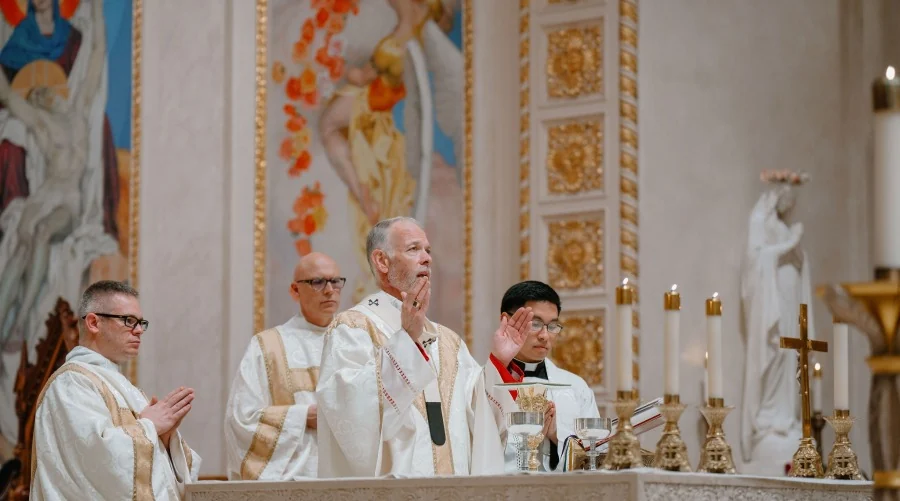
(ZENIT News / Portland, 15.11.2026).- The Archdiocese of Portland, Oregon, has called on lay Catholics to refrain from raising or extending their hands, or holding hands with one another, during the Lord’s Prayer at Mass, arguing that these gestures belong to the priest’s liturgical role and should not be adopted by the congregation.
The clarification, published in the archdiocese’s November 2026 worship newsletter, addresses a practice that has become familiar in some Catholic parishes but remains far from universal. While some worshippers assume the posture known as orans — standing with arms raised and hands extended — others join hands during the Our Father. The archdiocese says neither gesture is prescribed for laypeople in the Roman liturgy.
“Neither deacons assisting at Mass nor the lay faithful are instructed to assume this posture,” the statement explains. It identifies the gesture as proper to the priest, who extends his hands while leading the prayer on behalf of the assembled congregation.
The archdiocese grounds its position in the Church’s liturgical and canonical legislation, rather than in a judgment about the personal devotion of Catholics who have adopted these gestures. Its central argument is that the different roles within the celebration of the Eucharist should remain visible and respected.
The General Instruction of the Roman Missal, the principal set of norms governing the celebration of Mass in the Roman Rite, specifies when the priest is to extend his hands. Although it does not explicitly forbid laypeople from doing so during the Our Father, Portland argues that its instructions consistently assign this gesture to the celebrant and concelebrating priests.
The archdiocese also invokes the Second Vatican Council’s Constitution on the Sacred Liturgy, Sacrosanctum Concilium, which states that no one, “even if he be a priest,” may add, remove or change anything in the liturgy on personal authority. Since the Roman Missal directs the priest to extend his hands during the Lord’s Prayer, the archdiocese maintains that extending the same gesture to deacons and laypeople would introduce a change not provided for in the liturgical books.
A further reference comes from Canon 907 of the Code of Canon Law, which prohibits deacons and laypeople from offering prayers — particularly the Eucharistic Prayer — or performing actions proper to the celebrating priest. Portland applies this principle to the gesture accompanying the Our Father, presenting it as an expression of the distinct responsibilities exercised by the priest during the liturgy.
The newsletter also points to the history of the Roman Missal. Before the introduction of the post-conciliar missal in 1970, the priest alone recited the Our Father within the Mass, extending his hands as he prayed on behalf of the people. Neither the revised missal nor the documents of the Second Vatican Council, the archdiocese observes, established a corresponding change in posture for the congregation.
The orans posture itself, however, is much older than the modern debate over its use at Mass. Raising the hands in prayer was widespread in the ancient world and appears repeatedly in the Bible. One of its best-known examples is the account in Exodus 17, in which Moses keeps his hands raised during Israel’s battle against Amalek. As long as his arms remain lifted, Israel prevails; when he lowers them, the tide turns against the Israelites.
The gesture also appears in the Psalms and the New Testament, and was depicted in early Christian art, including paintings in the Roman catacombs. Its use therefore carries a long history as an expression of supplication, praise and dependence on God.
Portland’s instruction does not challenge that spiritual heritage. Rather, it distinguishes the broader Christian tradition of praying with raised hands from the specific liturgical function assigned to the priest during the Eucharistic celebration. The distinction reflects a fundamental principle of Catholic worship: the Mass is not simply a gathering in which everyone performs the same actions, but a structured celebration in which the priest and the faithful participate according to their respective roles.
Thank you for reading our content. If you would like to receive ZENIT’s daily e-mail news, you can subscribe for free through this link.

Publicaciones relacionadas:
 USA: Health Care that Truly Heals Must be Grounded in Truth, says Bishop Rhoades
 Wave of Church Attacks in 2024 Sparks Concern Over Religious Freedom in the United States
 Archbishop of Denver Orders Famous American Exorcist to Fast in Public
 Mexico and Brazil: Surge in Attendance at Shrines of Our Lady of Aparecida and Our Lady of Zapopan
