

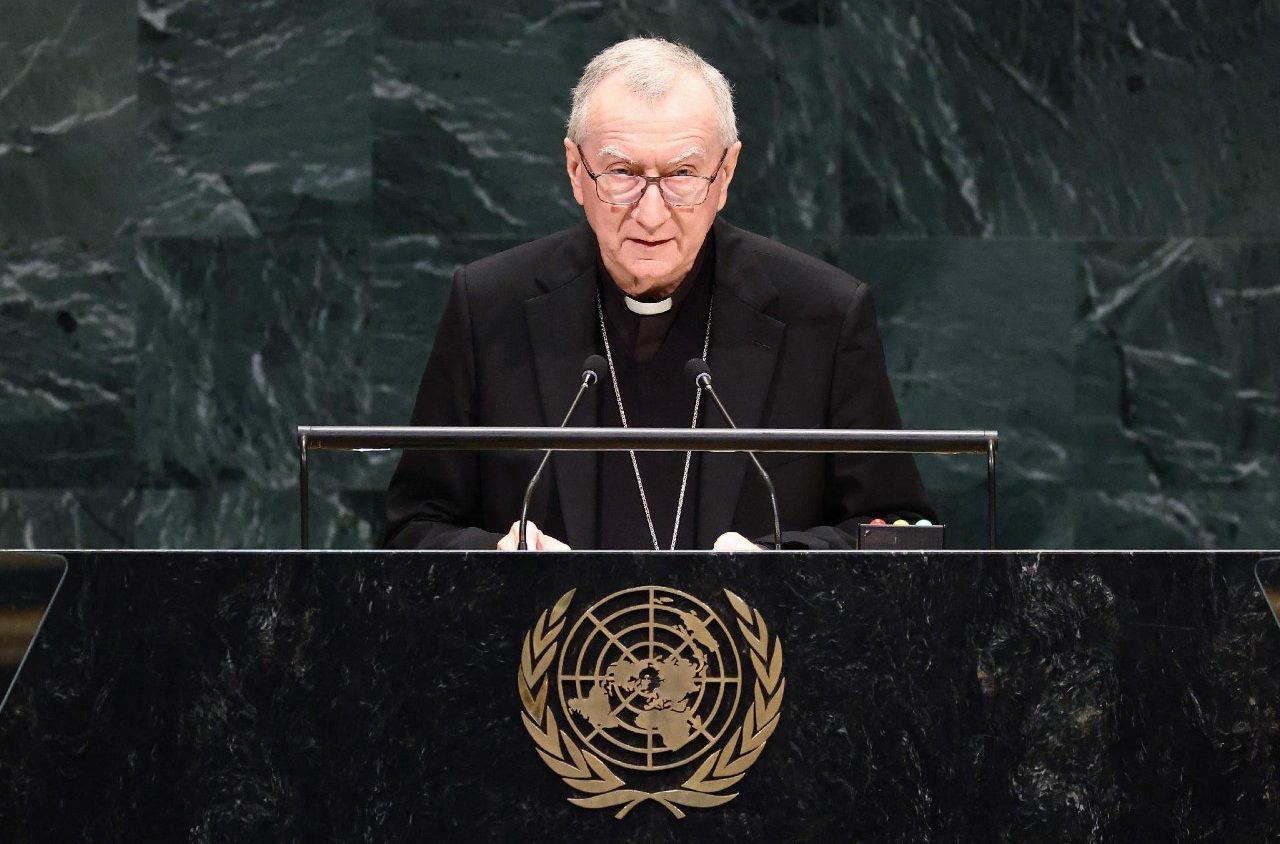
(ZENIT News / New York, 09.28.2026).- Below is the full text of the speech delivered by Cardinal Secretary of State Pietro Parolin during the General Debate of the 81st session of the United Nations General Assembly, held in New York from September 22 to 28, 2026:
***
Address by His Eminence Cardinal Pietro Parolin
Secretary of State and Head of the Delegation of the Holy See at the General Debate of the High-Level Week at the Opening of the 81st Session of the United Nations General Assembly
New York, 26 September 2026
“RESTORING TRUST, MANAGING TRANSFORMATION: A UNITED NATIONS THAT DELIVERS FOR ALL”
Mr. President,
I am honored to extend to you and to the distinguished representatives of the Nations assembled here the warm greetings of His Holiness Pope Leo XIV, while also congratulating Your Excellency on your election as President of this esteemed Assembly.
In a world marked by rapid technological change, environmental threats, renewed conflicts, and deepening fractures in the international order, this year’s theme “Restoring Trust, Managing Transformation: A United Nations that delivers for All”, is not merely aspirational; it is an urgent moral and political imperative.
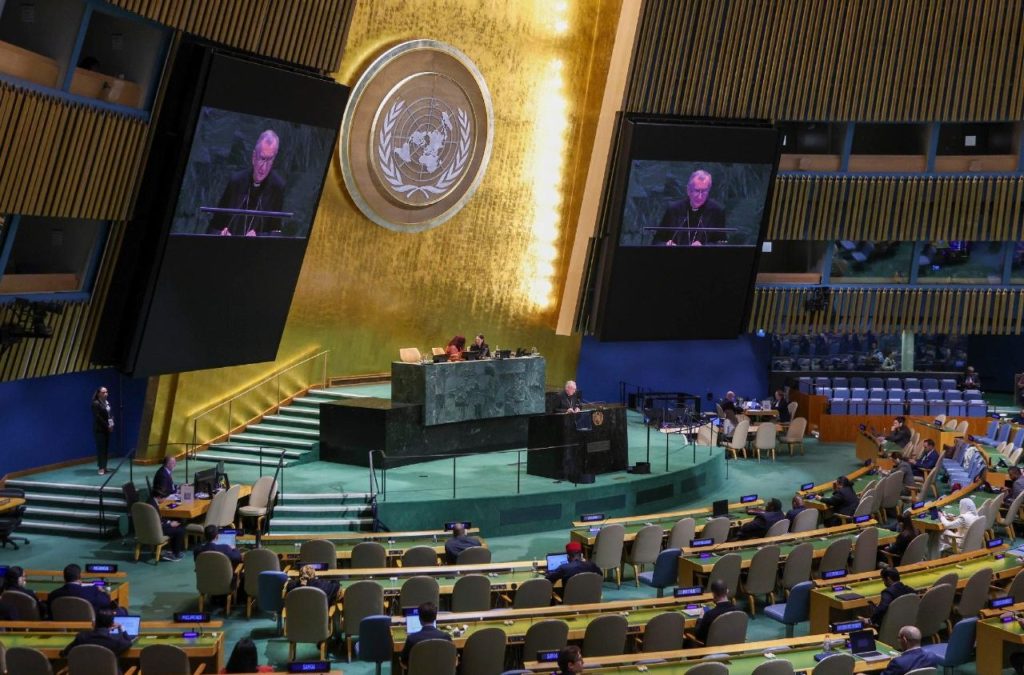
Every international institution, beyond its legal framework, requires mutual trust among its members to be effective. Moreover, trust is an ongoing process. It is fostered through mutual respect and dialogue, and requires a relentless commitment to the values of human dignity and justice on which multilateral institutions are founded. Regrettably, international relations today are characterized by a growing lack of trust among actors, especially through the disregard of the principle pacta sunt servanda. This often leads to isolation and defensive postures, which may result in further tensions. It also creates a vicious cycle that significantly reduces opportunities to build solid relationships and feeds a system of mutual threats based on the illusion that strength breeds power.
In this regard, States should go beyond the national and economic interests and establish discussions and joint decisions that prioritize the promotion of the common good, centered on the God-given dignity of every human person.
Pope Leo XIV identifies three essential words that must guide diplomacy: peace, justice, and truth. Underlining their interconnectedness, he warns against the return of a diplomacy of force and reaffirms the indispensable role of multilateral institutions. [1] Indeed in his first Encyclical Letter Magnifica Humanitas, the Pope emphasized that “there is an urgent need to shift from the ‘culture of power’ to a genuine ‘culture of negotiation,’ in which dialogue and diplomacy become the standard means of resolving conflicts. […] In international relations, dialogue is an irreplaceable diplomatic tool for preventing conflicts and rebuilding bonds of trust. Faced with the impulsive broadcasts, aggressive rhetoric and power politics that characterize our ‘time, the vocation of diplomacy is to foster dialogue with all parties, including those interlocutors considered less ‘convenient’ or not considered legitimized to negotiate.’ Therefore, every ounce of humility and patience should be employed in order to nurture even the faintest signs of goodwill among parties in conflict, so as to advance the process of peace.”[2]
Mr. President,
In an age that risks reducing the person to consumer, data, or instrument, Pope Leo XIV insists that the human person remains the measure of all progress. At the heart of this conviction stands the acknowledgement of the inviolable God-given dignity of every human person. This dignity is not conferred by the State, by economic productivity, or by technological capacity; it is intrinsic, rooted in the fact that every person is willed and loved by God. From this flows the sacredness of life, from conception to natural death, as well as the imperative to safeguard the human person and that every society that aspires to be regarded as civilized has a duty to protect.
Closely linked is the dignity of work. In fact, work is not merely a means of production, but an irreplaceable participation in the creative work of God and a path to personal fulfilment and social solidarity. Unworthy working conditions, precarious employment, exploitation of workers, and the exclusion of those in need destroy hope, fracture societies and fuel conflict. In this perspective, economic justice becomes a prerequisite for peace.
Nowhere is this anthropological challenge more acute than in the domain of artificial intelligence. Pope Leo XIV addressed in his first Encyclical Letter this new technological challenge, which he does not reject but calls for its ethical ordering. The control of these powerful tools must not remain in the hands of a select few; they must serve humanity, not the other way around. In particular, the development of lethal autonomous weapons systems (LAWS) raises profound moral questions. In this critical domain, Pope Leo XIV provides clear criteria for discernment: “The first such criterion concerns personal responsibility. When a decision to strike becomes automated or opaque, the risk of abdicating responsibility increases. For this reason, the chain of responsibility must be identifiable and verifiable; those who design, train, authorize and employ technology must be held accountable for their decisions. The second criterion pertains to the moral timeframe for making judgments. While AI tends to expedite the decision-making processes, speed and efficiency should never be the supreme motivating force for the irreversible decisions made in the context of war. The third criterion is the identification and protection of civilians. Any technology that facilitates attacks without seeing the face of human beings lowers the moral threshold of conflict. Target selection and the use of force must not confuse combatants and non-combatants, nor ignore the impact on defenseless populations. These criteria give rise to certain non-negotiable requirements. First, all systems used in a war setting must guarantee the possibility of retracing and reconstructing decision making processes, so that accountability and blame are not collapsed into ‘the machine’. Second, the decision to use lethal force cannot be delegated to opaque or automated processes, but must remain under effective, self-aware and responsible human control. Finally, it is imperative to establish a shared framework — also at the international level — in order to curb the technological arms race and ensure robust protection for civilians and the infrastructures necessary for their survival.”[3]
Whenever artificial intelligence is involved, it is not enough, therefore, to invoke a generic type of ethics, it is rather critical to freeing it from logics of domination, exclusion, and death. Technology must respect “the primacy of the human person, in order to ensure that it will always be human intelligence, with its conscience and freedom, that guides technical innovations and responsibly determines their use and limits.”[4] AI can help restore trust if it is not empowered to cause harm, but if reliability, security, and human oversight are guaranteed. In effect, technological advances, which are accompanied by an increase in vulnerabilities, are bound to also heighten mistrust and lead to an unacceptable level of risk.
Within the framework of the reflection offered by Magnifica Humanitas, the Holy See views with particular concern the phenomenon of addictions, which, in their various forms, can undermine a person’s freedom and foster dynamics that exploit human vulnerability. [5]As Pope Leo XIV observes, “when business models thrive on human weakness, the person is treated as a means rather than as an end”.[6]
This concern is particularly acute with regard to drugs and other forms of addiction, which pose a serious challenge to the dignity of the human person, to young people, families and the social fabric as a whole. [7] The Holy See therefore considers it important to promote “comprehensive responses”,[8] grounded in community-based prevention, scientific care, justice with a human face, and directed towards care, presence and the rebuilding of the fabric of the community, as well as recovery and reintegration for those affected.[9] At the same time, it is necessary to address resolutely the criminal networks and interests that fuel this phenomenon.[10]
In this sense, international cooperation can contribute to rebuilding trust by establishing common norms and policies and, above all, providing concrete responses that support the most disadvantaged members of society. There is a need “to multiply places of healing, encounter and education”,[11] so that no person may ever be considered lost.
Mr. President,
For some years now, the world has spiraled into violence that has progressively spread and intensified, continually opening up new theaters of war. The Holy See strongly emphasizes the urgent need for an immediate and total cessation of hostilities as a prerequisite for any serious engagement in restoring and building the future.
At the same time, it is necessary to consider, as Pope Leo XIV insists, that Peace is not a “negative” word, that is the mere absence of war. He observes that too often peace is considered as a temporary respite between conflicts, while living in a constant “state of conflict” at every level of human relations. Peace is first a gift — the gift of the Risen Christ — yet an active and demanding gift. It is built in the heart of every person and is an integral part of the collective memory of every community, as well as of humanity’s heritage. It requires truth and justice, while rejecting pride and vindictiveness by choosing words and actions that soothe rather than wound.[12]
Furthermore, as Pope Paul VI affirmed, “peace that is not the result of true respect for man is not true peace. And what do we call this sincere feeling for man? We call it justice.”[13]Peace, is the fruit of justice. It requires the patient construction of just relationships within and among nations. It demands decisions to address the root causes of conflict: inequality, exclusion, the denial of fundamental human rights and freedoms, and the failure to recognize the other as a brother or sister rather than a rival.
In the effort to restoring trust and peace, disarmament is therefore not an optional ideal but a necessary vehicle. No true peace is possible without genuine common resolve for disarmament; the legitimate right of every people to provide for its own defense must not degenerate into a race to massive rearmament.[14]The prevailing conception of security, which is primarily based on deterrence and military dominance, is neither inevitable nor exhaustive. Another approach to security is possible: one that considers policies’ impact on human life and dignity and is founded on multilateral cooperation and responsibility towards the common good and future generations. This approach offers a far more credible foundation for long-term international stability than one based on the perpetual threat of annihilation.
It also requires the protection of civilians in armed conflict and the provision of humanitarian assistance. International humanitarian law is not a flexible or optional instrument subordinate to military convenience; it is a binding commitment of States. Pope Leo XIV stated clearly that it is not possible to “ignore that the destruction of hospitals, energy infrastructure, homes and places essential to daily life constitutes a serious violation of international humanitarian law. The Holy See firmly reiterates its condemnation of any form of involvement of civilians in military operations.”[15]
Mr. President,
The dignity of the person finds concrete expression in the fundamental human rights and freedoms which “are inviolable, since they are inherent in the human person and in human dignity. Consequently, they are universal and inalienable. Precisely because they are grounded in the common dignity of every man and woman.”[16]These rights are universal, interdependent, and rooted in the natural law; they are not a concession by any government. Particular attention must be paid to those categories of persons most at risk: those in the womb, the elderly, the disabled, the sick, refugees and migrants, the unemployed, the marginalized, the lonely, and those living under conditions of extreme poverty, violence, or conflict.
Among these fundamental rights, religious freedom occupies a privileged place. It is not a secondary liberty but an essential dimension of the human person. As Pope Benedict XVI affirmed, religious freedom “is indeed the first of human rights, not only because it was historically the first to be recognized but also because it touches the constitutive dimension of man, his relation with his Creator.[17]Without the possibility of seeking and adhering to the truth about God according to the dictates of conscience, other freedoms remain incomplete. Full respect for religious freedom is indispensable for the purification of the heart necessary for peaceful.[18]
Tragically, Christians in many parts of the world continue to suffer discrimination, violence, and outright persecution simply because of their faith. Churches are attacked, communities displaced, and individuals killed or imprisoned. While condemning all forms of religious discrimination, the Holy See raises its voice on behalf of these brothers and sisters, not in a spirit of exclusive advocacy, but because the defense of any one community’s freedom strengthens the freedom of all. Silence in the face of such suffering would be a betrayal of the Church’s mission and of the universal human rights the international community has pledged to uphold.
Furthermore, dignity is not dependent on geographical location or socioeconomic status. Those who move, or are forced to move, always maintain their dignity. It is essential to continue to address the underlying causes so that migrating once again becomes a matter of choice rather than one of necessity forced by circumstance. It is important not to ignore the plight of those seeking refuge, those forcibly displaced from their homeland, and those undertaking perilous journeys.
Mr. President,
The passing of time does not make a war any less intolerable; rather, it makes the responsibility of those who can end or help bring it to an end all the more grave. After more than four years of war in Ukraine, the death toll continues to rise. Faced with this tragedy, the Holy See, while calling for strict observance of the international humanitarian law, highlights the urgent necessity to bring hostilities to an end, and paving way for diplomacy. Peace cannot be postponed; weapons must fall silent and bombardments must cease. The Holy See encourages every initiative aimed at achieving an immediate, complete and effective ceasefire.
The Holy See reiterates its call for an end to the ongoing violence against the Palestinian civilian population in the West Bank, particularly the escalation of hostilites, home demolition and movement restriction, driving the displacement of Palestinian communities.
On the situation in Gaza, the Holy See remains concerned about the dire humanitarian crisis, the widespread destruction, mass displacement and the severe persisting shortages. In this regard the Holy See urges the international community to work toward advancing the two-state solution, with a view to bringing about a just and lasting peace.
The Holy See welcomes the signing of the Trilateral Framework Agreement between the United States, Israel, and Lebanon, aimed at stabilizing the southern borders of the Republic of Lebanon and achieving a just and lasting peace. This agreement in itself represents a significant development. However, the Holy See expresses serious concerns regarding the difficulties encountered in its implementation and calls on the parties involved to respect fully and enforce the terms of the agreement through concrete actions. Respect for sovereignty and borders forms the essential foundation for the implementation of the peace plan.
Furthermore, the presence of Christians in Lebanon and throughout the Middle East must not only be safeguarded as the legitimate continuation of a historic presence, but must also be encouraged by the international community, since Christians aspire to be an active force for peace, spirituality, and culture within the mosaic of peoples that make up the Levant, where the Christian faith originated.
The Holy See is following with deep concern the situation in the Gulf region where the conflict has gradually spread and the violence shows no signs of abating. In particular, the Holy See cannot remain silent about the dramatic impact that this conflict is having on vulnerable civilian populations, who are being driven into hunger and forced displacement, and who are living in barely sustainable conditions. This conflict has also affected vital infrastructure, maritime transport routes and energy resources that are of strategic importance to the entire global economy which has an impact on the livelihoods or persons all around the world. The Holy See strongly reiterates its appeal for the parties involved to find the courage to engage in dialogue. Only a renewed commitment to negotiation, supported by the international community, can restore the prospect of stable peace and shared development to the Gulf region.
The international community must not forget the tragic plight of the hundreds of thousands of Rohingya who, for more than nine years now, suffer not only from the tragedy of statelessness, but also have been subjected to inhumane and deadly circumstances. These individuals are deprived of their inherent rights, in flagrant disrespect of their human dignity. Their suffering must end! The conditions must be created within their homeland to allow a safe, legal, voluntary and unhindered return.
The Holy See renews its heartfelt appeal for an immediate end to the conflict in Sudan, a land that has for too long been ravaged by indiscriminate violence affecting the most defenseless, starting with children and women. Faced with an unprecedented humanitarian catastrophe, all parties are urged to initiate, without delay, a sincere and constructive dialogue with the support of the international community, to facilitate assistance to the population and ensure stability and peace.
The Holy See appeals to all key figures in South Sudanese politics to prioritize the well-being of the nation over any partisan interests. Everyone, based on their own responsibilities, is called upon to promote actions and words that contribute to reconciliation, peace and harmony amongst all South Sudanese.
The Holy See is following with deep concern the humanitarian crisis currently unfolding in certain areas of Somalia, where outbreaks of violence and extreme weather events are exacerbating the population’s already precarious living conditions. The Holy See urges the international community to generously commit to meeting the immediate needs of the most at risk, especially women and children.
The situation in the Democratic Republic of the Congo is of concern to the Holy See, particularly the protracted crisis in the east of the country and the Ebola epidemic. The Holy See, while expressing full support for the peace processes in the Country, encourages national dialogue, and calls for the urgent protection of health and humanitarian workers, unimpeded access to aid, and the strengthening of regional cooperation to address these challenges in an integrated manner. Particular importance must be attached to reconciliation among communities, as it is an indispensable condition for a truly lasting peace. Furthermore, the Holy See is preoccupied by the terrorist attacks especially in North Kivu and Ituri, which repeatedly target the civilian population, including Christian communities, involving killings, abductions and the destruction of villages and Church structures.
The Holy See notes with concern the advance of jihadist groups from the Sahel towards the coastal countries of the Gulf of Guinea. The response cannot be exclusively military: it must include the prevention of radicalization, the development of border areas, the education of young people, social cohesion and interreligious dialogue, fully valuing the role of religious communities in preventing extremism.
The Province of Cabo Delgado in Mozambique remains destabilized after almost nine years of armed conflict. The Holy See while calling for the end of the conflict, remains concerned about the sporadic episodes of violence which prevent internally displaced persons from returning to their places of origin and force them to continue living in a situation of suffering and food insecurity, with no prospects of a better future.
In Venezuela, the Holy See encourages every effort aimed at the full restoration of democratic order through peaceful, inclusive means that respect national sovereignty, as well as the launch of a process of national reconciliation based on dialogue, the pursuit of the common good and full respect for human rights and civil liberties.
In this context, the sometimes difficult situation faced by detainees in Venezuela, as well as the suffering endured by their families, continue to give rise to humanitarian concern and should not be overlooked. The same consideration applies to the pressing need for a swift recovery of the national economy, for the benefit of the entire population, the majority of which continues to endure extremely difficult living conditions.
The Holy See continues to follow the situation in Haiti with great attention; the country is currently experiencing a period of serious political, institutional and social instability, as well as a dramatic humanitarian emergency. The Holy See encourages all Haitians to prioritize dialogue and the pursuit of the common good and renews its appeal to the international community to accompany the country with determination and generosity on its arduous journey towards peace, democracy and a renewed confidence in its future.
The Holy See is closely monitoring the situation between Cuba and the United States and calls upon all those responsible to foster a sincere and effective dialogue, so as to avoid any action that might increase the suffering of the beloved Cuban people.
The Holy See is following the situation in Nicaragua with particular concern and reiterates its constant appeal to pursue a path of respectful and constructive dialogue with the country’s authorities, for the good of the people and the Church in Nicaragua.
The Holy See encourages Azerbaijan and Armenia to consolidate the process of achieving a stable and lasting peace in the South Caucasus.
Mr. President,
We return, then, to the theme of this year. Multilateralism is in crisis. Pope Francis wrote that “It is not helpful to confuse multilateralism with a world authority concentrated in one person or in an elite with excessive power: ‘When we talk about the possibility of some form of world authority regulated by law, we need not necessarily think of a personal authority’. We are speaking above all of ‘more effective world organizations, equipped with the power to provide for the global common good, the elimination of hunger and poverty and the sure defense of fundamental human rights’”.[19]
As Pope Leo XIV observed in his 9 January 2026 address to the Diplomatic Corps: “A diplomacy that promotes dialogue and seeks consensus among all parties is being replaced by a diplomacy based on force, by either individuals or groups of allies. War is back in vogue and a zeal for war is spreading. The principle established after the Second World War, which prohibited nations from using force to violate the borders of others, has been completely undermined.”[20]Peace is no longer sought as a gift and a desirable good in itself, but as a reality imposed through arms and weapons. This gravely threatens the rule of law, which is the foundation of all peaceful civil coexistence.
Yet the crisis of multilateralism does not diminish its importance. As in every crisis, it is ultimately a question of will: the will to uphold justice rather than resort to violence; the will to uphold the rule of law rather than submit to domination; the will to choose peace over destruction. The United Nations was born from the ashes of global catastrophe with that very determination to prevent future ones, to safeguard peace, defend fundamental human rights, and promote sustainable development. Eighty years later, it must be adapted to contemporary realities while remaining faithful to its founding purposes. It must become more focused, more efficient, and more oriented toward the unity of the human family rather than allowing ideological divisions to prevail.[21]
The Holy See recognizes the current challenges the United Nations is facing. The UN80 Initiative, which is now entering its implementation phase, is an important sign of the Organization’s willingness to examine itself critically and undertake the necessary changes to fulfil its purposes more effectively. The Holy See welcomes this effort and calls upon Member States to play an active and constructive role in ensuring that reform is guided by a renewed sense of responsibility towards the common good and the dignity of every human being. “The Holy See supports and accompanies these endeavors, while also recognizing that the current weaknesses of the UN and the international political system reveal the need for profound reforms. This is not simply a question of technical adjustments, for the crisis of convictions and values that also concerns the ethical foundations of nations makes it more difficult to direct multilateralism toward the true common good.” [22]
Authentic multilateralism requires agreement on the meaning of words. When language is emptied of content or deliberately distorted, dialogue becomes impossible. It requires a shared commitment to international law, including humanitarian law. It requires the humility to recognize that no nation, however powerful, can face alone the challenges of food insecurity, migration, technological disruption, climate and environmental degradation, or the threat of nuclear or autonomous weapons. Above all, it requires the recovery of trust — trust that agreements will be honored, that the weak will not be abandoned, and that the common good will take precedence over the pursuit of unilateral advantage.
The Holy See remains committed to this patient, often unglamorous work of bridge-building. It does so because the human family is one, every person bears an inviolable God-given dignity, and peace is possible when truth and justice are given their rightful place.
Mr. President,
The transformation the world is facing — technological, geopolitical, social — will not wait for the activity or inactivity of the United Nations. Whether it becomes a transformation that elevates the human person or one that diminishes it, depends on the choices made together in these rooms. It is imperative to disarm not only weapons but the logic of domination; to protect the most in need; to speak the truth in charity; and to rebuild, through dialogue and solidarity, a multilateral order that truly delivers for all.
May the international community, as the family of Nations, have the courage to restore trust, the wisdom to manage transformation justly, and the perseverance to build peace. In this regard, the Holy See strongly urges all parties to engage in sincere negotiations to put an end to all wars and conflicts. War brings only death and destruction, whereas peace brings development and prosperity. The Holy See will continue to play its part in building a better future for all.
Thank you.
___________________
[1] Cfr. Pope Leo XIV, Address to the Members of the Diplomatic Corps Accredited to the Holy See, 16 May 2025. [2] Pope Leo XIV, Encyclical Letter Magnifica Humanitas, 221, 224.
[3] Pope Leo XIV, Encyclical Letter Magnifica Humanitas, 199-200.
[4] Idem. 97.
[5] Cfr. Idem. 170.
[6] Ibid.
[7] Cfr. Pope Leo XIV, Address to the participants in the Meeting promoted by the Pontifical Commission for Latin America on addiction-related situations in Latin America, 27 August 2026.
[8] Ibid.
[9] Cfr. Ibid.
[10] Cfr. Pope Leo XIV, Address on the occasion of the International Day against Drug Abuse and Illicit Trafficking, 26 June 2025.
[11] Ibid.
[12] Cfr. Pope Leo XIV, Address to the Members of the Diplomatic Corps Accredited to the Holy See, 16 May 2025. [13] Pope Paul VI, Message for the celebration of the Day of Peace, 1 January 1972.
[14] Cfr. Pope Leo XIV, Address to the Members of the Diplomatic Corps Accredited to the Holy See, 16 May 2025. [15] Pope Leo XIV, Address to the Members of the Diplomatic Corps Accredited to the Holy See, 9 January 2026. [16] Pope Leo XIV, Encyclical Letter Magnifica Humanitas, 55.
[17] Pope Benedict XVI, Address to the Members of the Diplomatic Corps Accredited to the Holy See, 10 January 2011. [18] Cfr. Pope Leo XIV, Address to the Members of the Diplomatic Corps Accredited to the Holy See, 16 May 2025. [19] Pope Francis, Apostolic Exhortation Laudate Deum, 35.
[20] Pope Leo XIV, Address to the Members of the Diplomatic Corps Accredited to the Holy See, 9 January 2026. [21] Cfr. Ibid.
[22] Pope Leo XIV, Encyclical Letter Magnifica Humanitas, 226.
Thank you for reading our content. If you would like to receive ZENIT’s daily e-mail news, you can subscribe for free through this link.

Publicaciones relacionadas:
 China and Vatican: positive signals, but there is a silence that weighs on us
 Pape Leo Spoke On The Phone With Vladimir Putin: This Is What Their Conversation Was About
 China recognizes first bishop appointed by Pope Leo XIV for a Chinese diocese
 US Congress: bill introduced to prevent revocation of Pope Leo XIV’s citizenship and tax issues
