

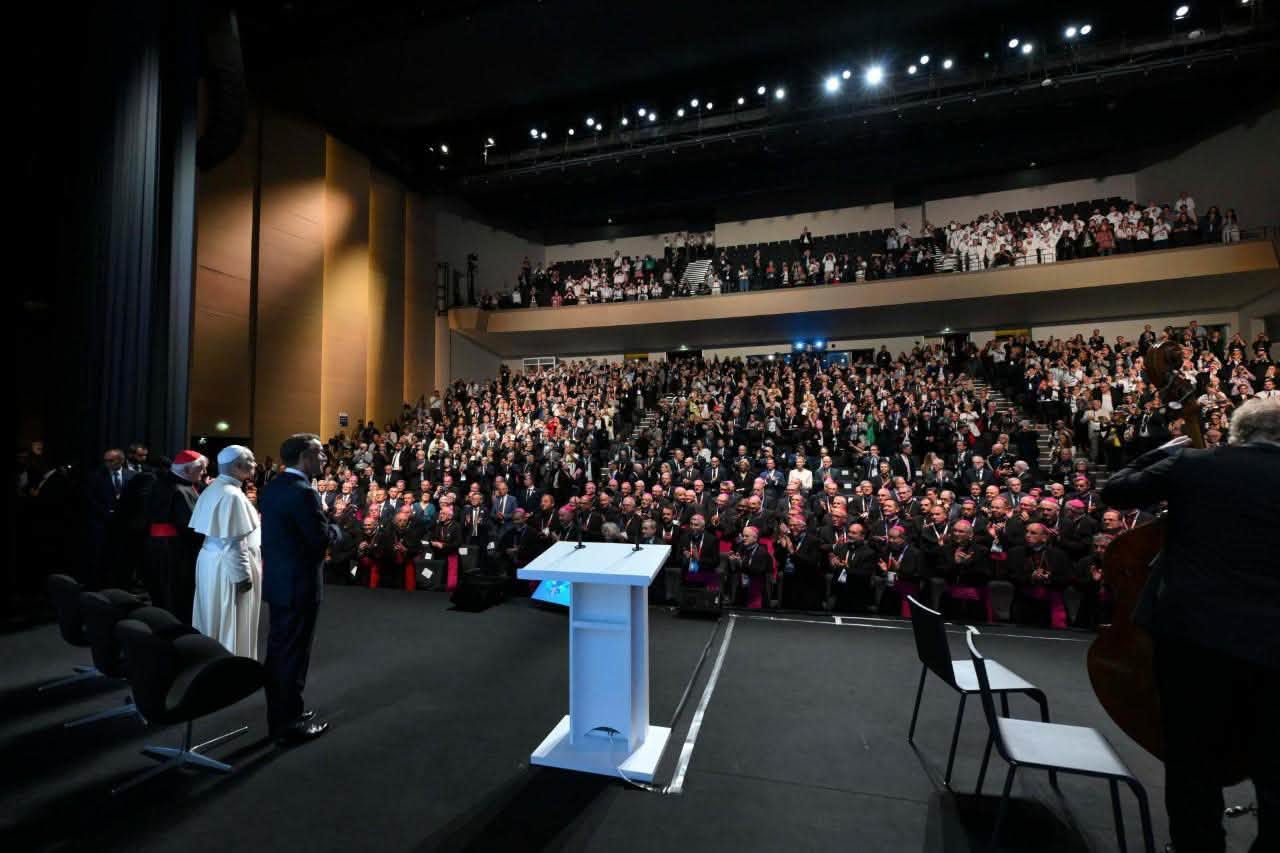
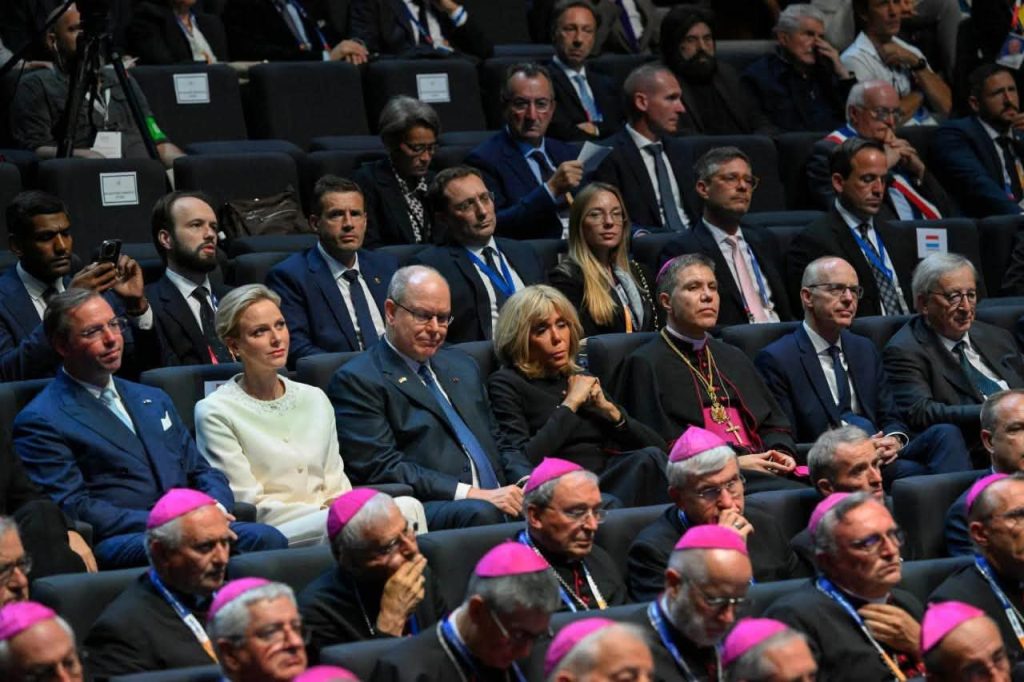
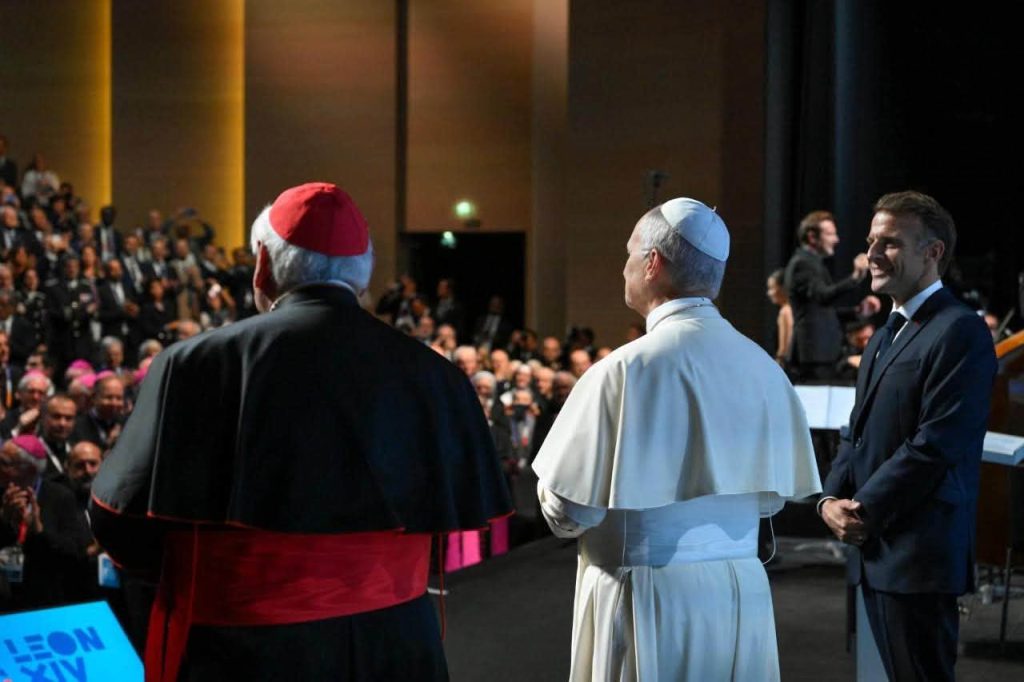
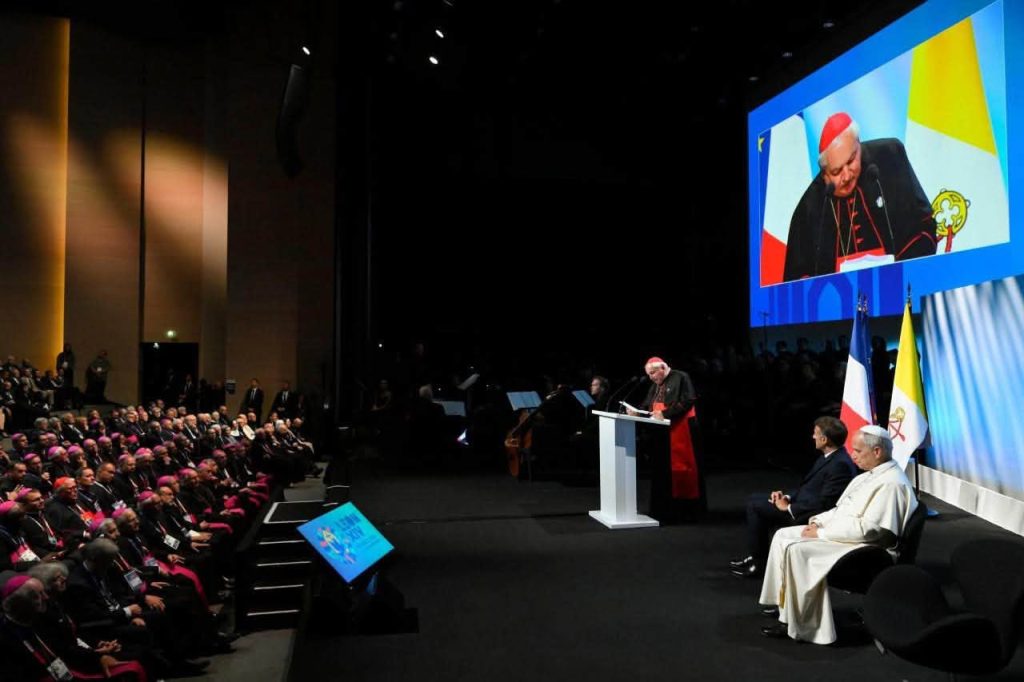
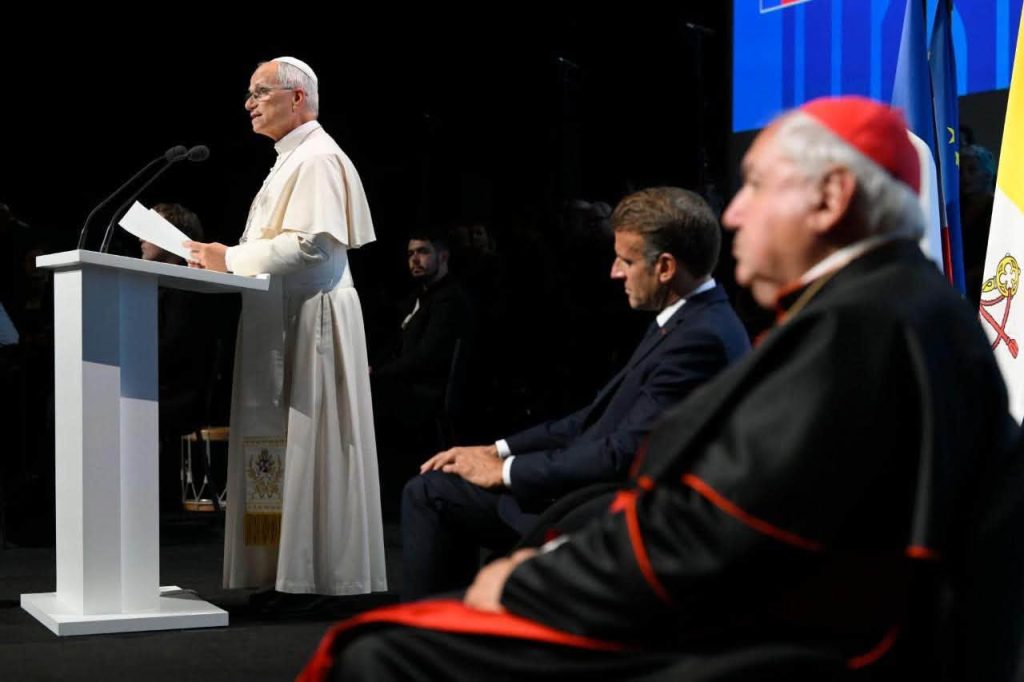
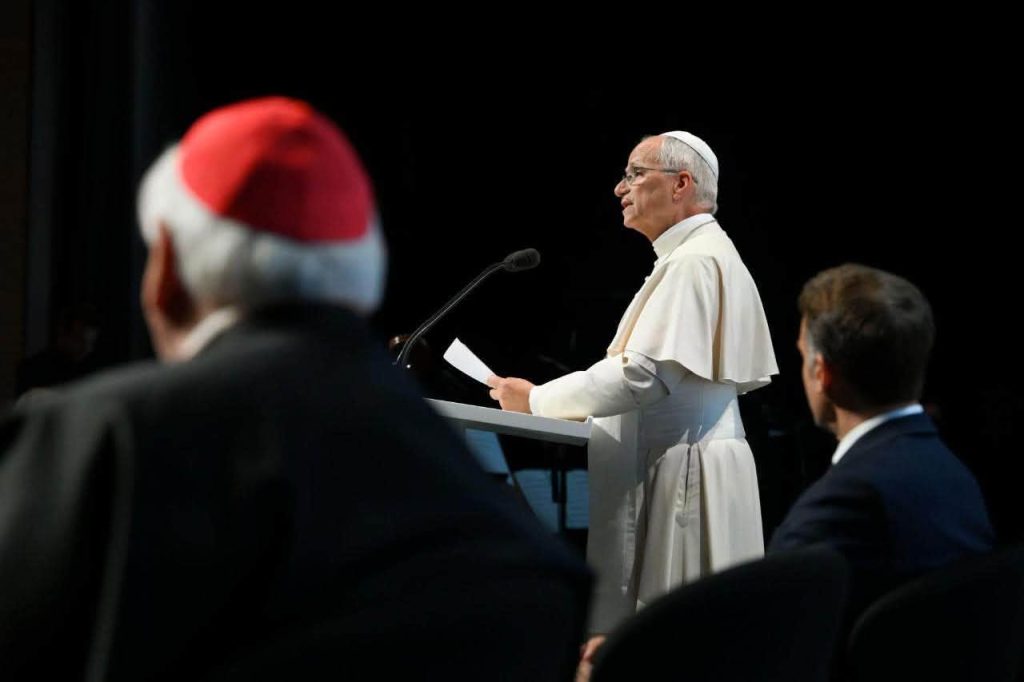
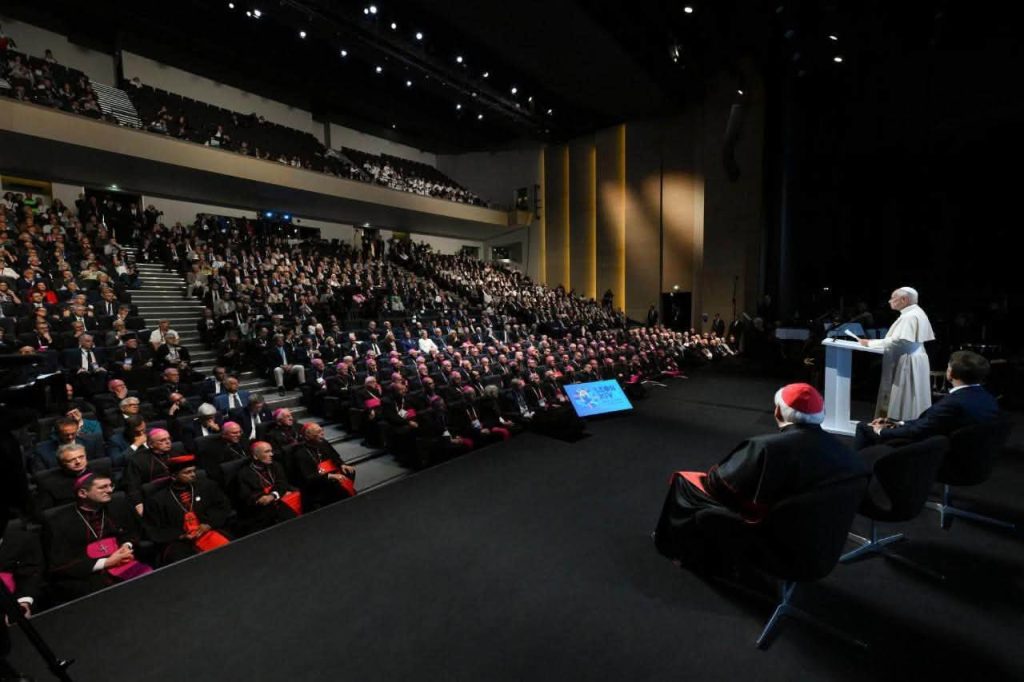
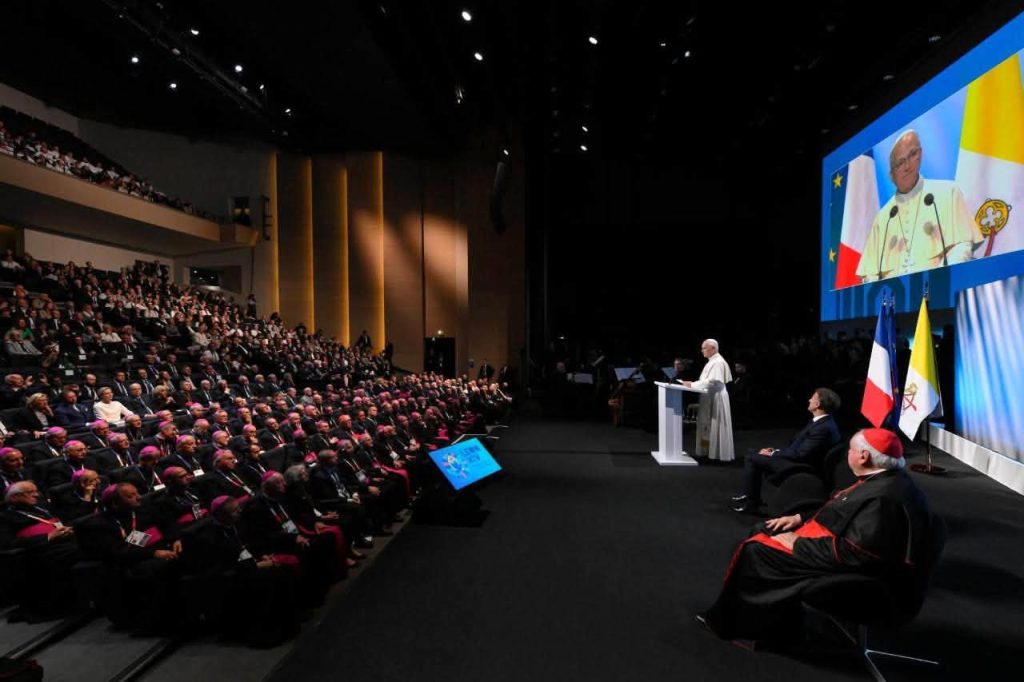
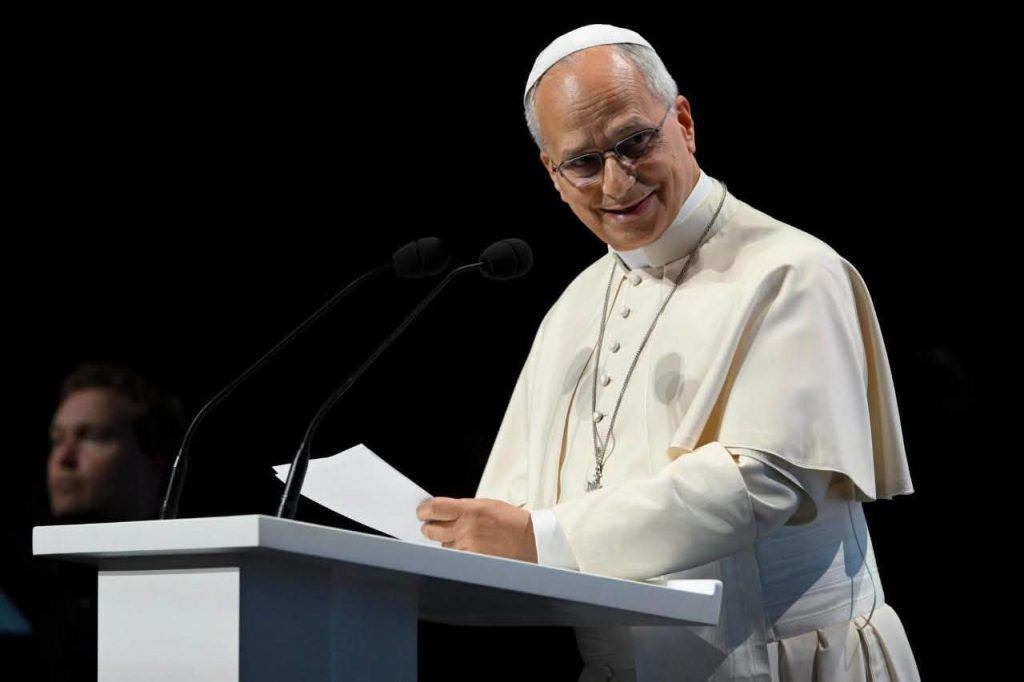
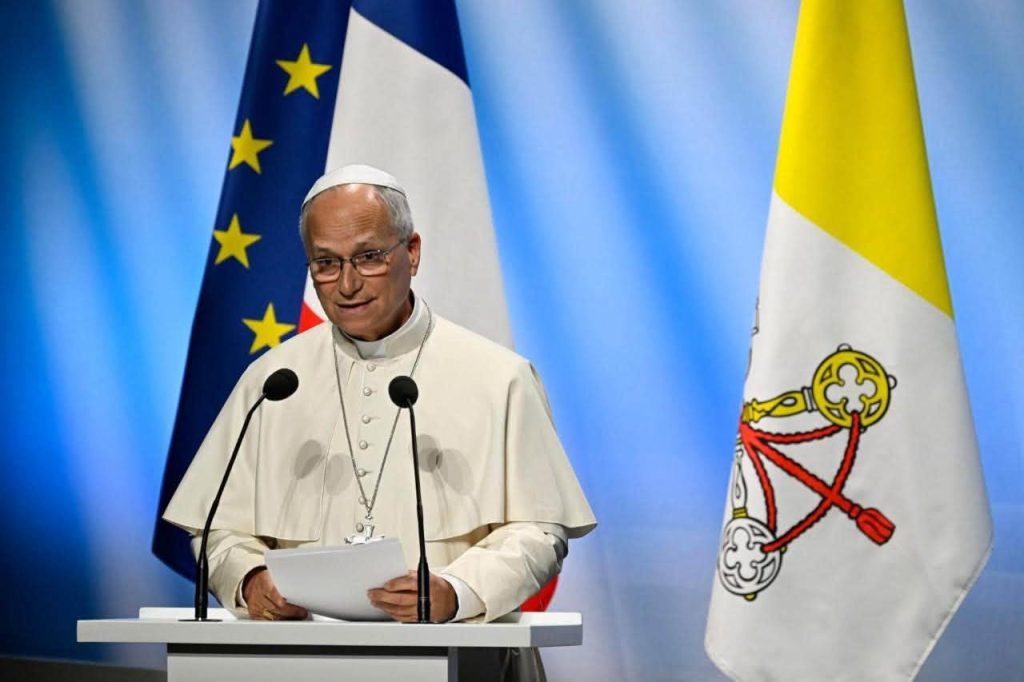
(ZENIT News / Metz, 09.28.2026).- At the conclusion of the Interreligious Meeting in one of the halls of the “Robert Schuman” Conference Center in Metz, Leo XIV proceeded to the auditorium of the same center to preside over the meeting titled “At the Roots of Europe: For Peace and Unity.” The session opened with a speech by the President of France, followed by one from the Archbishop of Marseille, Cardinal Jean-Marc Aveline. Also present at the gathering were three European monarchs: Prince Albert of Monaco, Grand Duke William V of Luxembourg, and Monsignor Josep-Lluís Serrano Pentinat, Bishop of Urgel and Co-Prince of Andorra. Below is the English translation of Pope Leo XIV’s widely acclaimed speech:
***
Mr President,
Your Eminence,
Distinguished Civil and Religious Authorities,
Ladies and Gentlemen,
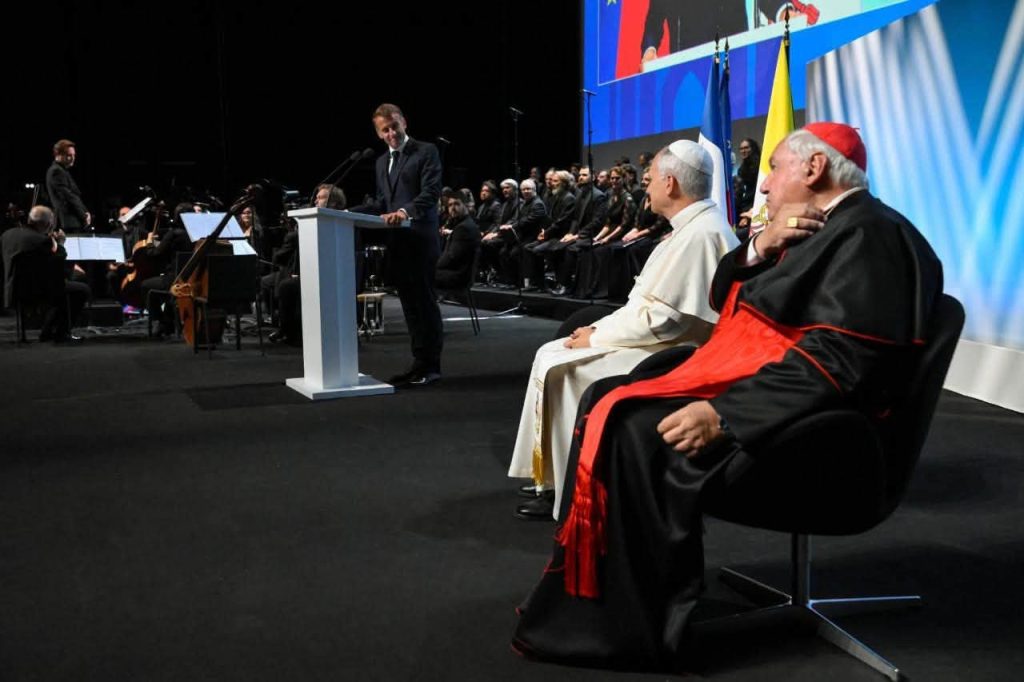
I am pleased to be here in this historic city, a crossroads at the heart of the continent, for this meeting entitled “To the Roots of Europe, for Peace and Unity.” I thank you for the kind words just addressed to me.
The title of our meeting was undoubtedly inspired by the figure of Venerable Robert Schuman, whom we would like to honor in a special way today in this Center that bears his name, and especially here in Moselle, where he lived for many years, where he is buried and which he represented for many years in the National Assembly. It was from this region, with all its trials and tribulations in the nineteenth and twentieth centuries, that he drew the inspiration to help shape the Europe of today and tomorrow through his famous Declaration of 9 May 1950. This text marks both the starting point and the culmination of his lifelong commitment to the reconciliation and unity of the European continent.
Today, I would like us to make an imaginary journey that begins from the roots of Europe, moves through the present and looks towards the future. We can ask ourselves: how was Robert Schuman shaped by the history of this land, of which he was a son, and how did he play a fundamental role in shaping modern Europe, to the point of being regarded as one of its founding fathers?
It is always difficult to define Europe, whether we are speaking of its present or past. Europe gradually developed a sense of its own identity over the course of the historical periods of Hellenistic civilization, the Roman Empire and then the spread of Christianity, integrating, over time, new cultures, including the Germanic and Slavic cultures, thereby expanding to encompass ever larger regions.
Europe must therefore be understood as a cultural and historical reality before a geographical one. Over the centuries, its contours and definitions have changed, undergoing periods of growth, profound crises and new beginnings. One constant however can be observed throughout its long and turbulent history, namely that Europe has flourished and progressed when it has been able to draw on the best aspects of its past and reinvent them in new and creative ways through encounters with others. Indeed, European civilization is also the fruit of centuries-long encounters, even though these have not always been easy. We need only think of the presence of Arab culture in the Iberian Peninsula, or of the expansion of the “old continent” into the “new world,” which gave rise — at times painfully — to new integrations on the American continent.
Yet in order to understand this long history, we cannot overlook another founding father of Europe: Saint Benedict, whom Saint Paul VI proclaimed its patron in 1964, describing him as a “messenger of peace, craftsman of unity, teacher of civilization.” [1] Care for the poor, the sick and the elderly; education of children and universities; hospitals and medicine; architecture and engineering; the development of the sciences; law and the organization of cities and States themselves — so much in Europe stems from the profound influence of Saint Benedict and his monks! Without this monastic tradition, European civilization as we know it would not exist. Here in Metz, thanks in part to the work of Saint Chrodegang, one can sense the Benedictine spirit of fraternity, communion and sharing. It was from here that Gregorian chant spread throughout the Carolingian territories, bringing harmony and beauty to the whole continent.
We cannot speak of Europe, then, without mentioning Christianity. Robert Schuman understood this when he wrote: “Christianity taught the equality of all people by nature, as children of the same God, redeemed by the same Christ, without distinction of race, color, class or profession. It taught the dignity of work and the duty of all to undertake it. It recognized the primacy of those inner values which alone ennoble the human person. The universal law of love and charity made every person our neighbor, and it is on this that social relations in the Christian world have since been founded.” [2]
Another founding father of modern Europe was Alcide De Gasperi, who expressed the same idea, emphasizing that the “common European heritage” [3] is “that shared moral outlook which exalts the human person and his or her responsibility, with its spirit of evangelical fraternity, its respect for the law inherited from the ancients, its love of beauty refined over the centuries, and its commitment to truth and justice sharpened by a thousand years of experience.” [4]
Far from being an exclusively religious criterion, [5] recognizing Europe’s debt to Christianity helps us understand more clearly that openness to the transcendent is always a constitutive part of the human person and a living source of civilization.
In this regard, Article 17 of the Treaty on the Functioning of the European Union is of great importance. It calls for “an open, transparent and regular dialogue with… churches,” and it “respects and does not prejudice the status” which Churches enjoy in the Member States. The principle of secularity (laïcité) that governs the life of States does not simply imply the non-confessional nature of civil institutions; it also presupposes genuine cooperation among all parties, as well as respect by national and European authorities for the autonomy of the Churches and the promotion of their freedom of organization, expression and worship.
This requires returning to the sources of the values that underpin civil society, namely “the universal values of the inviolable and inalienable rights of the human person, freedom, democracy, equality and the rule of law” (Treaty on European Union, Preamble).
In today’s multicultural context, affirming the universal character of these values, which is essential to their survival, requires both a rediscovery of Europe’s roots and an openness to dialogue with others. This is a social and political necessity if we are to rediscover the central place of the human person and give real substance to words such as freedom, democracy, peace and unity. For this reason, Pope Francis’ invitation remains valuable, namely to appreciate the complexity of European reality in all the richness of its traditions and sensibilities, while “striving to create a constructive harmony, one free of… pretensions to power.” [6]
This twofold movement — returning to our roots and then engaging in dialogue — can also help us to restore a proper balance both among the rights themselves and between rights and duties. As Pope Francis always reminded us, “The equally essential and complementary concept of duty no longer seems to be linked to such a concept of rights. As a result, the rights of the individual are upheld, without regard for the fact that each human being is part of a social context wherein his or her rights and duties are bound up with those of others and with the common good of society itself.” [7]
Contemporary Europe is now entering a new stage in its long history of encounters, with the arrival on the continent of so many men and women fleeing war and persecution or seeking a better life far from poverty and hardship.
As I said during my recent visit to the Canary Islands in Spain, “Human dignity demands legal and safe pathways, rescue and assistance, real cooperation against traffickers, effective protection for victims, serious processes of reception and integration, and policies that allow every person to live with dignity in their own land” (Address to Organizations working with Migrants).
However, this alone would not suffice. To welcome a person means to integrate them as if they were part of one’s own family, offering them the opportunity to develop their gifts, abilities and sensibilities, but also to enter into the life of the household. We must grasp the historical significance of what is taking place, namely an unprecedented encounter between peoples and cultures, which calls us to rediscover our roots in new and creative ways, while at the same time listening carefully to others. The universal character of Europe’s founding values assures us that this dialogue is possible and that it can provide a solid foundation for our societies, enabling us to work more effectively for peace and a reconciled world.
It was precisely this clear-sightedness that inspired men like Schuman to overcome the opposition between cultural identities and to establish the European institutions after the immense tragedy of the Second World War, which showed the depths of the evil that human beings are capable of when they believe that nothing stands in the way of their exercise of power.
Robert Schuman, who lived through a time of constantly shifting borders, helped to lay the foundations of a Europe that was aware of the urgent need to tear down the walls that were dividing it. His Christian formation taught him the value of equality, without distinction of race or social class, and the dignity of work. The succession of different national sovereignties taught him the importance of international law and the value of keeping one’s word. Having grown up in an environment where pride and a spirit of revenge seemed to prevail, Schuman committed himself to peace and fraternity among peoples who, after having been in conflict for so long, finally recognized their need for each other.
What, then, can Robert Schuman teach Europe and the world today?
First of all, a deep desire for peace. Today, sadly, war has returned, even to Europe: a new “senseless slaughter,” [8] claiming countless civilian lives every day. And today, as in 1950, the words of the Schuman Declaration remain timely: “An organized and revitalized Europe can make a contribution to civilization which is indispensable for maintaining such peaceful relations.” [9] We need to commit ourselves to patient dialogue, to show courage in negotiation and to be willing to give up some positions for the greater good of peace.
Of course, the search for peace in Europe, as throughout the world, must not be confused with a naïve form of pacifism. On the contrary, Schuman’s words are more relevant than ever: “World peace cannot be safeguarded if constructive efforts are not made commensurate with the dangers that threaten it.” [10] However, we must also guard against the illusion that rearmament is the answer. “It is no coincidence that repeated calls to increase military spending, and the choices that follow, are presented by many government leaders as a justified response to external threats” ( Message for the 59th World Day of Peace, 1 January 2026). Promoting peace is an active task. Today we must ask whether we are truly making “creative efforts” to advance world peace, or whether we are simply seeking to “stem the tide of war” and better prepare ourselves for wars that we assume are still to come.
According to Schuman, Europe is a continent where dialogue is preferred to armed conflict, and where resources are shared so that “any war… becomes not only unthinkable but materially impossible.” [11]
Schuman understood Europe to be based on respect for international law, which, unlike national law, cannot be enforced by one State through force, but rests on the universally recognized principle of pacta sunt servanda. This principle is safeguarded by the specific legal framework of this region, which also governs relations between the State and the Catholic Church on the basis of the 1801 Concordat between the Holy See and France, which is still in force.
International law and multilateralism emphasize the genuine equality of States in their relations and constitute the best antidote to the desire for domination, which lies at the root of every conflict. Today, relations between individuals and States are becoming increasingly uncivilized. The value of keeping one’s word is dismissed; instead, people boast of lies and deceit. Europe can help to break this cycle through the respect for others that it has learned to cultivate and preserve. Over the past eighty years, Europe has amply demonstrated that it is possible to articulate divergent opinions, claims and interests through encounter rather than conflict.
Schuman reminds us that we must always be realistic and courageous: “Europe will not be made at once, nor according to a single master plan of construction. It will be built by concrete achievements, which create de facto dependence.” [12] We must never lose confidence in our ability to move forward, even when the steps we take are small and almost unnoticed. The modern desire to “have everything, and right away” does not fit with European history and culture, which instead teach us the value of time and patience. It is through small steps that we can bring to life this concrete solidarity, so that no one feels abandoned or forgotten.
As I share these thoughts with you, I am thinking above all of young people, who are called upon to build the Europe of today and tomorrow. Schuman already expressed this hope: “May this idea of a Europe reconciled, united and strong become the watchword of the younger generations, eager to serve a humanity at last freed from hatred and fear, which, after far too many divisions, is learning once again about Christian fraternity.” [13]
To young people, I say: have the courage to take up with responsibility the task of promoting peace — in your hearts, in your relationships, within your families, in schools and universities, in your cities and countries, and throughout all of Europe.
Do not give in to the mentality of violence and oppression.
Love life at every moment, and do not be afraid of the future!
Do not be afraid to start a family, to bring children into the world, to defend the dignity of every person, from the moment of conception to death.
Do not be afraid to work tirelessly for the good of your communities, including through political engagement.
Be builders of community!
And with you, Europe, firmly rooted in its heritage, will continue to flourish and to inspire the whole world.
May God sustain you in these commitments, and may he bless and protect all of Europe.
___________________________________________
[1] SAINT PAUL VI, Apostolic Letter Pacis Nuntius (24 October 1964): AAS 56 (1964), 965. [2] R. SCHUMAN, Pour l’Europe, Geneva 2010 5, 57-58. [3] A. DE GASPERI, Our Homeland, Europe: Address to the European Parliamentary Conference, 21 April 1954, in: Alcide De Gasperi e la politica internazionale, Rome 1990, vol. III, 437-440. [4] Ibid. [5] Cf. ibid. [6] FRANCIS, Address to the Council of Europe, 25 November 2014. [7] FRANCIS, Address to the European Parliament, 25 November 2014. [8] BENEDICT XV, Note to the Heads of the Belligerent Peoples (1 August 1917): AAS 9 (1917), 423. [9] Schuman Declaration, Paris, 9 May 1950. [10] Ibid. [11] Ibid. [12] Ibid. [13] R. SCHUMAN, Pour l’Europe, 46.Thank you for reading our content. If you would like to receive ZENIT’s daily e-mail news, you can subscribe for free through this link.

Publicaciones relacionadas:
 Pope Leo XIV brings spiritual exercises back to the Apostolic Palace: they will be preached by a Norwegian monk (and bishop)
 Peruvian government announces Pope’s trip; Vatican officially announces he will not visit the United States
 For the first time, a Pope will address the Spanish Parliament: it will be Leo XIV during his visit to Madrid in June 2026
 Pope Leo XIV, seminarians, and the call to a supernatural view of reality
