

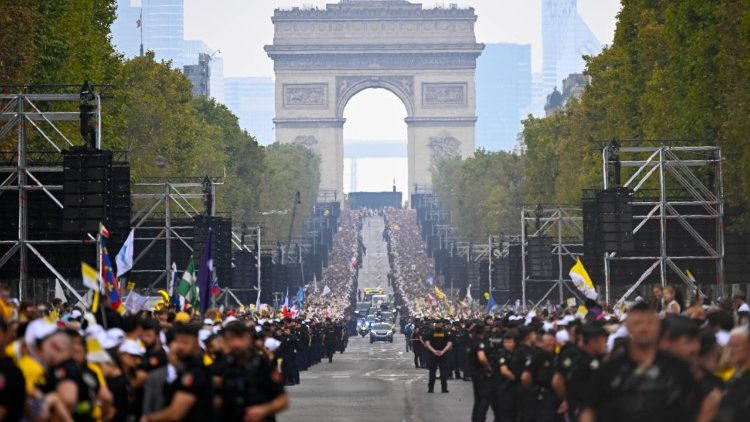
(ZENIT News / Rome, 10.20.2026).- In an increasingly polarized political landscape, Pope Leo XIV has achieved something few foreign leaders can claim: broad approval across France’s ideological divide. A new survey places the American pontiff well ahead of presidents and prime ministers, suggesting that his appeal extends beyond the Catholic faithful and the traditional boundaries of party politics.
According to a Cluster 17 poll conducted on October 14 and 15, 65 percent of respondents expressed a “very good” or “fairly good” opinion of Leo XIV, making him the most positively regarded foreign political figure among those surveyed. The findings come weeks after his historic visit to France, during which more than one million people gathered in Paris, Lourdes and Metz.
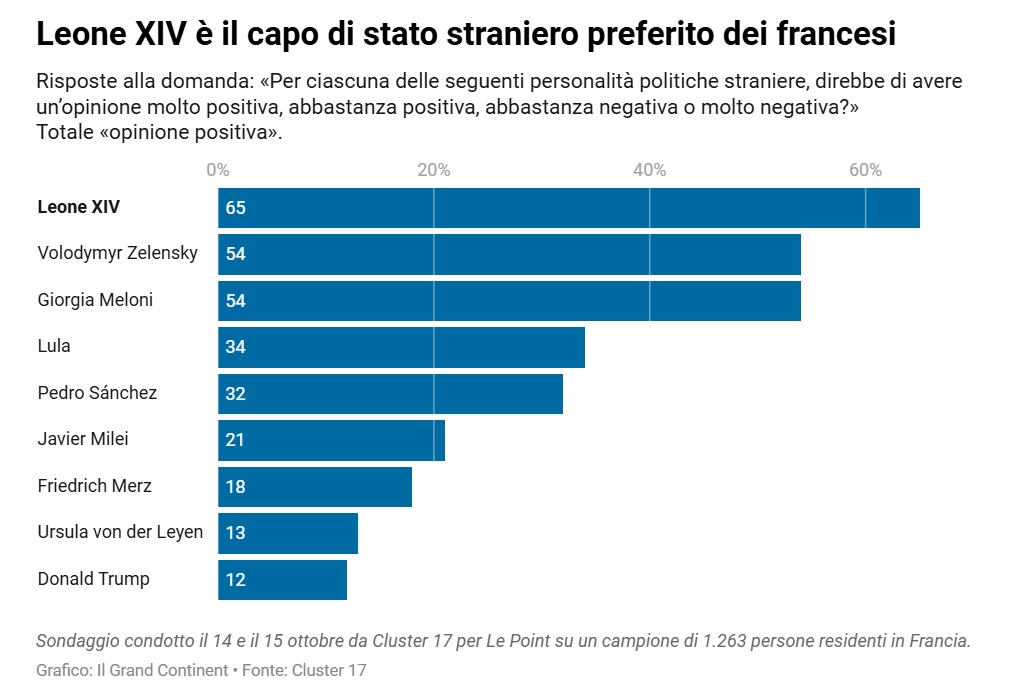
The result is striking not simply because of the pope’s overall popularity, but because of its breadth. Leo receives favorable ratings from 78 percent of supporters of the center-right Republicans and 75 percent of National Rally voters. Yet his appeal is not confined to the right: 54 percent of supporters of the left-wing France Unbowed movement also view him positively. Among the foreign figures included in the survey, he stands out as the only one to command favorable opinions across the political spectrum.
Such figures do not necessarily indicate agreement with the Church’s teaching or establish why respondents admire the pontiff. They do, however, suggest that Leo has so far avoided the partisan associations that weigh heavily on many contemporary political leaders. His religious office, international stature and public presence may offer a different kind of authority from that exercised by elected politicians, although the survey alone cannot determine which factors explain his standing.
The contrast with the rest of the international political field is considerable. Italian Prime Minister Giorgia Meloni and Ukrainian President Volodymyr Zelensky each receive positive ratings of 54 percent, eleven points below the pope. Their support, however, is sharply divided along political lines. Meloni is viewed unfavorably by 80 percent of France Unbowed supporters, while she enjoys approval from 91 percent of National Rally voters and 95 percent of Reconquête supporters. Zelensky, meanwhile, faces unfavorable opinions from 55 percent of France Unbowed supporters and 58 percent of National Rally voters, but receives positive ratings from 92 percent of supporters of President Emmanuel Macron.
Brazilian President Luiz Inácio Lula da Silva follows with 34 percent favorable opinions, ahead of Spanish Prime Minister Pedro Sánchez, at 32 percent.
At the opposite end of the rankings stands U.S. President Donald Trump, whose 82 percent unfavorable rating makes him the most rejected foreign leader in the survey. European Commission President Ursula von der Leyen also faces widespread disapproval, with 73 percent viewing her negatively. The figures underline how differently French respondents assess political leaders whose public images are closely associated with contentious national and international debates.
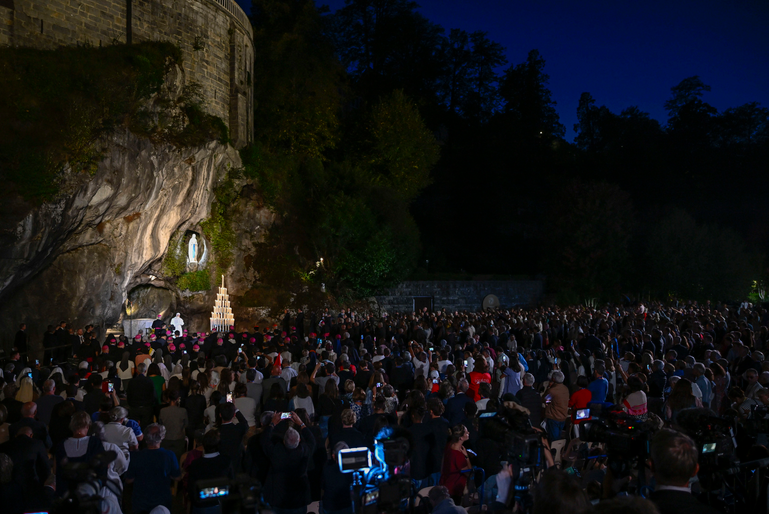
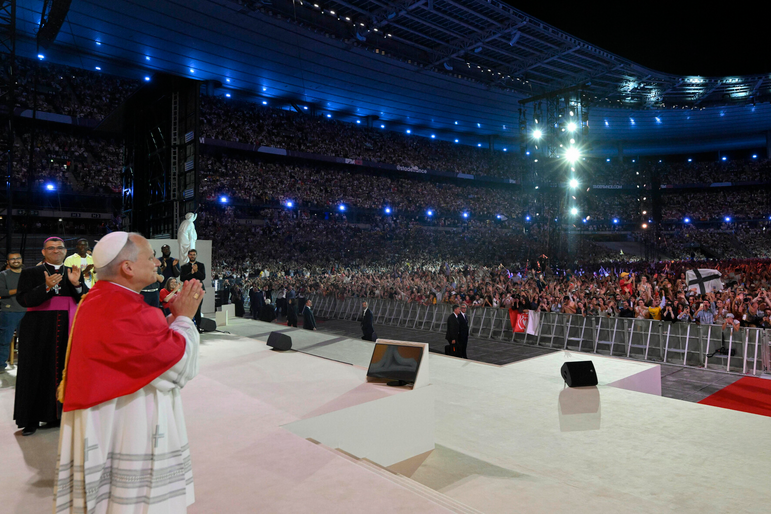
Leo’s reception in France offers a different picture. His visit appears to have reinforced an image capable of attracting people who disagree profoundly on political questions. The crowds that filled public spaces and churches during his journey provided a visible expression of interest; the subsequent poll suggests that this welcome was accompanied by substantial public goodwill.
Nevertheless, a favorable opinion of a pope does not automatically translate into support for Catholic doctrine on life, family, religious freedom or other contested issues. The more meaningful test will be whether the pontiff can sustain this broad confidence while speaking clearly about the moral questions on which the Church cannot simply follow public opinion.
Thank you for reading our content. If you would like to receive ZENIT’s daily e-mail news, you can subscribe for free through this link.

Publicaciones relacionadas:
 In what sense is the Bible the Word of God in human words? Pope Leo XIV responds
 Opus Dei before the Pope: what was said about the new statutes and some controversies in Argentina
 Pope Leo XIV summons bishops to Rome to discuss the reimplementation of the controversial Amoris Laetitia
 Two interpretations of the empty tomb, only one to choose: Pope Leo XIV’s reflection
