

(ZENIT News / Guadalajara, 10.20.2026).- There are stories in which life seems to follow an almost impossible path, yet every breath becomes a reason for gratitude. For parents navigating the uncertainty of a prenatal diagnosis, faith does not erase fear, nor does it guarantee the outcome they desire; however, it can provide a strength that sustains them as they fight for their children. In these little lives, surrounded by medical care, prayers, and family love, many discover an invitation to trust in Providence: not because they understand all of its ways, but because they believe that no life lacks dignity, and that hope can flourish even amidst great fragility.
Iñigo Prieto Delic is one of only eight children worldwide to have survived bilateral renal agenesis. He was born without kidneys, and also lacks a urethra and a bladder. «We are made for Heaven, and only God knows when we will go there,» says his father, who shares their story here.
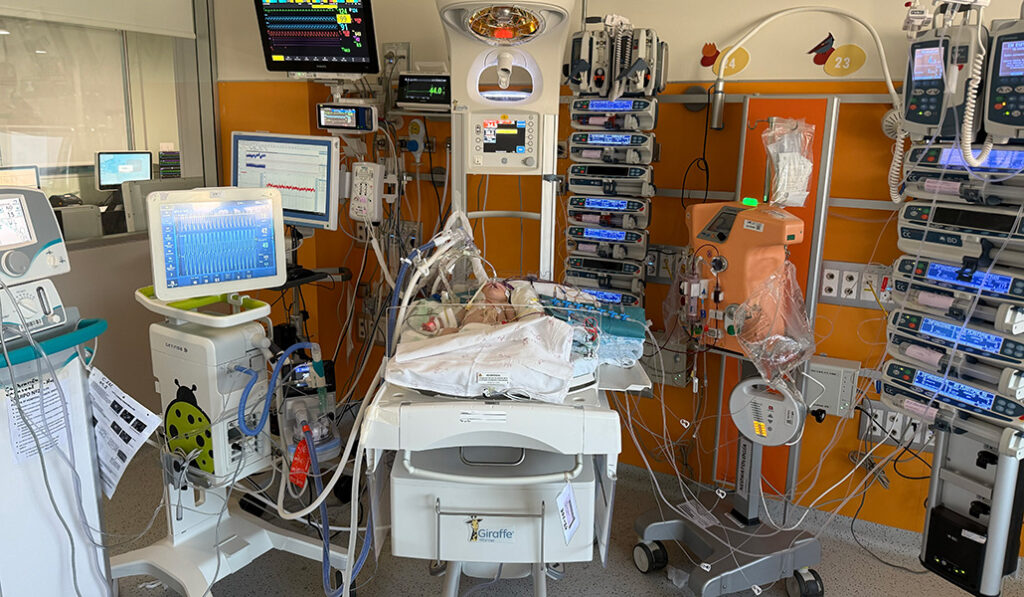
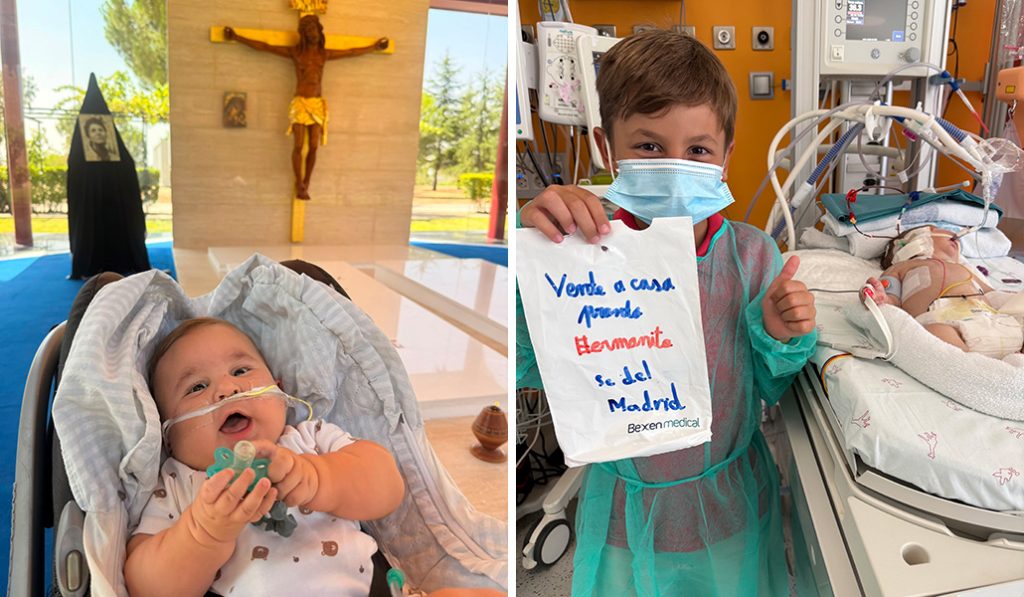
Iñigo de Loyola Maria Prieto Delic is your typical chubby eleven-month-old baby. But in his home, the scale — so dreaded by many after the summer — is not an enemy, but an ally. The little boy needs to reach a weight of ten kilograms and be at least two years old to undergo the kidney transplant he requires to keep living. Currently, he weighs 8.3 kilograms, and he turned one on August 21st. If he reaches his goal, it will be yet another miracle for this child, who is half-Spanish (from Córdoba) and half-Bosnian (from Mostar). His parents say they are «enormously grateful for the prayers of the Church and for La Paz Hospital, seeing how God has allowed our son to continue living,” especially considering that, at the beginning, he was given less than a 1% chance of survival. Iñigo Maria was born without kidneys, and he also lacks a urethra, ureters, and a bladder.
Iñigo and Diana, his parents, first learned of the situation during a 20-week ultrasound. That day, Diana had gone to the clinic alone. The doctors noticed a lack of amniotic fluid and referred her to the Reina Sofía Hospital. «She called me, crying. I was teaching a math class, I’ll never forget it,» recalls Iñigo Prieto, who, until last year, was a teacher at the La Salle school in Córdoba. «We went together to the Reina Sofía, where Diana underwent a contrast-enhanced scan.» The result was devastating:
«Your son has no kidneys. He suffers from a condition incompatible with life, known as bilateral renal agenesis.»
«And is there nothing that can be done?»
«No.» «The options are to wait for the baby to pass away or to have an abortion.»
When they stepped out of the consultation room to take a breath, Diana and Iñigo’s eyes were filled with tears. «We hugged each other and cried for a while,» she admits. Upon going back inside, they pressed the question: «Is there really nothing that can be done? Isn’t there some kind of intrauterine intervention?»
The doctors stood by their answer. There was nothing to be done, so they went home with their hearts shattered. «You can’t imagine the pain you feel knowing that your child is dying and there’s nothing you can do,» they lamented.
The following day, the couple received a call from one of their catechists from the Neocatechumenal Way. «He spoke to us about Heaven. It was very comforting and filled us with hope. He even offered us the possibility — when the time came — of burying little Iñigo alongside one of his own daughters in Córdoba, who had also passed away shortly before her birth. I thought that was a beautiful gesture,» he says.
Nevertheless, Iñigo explained that he had to handle some «unpleasant» tasks during those days, such as making phone calls to inquire about procedures following a death. After all, it is not easy to trade a crib for a coffin; «that is why we asked the Lord to help us accept and bear this cross.»
Their concern was ensuring that, should the baby pass away soon, his body would be released to them so they could bury him. «You aren’t always given the body in such circumstances,» he notes. They also held out hope that they might be able to baptize him, should he remain alive.
The situation, however, changed radically when Iñigo searched for «bilateral renal agenesis» on Google. «Everything I found indicated that the condition was incompatible with life.» There was no data or photos of any survivors, at least, not in Spain. He tried searching in English, and, voilà, the case of Abigail Beutler suddenly appeared on his screen. She had survived the same condition, thanks to Johns Hopkins Hospital in Baltimore, Maryland, U.S.A.
Abigail’s Case
Abigail Rose Beutler is the daughter of Jaime Herrera Beutler, a former U.S. Congressman, and Dan Beutler. She was born on July 15, 2013, at 28 weeks of gestation, after it was diagnosed that she had neither of her two kidneys.
At 20 weeks of pregnancy, her parents received a prognosis that the baby would not survive.
Jaime and Dan sought medical alternatives and turned to prayer, convinced that they had to fight for their daughter’s life.
An Extraordinary Survival
Doctors performed five saline solution infusions while the baby was in the womb to promote lung development. Abigail was born breathing; she underwent dialysis during her early years and later received a kidney donated by her father.
The family publicly expressed their gratitude to God for Abigail’s survival. Her story was shared by national media outlets and by Stanford Children’s Health Center, where she received specialized care.
Continuing with the Case of Baby Iñigo
The Prieto-Delic couple and doctors at Johns Hopkins Hospital met several times via videoconference. «After reviewing the case, they confirmed they were willing to help us.» However, Diana and Iñigo would have to cover the costs themselves. «The final question on the form they sent us asked: ‘Are you fully confident that your financial resources are sufficient to cover travel, flights, hospital procedures, etc.?'» They answered yes, even though they had been informed that a single hospital stay could cost US$250,000.
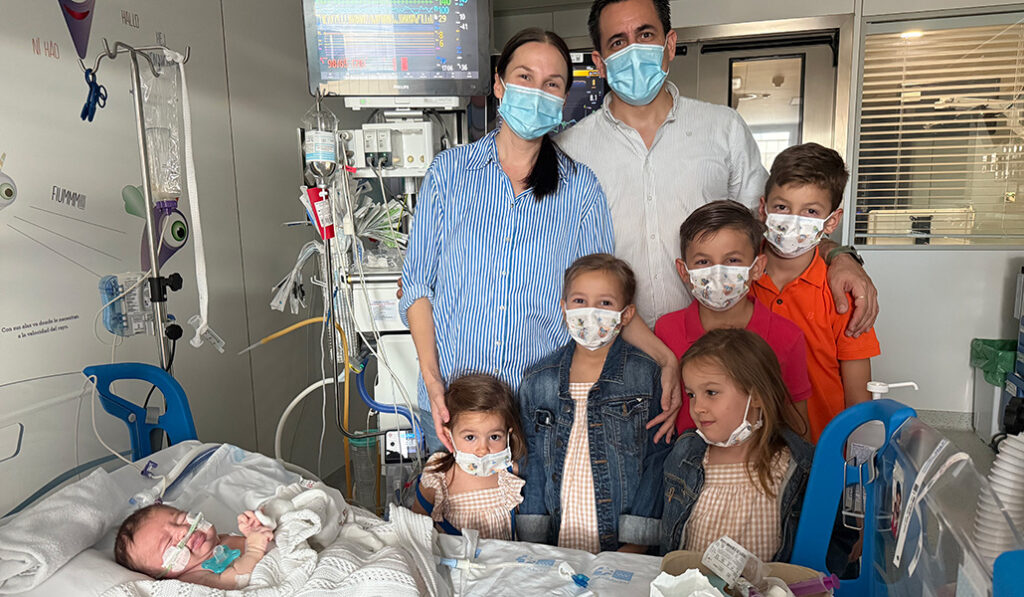
The plan involved taking out a mortgage and leaving their other five children in the care of members of their community, relatives, and friends. At Johns Hopkins, Diana would undergo a treatment involving amnio-infusions. «Using needles, a special fluid is injected into the amniotic sac. This allows the baby to develop his lungs and limbs until birth.» From that point on, they would have to wait until the little one reached a weight of at least ten kilograms and turned two years old.
Help from Heaven
“We entrusted the child to Pope Francis, who had just passed away, and to Carmen Hernández, co-initiator of the Neocatechumenal Way,” and the response was as swift as it was unexpected. «A friend of ours, a gynecologist named María Sánchez del Solar, shared our case in a WhatsApp group for Christian gynecologists, affiliated with the Jérôme Lejeune Foundation, and it turned out that one of them, Jaime Siegrist, had encountered a similar situation.» The doctor offered to bring the matter to the attention of the head of the Gynecology and Obstetrics department at La Paz Hospital in Madrid, José Luis Bartha. He invited the couple to a meeting with the heads of the various medical specialties that would be involved, should little Iñigo survive the amnio-infusions.
«He made things very clear to us: ‘There is a high probability that the child will die, but we are going to do everything in our power,'» he told them. There was a significant risk that the amniotic sac might rupture; if that happened, and the baby weighed less than 2 kilograms, there would be nothing they could do. At that weight, he could not be admitted to the ICU, as he would require dialysis, and the cannulas that would need to be inserted into his jugular vein were not small enough for a baby of that size.
There was also a risk of pneumothorax, pulmonary hypoplasia, and the danger of generalized sepsis for the mother… «The list goes on, but in the face of all this, we decided to place our trust in the hands of the doctors, and, above all, in the Lord. Ultimately, we are made for Heaven, and only God knows when we will go there. All we have done is pray and wait, united with the Church.»
Technical expertise and faith, a winning combination that enabled Iñigo to overcome every challenge life has thrown his way. The first of these occurred the moment he was born: «They took him to the ICU, where I was able to have him baptized in an emergency. His oxygen saturation was at 50%, and we were warned that he might die.» But he didn’t, nor did he on the two other occasions when he came close to joining the Lord.
Now, the Prieto Delic family continues their battle against the odds from Madrid, where they have moved to be close to the hospital. «In truth, for us, this story has been a beautiful fusion of faith and the selfless help of courageous doctors who have championed life,» Iñigo asserts. He adds, «It has been a hard, difficult time, but the Holy Spirit has guided us with gentleness, and the Lord has made His presence felt many times in a way that is hard to put into words.»
Finally, the little boy’s father expresses his gratitude to everyone who has helped them. He mentions the Church, specifically the «community and catechists» of the San Francisco and San Eulogio parish in Córdoba, as well as «so many acquaintances, priests, missionaries, prayer groups, and the multitude of people who have prayed for us and for this child.» Furthermore, he and Diana are deeply grateful to «the entire staff at La Paz Hospital.» He emphasizes, «In these times, it is truly remarkable to have doctors who fight for life against all odds, always demonstrating great humanity and integrity.» He concludes the interview by giving thanks for «the intercession of those in Heaven, including Carmen Hernández, Pope Francis, and many others, who have interceded, and continue to intercede, before the Father on behalf of this life.»
Cases of babies who survive very serious prenatal diagnoses or extremely premature births can serve as moving testimonies to their parents’ faith, hope, and trust in Divine Providence.
Medicine provides insight into the clinical course of a condition, while faith helps many families find meaning amidst uncertainty. Both perspectives can be presented without claiming that prayer guarantees a cure, and without undermining the work of medical professionals.

Publicaciones relacionadas:
 From cancer to the Church through a miracle: Jordan Peterson’s wife converts to Catholicism, thanks to the Rosary
 Donate 5 million euros to emblematic Parisian church: and here are the reasons why
 Monaco reaffirms its Catholic identity by halting abortion reform: Prince refuses to enact the law
 Anglican Monastic Community Converts to Catholicism: The Inspiring Story of Faith and Perseverance of Twelve Women
