

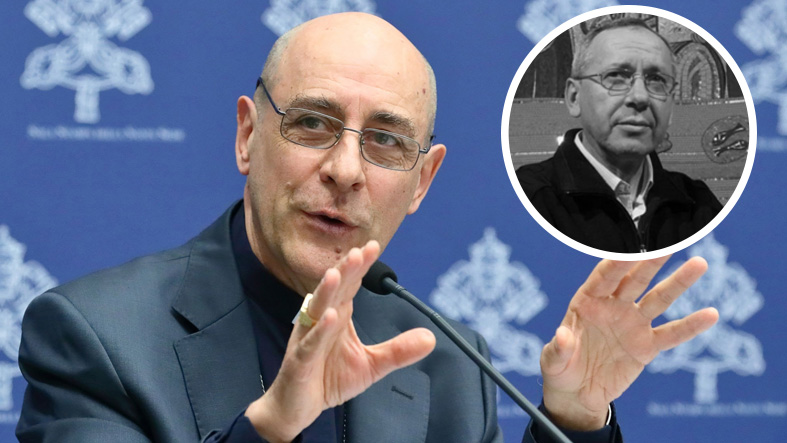
(ZENIT News / Rome, 11.25.2026).- The Vatican has reaffirmed that the canonical trial of former Jesuit priest and religious artist Marko Rupnik is proceeding independently, while acknowledging that the Catholic Church still faces significant legal challenges in prosecuting cases of spiritual abuse. The statements come amid growing questions about the length of the proceedings and the absence of a clearly defined canonical offense covering certain forms of spiritual manipulation.
Cardinal Víctor Manuel Fernández, prefect of the Dicastery for the Doctrine of the Faith (DDF), told the National Catholic Register on November 20 that the five judges appointed to examine Rupnik’s case have complete autonomy and that the Holy See is committed to avoiding any interference. Nevertheless, he stressed that the Vatican hopes the proceedings will conclude as soon as possible.
The tribunal, established in October 2025, consists of two women and three men, all selected from outside the Vatican’s dicasteries. Fernández said the judges had been explicitly promised independence and that his department would neither impose deadlines nor demand information about their work. The cardinal presented this restraint as a necessary condition for respecting the integrity of the judicial process, rather than a lack of interest in reaching a conclusion.
Rupnik faces allegations of sexual, psychological and spiritual abuse, as well as abuse of conscience. The precise canonical charges have not been made public, and the Vatican has maintained strict confidentiality throughout the proceedings. In July 2026, the Holy See’s press office specifically denied reports that the judges had already reached a decision, explaining that disclosing information could compromise the trial and prejudice those involved.
The case has attracted particular scrutiny because the Church initially declined to pursue a canonical trial on the grounds that the alleged offenses had become time-barred. Following public criticism, Pope Francis lifted the statute of limitations in October 2023, allowing the proceedings to go ahead. Rupnik, who was expelled from the Society of Jesus, was subsequently incardinated in the Diocese of Koper, Slovenia, in 2023. He has continued to live without significant restrictions at his art center in Rome despite the serious allegations against him.
The controversy has also extended beyond the courtroom. Rupnik’s religious artwork, which appears in churches and Catholic institutions around the world, has been removed or covered in some locations. Other works continued to appear in Vatican communications and religious settings, prompting questions about how the Church should deal with the public legacy of an artist facing such grave accusations.
Yet the legal questions raised by the case reach beyond Rupnik himself. One of the central difficulties is that canon law does not currently establish spiritual abuse as a separate, clearly defined criminal offense. Although certain behaviors associated with spiritual manipulation can already be prosecuted under existing provisions, the absence of a specific legal definition may complicate the handling of conduct that does not fit easily within established categories.
Fernández said spiritual abuse was a matter of considerable personal concern and revealed that he had asked the Pope to consider making it a distinct canonical offense. The issue is now being examined by the Dicastery for Legislative Texts, which must determine whether new legislation is necessary or whether existing offenses can be interpreted and applied more effectively.
The cardinal emphasized that any legislative development should respond to the broader needs of the Church rather than being designed around an individual case. This distinction is important: canonical legislation must establish general standards that protect the faithful and guarantee due process, rather than introduce rules retrospectively to secure a particular outcome.
Pope Leo XIV has also acknowledged the problem. Speaking to journalists aboard the papal flight returning from Peru earlier in November, he explained that the Church was studying how spiritual abuse could be addressed within its legal system. He cautioned, however, that the concept remains insufficiently defined and that effective justice requires a precise legal framework identifying prohibited conduct and the means of sanctioning it.
Leo indicated that no document addressing the issue should be expected immediately. His remarks nevertheless suggest that the matter has become part of a wider examination of the Church’s canonical procedures and its capacity to respond to forms of abuse that exploit religious authority and the trust of the faithful.
The distinction between spiritual direction and spiritual abuse is fundamental. Religious authority is intended to help believers develop their relationship with God, not to make them dependent on an individual, undermine their freedom of conscience or expose them to manipulation. When that trust is violated, the damage can extend beyond individual victims, affecting entire religious communities and weakening confidence in the Church’s institutions.
Thank you for reading our content. If you would like to receive ZENIT’s daily e-mail news, you can subscribe for free through this link.

Publicaciones relacionadas:
 Cardinal Fernandez calls for clearer legal framework to address “spiritual abuse” in the Church
 Vatican: A French bishop succeeds Cardinal O’Malley as head of the Pontifical Commission for the Protection of Minors
 Memorare Is the Name of the Fund Created by the Vatican to Fight Against Abuses in Poor Countries
 Vatican announces date of its second report on protection against abuse
