

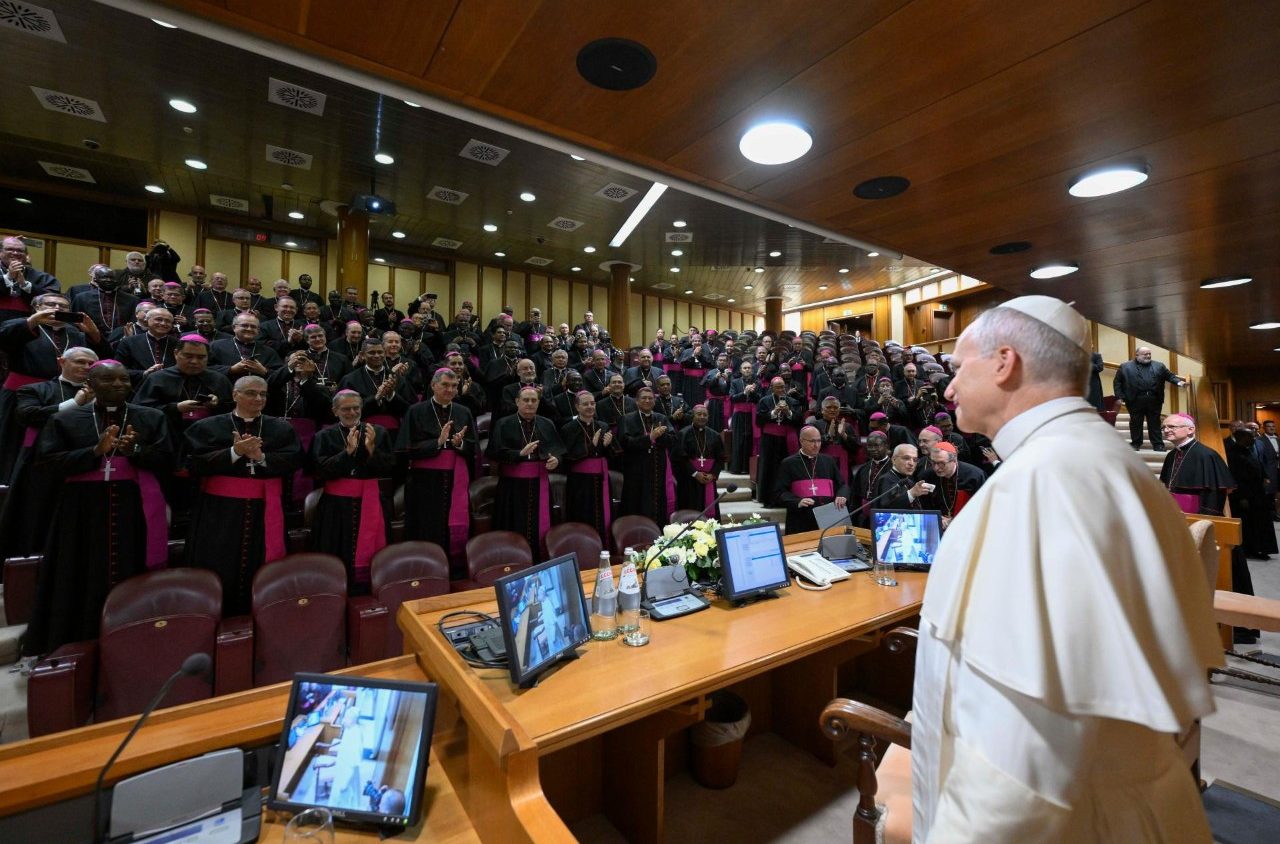
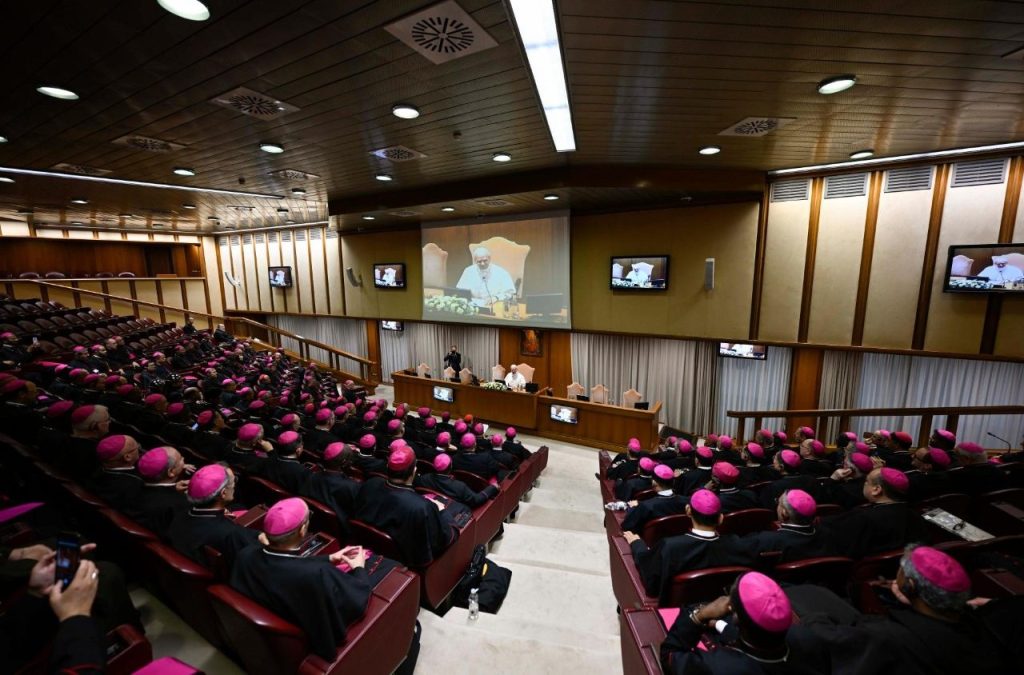
(ZENIT News / Vatican City, 09.10. 2026).- The Holy Father Leo XIV received in private audience, in the Synod Hall of the Vatican, a group of just over 110 newly appointed Bishops. They are in Rome for a week-long course offered to those who have received the Sacrament of Episcopal Ordination within the past year, a course that Cardinal Robert Prevost himself organized during his tenure as Prefect of the Dicastery for Bishops. Before delivering his address, Leo XIV offered condolences for the passing of Cardinal Luis Antonio Tagle’s father, who had died shortly before. We present below the English translation of the Pope’s address.
* * *
In the Name of the Father, of the Son, and of the Holy Spirit.
Peace be with you!
I am sincerely pleased to meet with you at the conclusion of these days of formation for new Bishops, and I thank the Dicasteries for Bishops, for the Eastern Churches, and for Evangelization — specifically the Section for First Evangelization and New Particular Churches –, for organizing this event. Some of those who worked on the organization are present here, and I thank them, as I have come to understand a little of what it takes to put this program together.
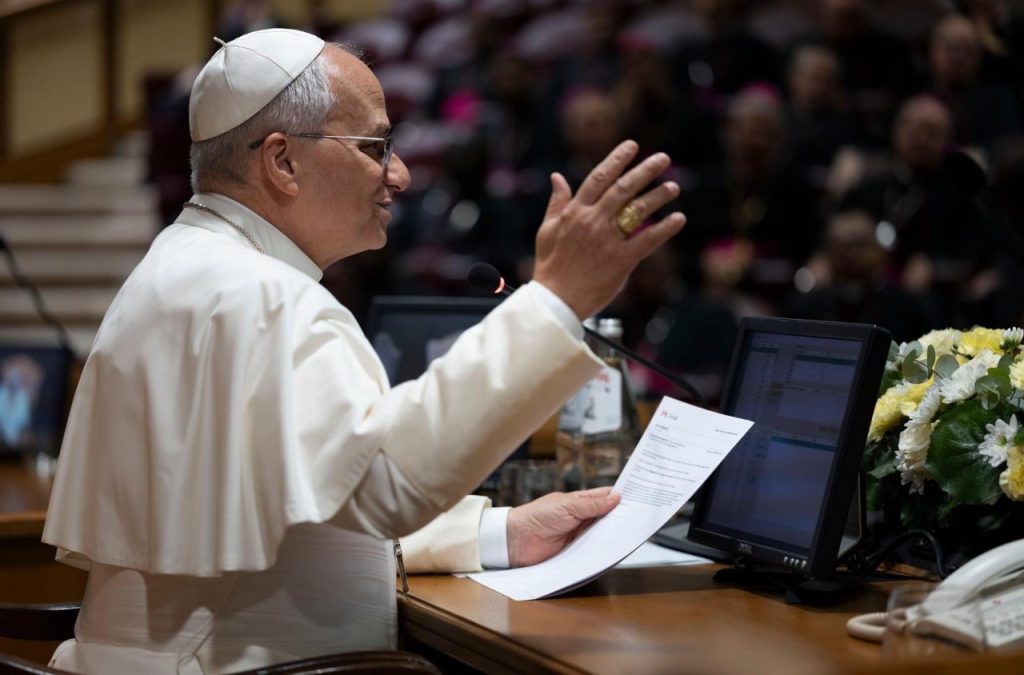
You have experienced a unique sense of fraternity: together you have listened, prayed, celebrated the Eucharist, and shared the hopes and dreams you carry in your hearts for the Churches the Lord has just entrusted to your pastoral care. All of this will help you remember something very simple yet valuable: no Bishop walks alone.
Dear brothers, please know that you are constantly in my prayers, along with your Churches: the priests, deacons, consecrated men and women, seminarians, families, young people, the elderly, the poor, those who suffer, and those who are still waiting to encounter the joy of the Gospel. Everyone must find a place in the Bishop’s heart, because everyone already has a place in the Heart of Christ. Therefore, I would now like to share with you some reflections on the theme: «Bishops, Servants of Communion in the Church and in Today’s World.»
[1]
First of all, remain with Jesus. Among the many things you will be called to do as Bishops, this is the most important. We are Bishops, but first and foremost, we are disciples. To speak of Him, we need to be with Him; to guide His people, we must let ourselves be guided by Him, each and every day. He «appointed twelve,» the Gospel of Saint Mark tells us, «whom He named apostles, to be with Him and to be sent out to preach» (Mark 3:14). This is the order of the Gospel: to be with Him and, through Him, to be sent forth. Let us never forget this. Therefore, always cherish the time you spend with the Lord: the Eucharist, the Word of God, prayer, and those moments when you can be in His presence with the simple heart of a disciple, who allows himself to be loved by his Lord. Our ministry springs from there. And when the heart remains close to Him, our service, too, becomes more serene, more free, and more fruitful.
[2]
A second aspect: possessing the Heart of Jesus, the Good Shepherd, a heart completely oriented toward the Father and, precisely for that reason, totally given over to one’s brothers. Jesus says: «I am the Good Shepherd. The Good Shepherd lays down his life for the sheep» (John 10:11). Here is our model. The Bishop is a man who learns each day to love his people more: to know the joys and sorrows of his flock, to share their dreams, and to rejoice in seeing communities grow. You will ordain priests and deacons, meet young people full of enthusiasm, witness the quiet generosity of so many men and women religious, missionaries, catechists, and families, and discover ever more deeply how beautiful the People of God is. Love the people the Lord has entrusted to you. Learn their names, listen to their stories, enter their homes when you can, and pray with them. Especially in young Churches, the Bishop’s presence often speaks volumes, even before he utters a word. A visit, a blessing, time spent with a priest, listening to a family, a conversation with a young person — these are small gestures, yet they can remain in a person’s heart for a lifetime.
[3]
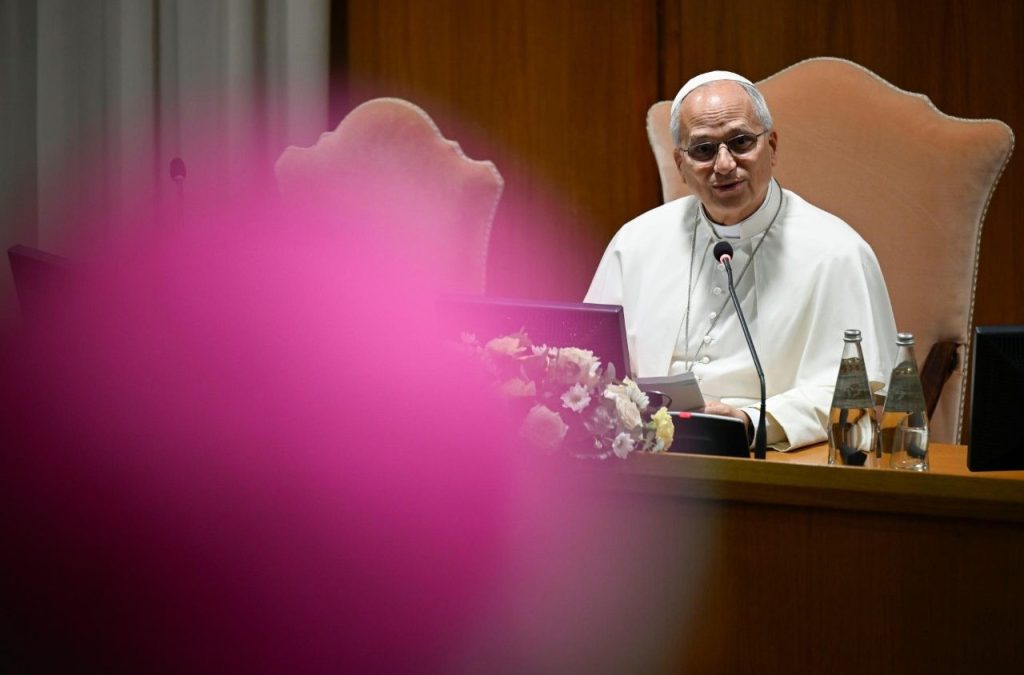
Another characteristic of the Bishop is what tradition calls sollicitudo pastoralis, pastoral solicitude. It does not simply mean having many responsibilities. It is something deeper: it is carrying one’s people in one’s heart. Saint Paul referred to his concern for all the Churches as his «daily burden» (2 Corinthians 11:28) the concern for all the Churches. Thus, the Church to which they have been sent becomes an ever-greater part of their lives, almost a part of themselves. This is intrinsic to episcopal fatherhood: having a big heart, large enough to make room for everyone, carrying one’s children within oneself and presenting them to the Lord in prayer each day. Pope Francis reminded us that «closeness is one of God’s traits in His relationship with His people» (Homily on the Centenary of the Birth of Saint John Paul II, May 18, 2020). And, speaking precisely to the Bishops attending a formation course on September 12, 2019, he said: «We exist to make this closeness palpable.» What valuable words for us! May the people be able to sense, through our presence, something of God’s tenderness and fatherhood! And this applies especially to priests.
In this regard, dear brothers, I urge you to love your priests. May they find in each of you both a father and a brother. Listen to them, encourage them, pray for them, rejoice in the good they do, and accompany them with confidence in their ministry. Pay special attention to those who are elderly or ill. Make them feel valued, let them know that the Church is grateful to them and that the Bishop does not forget them. Sometimes, a simple phone call, a visit, or an affectionate word from you is enough.
[4]
Another aspect of our ministry, which I would like to recall, is — to use Saint Augustine’s beautiful expression –, that of being an amoris officium (In Iohannis Evangelium, 123,5): a service of love. Our preaching is an act of love, just as listening, prayer, discernment, time dedicated to people, and presence are. It is pastoral charity that allows Christ, the Shepherd, to reach the people He loves through our humble selves.
We live in an era of rapid change. Advances in communication technologies and artificial intelligence have opened up possibilities that, until a few years ago, we would not have even imagined. Yet, they certainly cannot free humanity from sin and its consequences; the crises it is currently facing tragically demonstrate this. Amidst the complex, and in some respects, unsettling, scenario of the present day, the Church celebrated the Jubilee of Hope last year. Was this because it exists apart from the world? Quite the opposite: because, sent by Christ, who died and rose again, it is called to proclaim the Gospel of salvation to all. And we, the Bishops, are the first recipients of this mandate. With the Encyclical Magnifica Humanitas, I believe I have offered — primarily to the shepherds of the Churches –, a vision and a method for facing the great challenge of safeguarding what is human in the age of artificial intelligence. I encourage you to foster processes of reflection and dialogue within your dioceses, in order to form and support those who wish to commit themselves to the service of the Civilization of Love.
[5]
Many of you come from young Churches. You know the beauty and the challenges of mission, of a Church that may possess little, yet is rich in great faith. That is why I invite you to maintain a missionary heart. It is a precious gift the Lord has placed in your hands, one that can grow even greater in your episcopal ministry. A missionary Bishop has a heart open to all: not only to those who attend our parishes, but also to Christians of other denominations, believers of other religions, those who profess no faith, and all men and women of good will. He listens to and respects everyone; he reaches out to all and knows how to recognize the good present in the heart of every person.
Saint Augustine, when addressing his people, used to say: «Vobis enim sum episcopus, vobiscum sum christianus» — I believe everyone knows this –, «for you […] I am a Bishop; with you, I am a Christian» (Sermo 340,1). Let us walk with our people: let us pray with them, listen to the Word with them, and celebrate the Eucharist with them. Let us seek the face of the Lord with them each day.
Dearest brothers, as you return to your Churches, carry this certainty with you: the Lord who has called you is faithful. He will go before you on the journey, accompany you along the way, and, through the gift of the Holy Spirit, enlighten you each day. And may Mary, Mother of the Church, always watch over you and the people entrusted to your care. Thank you.

Publicaciones relacionadas:
 Pope Leo XIV brings spiritual exercises back to the Apostolic Palace: they will be preached by a Norwegian monk (and bishop)
 Leo XIV turns the consistory into a laboratory for mission and governance
 3 Criteria for Discernment in a Consistory Based on the Common Good of the Church: Leo XIV’s Guidelines to the Cardinals
 Here Is How the Morning of the First Day of the Pope’s Consistory with Cardinals Unfolded. Everything You Need to Know: Topics Discussed, Debates, Contributions, and Initial Proposals
