

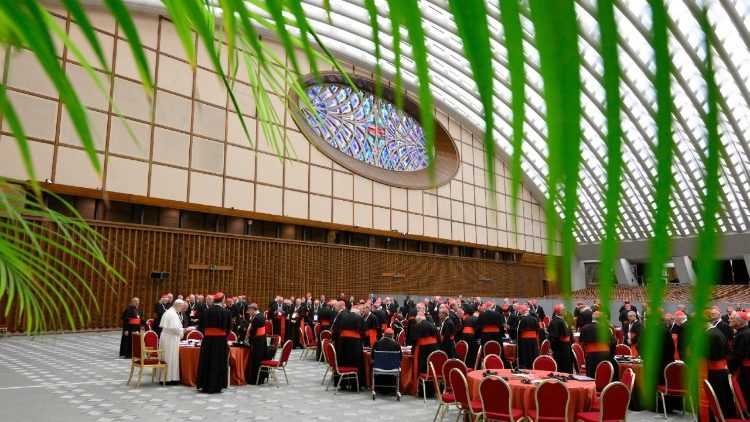
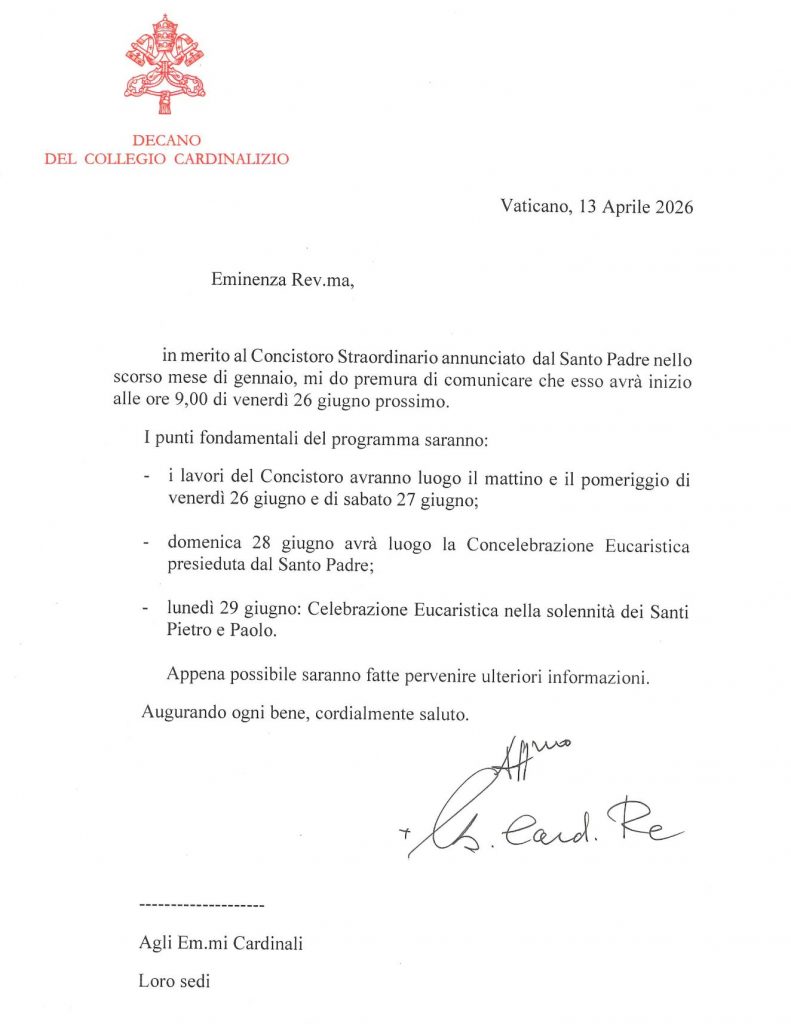
(ZENIT News / Rome, 04.15.2026).- The decision to convene cardinals from across the globe in Rome at the end of June 2026 is not merely a matter of calendar. It signals a governing method that Pope Leo XIV appears determined to institutionalize: a Church that thinks aloud, collectively, and at regular intervals. The extraordinary consistory scheduled for 26 and 27 June, followed by liturgical celebrations tied to the feast of Saints Peter and Paul, is emerging as a key instrument in that vision.
In a letter dated mid-April and circulated to members of the College of Cardinals, the Pope frames the upcoming gathering as a moment of discernment rather than decree. Unlike ordinary consistories—often associated with the creation of new cardinals—these extraordinary sessions function as consultative assemblies. All cardinals are invited, regardless of age or voting status in a conclave, reinforcing the idea that experience and geographical diversity are assets in shaping the Church’s direction.
This second consistory of the pontificate builds on the precedent set in January 2026, when cardinals met in working groups organized by language to discuss priorities raised during the conclave itself. That earlier meeting revealed both the appetite for greater collaboration and, according to some accounts, underlying tensions regarding internal procedures. Leo XIV’s response has not been to streamline debate but to expand it, proposing that such gatherings become annual fixtures lasting several days.
At the heart of the June discussions lies a dual axis: missionary renewal and structural reform. The Pope’s letter places renewed emphasis on Evangelii Gaudium, the 2013 apostolic exhortation of his predecessor, presenting it not as a historical document but as an unfinished program. He suggests that the Church must evaluate, with some rigor, how much of that vision has actually been implemented. The question is less doctrinal than operational: what has changed in pastoral practice, and what remains aspirational?
The text outlines a shift that Leo XIV considers essential. At the personal level, he calls for a transition from inherited faith to consciously lived faith. At the communal level, he advocates moving beyond what he describes as a “maintenance” model of pastoral care toward one oriented to mission. At the institutional level, he warns against excessive organizational complexity that risks suffocating initiative. The underlying concern is that ecclesial structures, while necessary, can become ends in themselves.
Concrete topics for the June meeting reflect this orientation. Among them are reforms to the processes of Christian initiation, an area that touches directly on how new generations are incorporated into the life of the Church. Another focus is the effectiveness of ecclesial communication, including that of the Holy See, which the Pope suggests should be more explicitly missionary in tone and purpose. The role of apostolic and pastoral visits is also expected to be reassessed, not as ceremonial obligations but as instruments of evangelization.
Yet other issues, while not explicitly listed in the Pope’s letter, are likely to surface. The question of liturgy remains particularly sensitive. Debate continues over the implementation of the 2021 norms restricting the pre–Vatican II Latin liturgy, and a report circulated among cardinals earlier this year defended the current disciplinary framework. Although Leo XIV has not publicly taken a definitive position, his practical approach is being closely watched for signs of either continuity or recalibration.
Closely linked is the broader question of governance. The apostolic constitution Praedicate Evangelium, promulgated in 2022, reshaped the Roman Curia with an emphasis on service to local Churches. Recent interventions by senior cardinals have reopened discussion on how authority is exercised within that framework, including the extent to which leadership roles might be more explicitly grounded in baptism rather than ordination. Such debates touch on long-standing theological and canonical principles, suggesting that the June consistory may engage not only pastoral strategy but ecclesiological foundations.
The logistical details of the gathering also hint at its broader significance. The sessions will begin at 9:00 a.m. on both days and conclude before the weekend’s liturgical events, including a concelebrated Mass with the Pope on 28 June. The following day, the traditional pallium will be imposed on newly appointed metropolitan archbishops, a rite that underscores communion between local Churches and the See of Rome. The timing has prompted speculation that new cardinals could be created, though no official confirmation has been given.
Numerically, the College of Cardinals currently comprises 243 members from 92 countries, including 120 electors and 123 over the age of 80. This global composition is not incidental; it is central to Leo XIV’s stated aim of fostering mutual knowledge among cardinals who often have limited opportunities for direct exchange. By bringing them together regularly, the Pope appears to be constructing a more synodal style of governance at the highest level of the Church.
What emerges is a pontificate that seeks to balance continuity with methodical change. Rather than issuing sweeping reforms in isolation, Leo XIV is building a process in which consultation becomes routine and discernment is shared. The consistory, traditionally a formal and episodic institution, is being recast as a recurring forum where theological reflection, pastoral urgency and institutional questions intersect.
Thank you for reading our content. If you would like to receive ZENIT’s daily e-mail news, you can subscribe for free through this link.

Publicaciones relacionadas:
 According to The New York Times Pope Leo XIV Is Among The Most Stylish People So Far in 2025
 Pope Leo entrusts the important Dicastery that elects bishops to a Carmelite and canonist
 Pope Leo XIV: yes to synodality, but without undermining the authority of the bishop
 Pope Leo XIV continues to reshape the Roman Curia: Meet the new Australian prefect of the Dicastery for Legislative Texts
