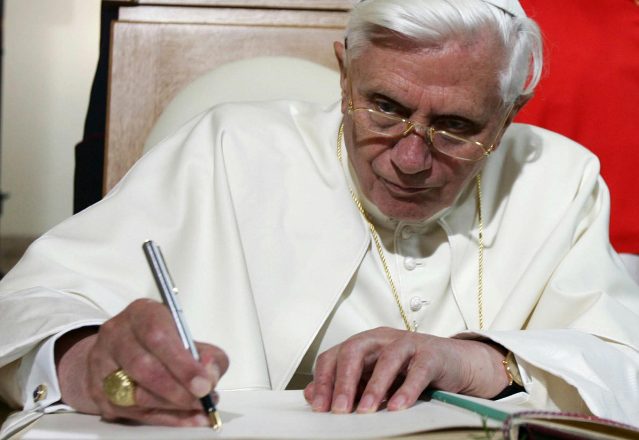
(ZENIT News / Rome, 03.12.2026).- A previously unpublished text written by Pope Benedict XVI shortly before his death has come to light in a new volume released in Italy, offering a rare glimpse into the theological reflections that occupied the retired pontiff in the twilight of his life.
The text appears in “La fede del futuro” (“The Faith of the Future”), the fourth installment in a collection of lesser-known and unpublished writings by Joseph Ratzinger. The book, published by the Italian house Edizioni Cantagalli, gathers texts that span different moments of the German theologian’s career but also includes material composed during his retirement in the Vatican after his historic resignation from the papacy in 2013.
The volume opens with a reflection by Cardinal Pietro Parolin, the Vatican Secretary of State, who situates Benedict’s thought within a broader contemporary context marked by uncertainty about religion’s place in the modern world.
According to Parolin, the question of the future has become central to theological reflection precisely because belief itself can no longer be taken for granted. “It is by no means certain that humanity will continue to believe in God,” he observes in the preface, noting that the former pope’s concerns extended beyond ecclesial questions to a wider atmosphere of global disorientation.
The accelerating pace of historical change, Parolin argues, has produced both unprecedented opportunities and serious dangers. In such a climate, the future is often perceived less as a promise than as a threat. For many people, he suggests, it has even taken on the contours of a nightmare, marked by anxiety, loss of hope and growing uncertainty about the direction of human civilization.
Within this framework, Benedict’s newly published text reads almost like a spiritual meditation written against the background of a world increasingly unsure of its foundations.
A meditation written in retirement
The unpublished letter, dated April 27, 2021, from Vatican City, bears the title “Introduction: Reflections on Christian Prayer.” Though relatively brief, it condenses many of the key theological themes that defined Joseph Ratzinger’s intellectual work for decades: the mediating role of Christ, the centrality of the Eucharist, and the transformation of human desire through encounter with God.
Benedict begins by offering a general definition of prayer as “the fundamental religious act,” describing it as humanity’s attempt to enter into a concrete relationship with God. Yet he quickly emphasizes what distinguishes Christian prayer from other forms of religious expression.
In Christianity, he writes, prayer occurs simultaneously with Christ and toward Christ. The believer prays together with Jesus while also addressing him. This paradox is possible because, in Christian doctrine, Christ is both fully human and fully divine.
For Benedict, this dual nature makes Christ the bridge—using a term deeply embedded in Christian tradition, the “pontifex”—who spans what he calls the infinite abyss between God and humanity. Christ therefore becomes not only the guide to prayer but also its very ontological possibility.
Returning to a familiar Gospel scene, Benedict recalls the moment in which the disciples, after observing Jesus at prayer, ask him: “Lord, teach us to pray.” Their request, he notes, reflects the awareness that while other religious teachers, including John the Baptist, instructed their followers in prayer, Jesus possessed an intimacy with God unlike any other.
From this observation Benedict identifies two inseparable dimensions of authentic prayer: one related to being itself and another connected to human consciousness. Both converge in a relationship with God that consists essentially in remaining in his presence.
Prayer and the logic of the cross
The former pope also addresses what he considers distorted or insufficient approaches to prayer. Drawing on a passage from the First Book of Samuel—“to obey is better than sacrifice”—he stresses that authentic worship cannot be reduced to ritual gestures alone.
In the Christian vision, he argues, prayer is inseparable from the logic of Christ’s self-offering on the cross. Prayer united with Jesus inevitably participates in that movement of self-giving.
For Benedict, this dynamic reaches its highest expression in the Eucharist. Christian prayer, he writes, is always rooted in the Eucharist, directed toward it and ultimately fulfilled within it.
He describes the Eucharist as prayer enacted with the whole of one’s being and as the decisive synthesis of worship and authentic adoration. In the sacrificial act of Christ, Benedict writes, the limitations of purely verbal prayer or ancient sacrificial systems are overcome by what he calls the definitive “yes” expressed through Jesus’ life and death.
Echoing early Christian theology, he notes that the Fathers of the Church often described the Eucharist in two complementary ways: as the end of pagan religious practices and, at the same time, as the defining form of Christian prayer itself.
Learning to overcome spiritual inertia
Benedict also reflects on the practical challenges of prayer in everyday life. Citing the Gospel parable of the friend who hesitates to rise from bed to give bread to a neighbor, he interprets the story as an illustration of humanity’s spiritual inertia.
Prayer, he suggests, always involves overcoming this inner resistance—the tendency to postpone, excuse or avoid the effort required to turn toward God.
For that reason, prayer is not limited to lofty spiritual themes but includes the humble act of bringing even the smallest details of daily life before God. In this sense, petitionary prayer, often criticized by some as spiritually immature, has an essential role.
Benedict rejects the idea that authentic prayer should consist only of praise while excluding requests. Such a view, he argues, would imply that God is indifferent to human needs.
Instead, asking God for help is part of a deeper process through which human desires are purified and integrated into what Benedict calls the “we” of Christ’s family. The structure of the Lord’s Prayer itself, with its seven petitions, demonstrates that asking is intrinsic to the Christian relationship with God.
A final window into Ratzinger’s mind
The publication of the text offers a final glimpse into the intellectual and spiritual world of Joseph Ratzinger during the last phase of his life. After resigning the papacy in 2013, Benedict lived in relative seclusion within the Vatican, devoting his time largely to prayer, study and writing.
Even as age and physical frailty advanced, the newly released reflections reveal a mind that remained characteristically precise and deeply rooted in the theological vision that had shaped his career as professor, cardinal and pope.
Seen in that light, the text does more than analyze prayer. It quietly expresses the conviction that, even in a world increasingly uncertain about faith, the Christian act of turning toward God—anchored in Christ and fulfilled in the Eucharist—remains the decisive source of hope for the future.
Below is the English translation of the full text of the Pope Emeritus’ statement, taken from the Catholic Herald:
***
INTRODUCTION THOUGHTS ON CHRISTIAN PRAYER
by Benedict XVI
In general terms, prayer is the fundamental religious act: it is, in some way, the attempt to enter concretely into contact with God.
The peculiarity of Christian prayer lies in the fact that one prays together with Jesus Christ and, at the same time, prays to Him. Jesus is at once man and God and can thus be the bridge, the pontifex, who makes it possible to overcome the infinite abyss between God and man.
In this sense, Christ is also, generally speaking, the ontological possibility of prayer. For this reason, He is also the practical guide to prayer.
That is why His disciples, who had seen Him pray, addressed this request to Him: “Lord, teach us to pray” (Lk 11:1). They recalled that John the Baptist had taught his disciples to pray, knowing well that He is infinitely closer to God than even the greatest religious figure: John the Baptist. Thus emerge the two fundamental characteristics of prayer: that relative to being and that relative to awareness. They are intertwined with one another.
The profound bond with God, in general terms, consists in abiding with Him. In Jesus’ school of prayer, our knowledge of Him grows, as does our closeness to Him. In this regard, we must also keep in mind Jesus’ criticism of mistaken or insufficient ways of praying. The juxtaposition with the Cross, evident throughout His proclamation and even in the prophetic words that had marked the tenor of prophecy up to Jesus—“To obey is better than sacrifice, to heed is better than the fat of rams” (1 Sam 15:22)—is already clear.
Moreover, Christian prayer, insofar as it is prayer together with Jesus Christ, is always anchored in the Eucharist, leads to it, and takes place within it. The Eucharist is prayer fulfilled with one’s whole being. It is the critical synthesis of cult and true worship. In it, Jesus has said His definitive “no” to mere words and His “no” to animal sacrifices, and He has placed in their stead the great “yes” of His life and death. Thus the Eucharist represents the definitive critique of cult and, at the same time, the cult in the broadest sense of the term.
The Fathers of the Church rightly characterized it on the one hand as the end of paganism, as consuetudo [custom], and on the other as characterizing Christianity itself as prayer.
I believe we ought to reflect much more deeply on this fundamental opposition. This fundamental orientation of Jesus’ dramatic history of prayer enables us to understand the whole realism with which He went about His proclamation. The parable of the man who did not want to get up to give bread to his friend clearly says that prayer is always also an overcoming of our inertia, which inspires so many excuses for not rising.
To pray means to push against this inertia of the heart and therefore also means the humility of bringing before God even the small things of our daily life, asking for His help.
One final point. Often, the realistic and humble way of praying is presented as an objection to petitionary prayer as such: that adequate prayer should always and only be praise of God, not continual begging. This would already be foolish, since God could not and should not be bothered with our small things. In our daily life, however, we must think of ourselves.
Yet in reality we need God precisely in order to be able to live our everyday life starting from Him and oriented toward Him. Precisely in not forgetting that our Father is the one in whom we trust, the Lord’s Prayer consists of seven petitions. Asking God also and above all means purifying our desires so that we can place them before God and so that they may be inserted into the “we” of the family of Christ.
Thank you for reading our content. If you would like to receive ZENIT’s daily e-mail news, you can subscribe for free through this link.