

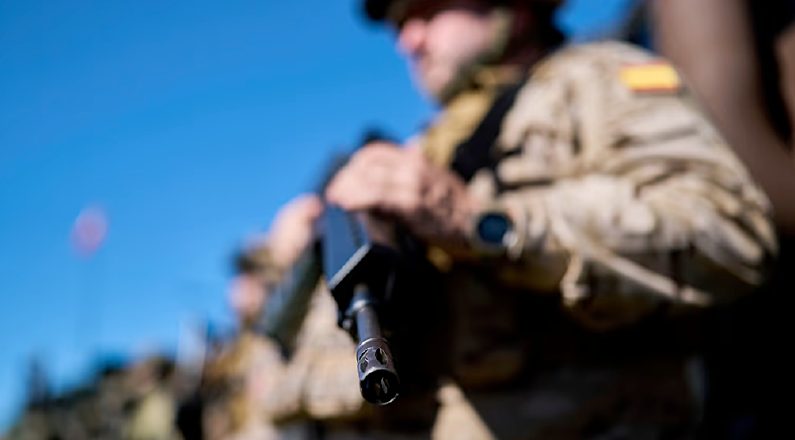
(ZENIT News / Mexico City, 05.21. 2026) .- The Stockholm International Peace Research Institute (SIPRI) published its annual report on April 27, detailing monetary investment in armaments for armies up to 2025, highlighting the rise in spending in this area.
The International Institute for Strategic Studies (IISS), which has analyzed defense and security issues since 1997 and is based in London, also confirmed the highest military spending since 1945, after the end of World War II.
SIPRI reports more than 60 armed conflicts in 2025 with military spending of almost $2.9 trillion, 2.9% more than in 2024. This marks the eleventh consecutive year of growth in military spending, which has increased by 41% since 2015. According to SIPRI, the largest increase in 2025 was in Europe at 14%, attributed to the war in Ukraine and pressure from the Trump Administration on NATO.
The French newspaper Le Figaro warned that these expenditures «represent 2.5% of global GDP, $352 per capita.» The United States accounts for 33% of all global military spending with $954 billion, although it reduced its spending by 7.5% compared to 2025.
The global trend toward increased spending is especially noticeable in Russia, with an increase to $190 billion, 5.9% more. Beijing reached $336 billion, a 7.4% increase, with 31 consecutive years of uninterrupted growth: China represents 12% of global military spending and ranks second. The combined spending of the United States, Russia, and China accounts for 60% of all military investment on the planet.
Germany ranks fourth with $114 billion in spending, a 24% increase. Poland also saw a 23% increase. And Spain 50%. Italy, for example, increased its spending by 20%.
Francesco Vignarca, Coordinator of the Campaigns of the Italian Network for Disarmament and Peace, commented that «many superficially argue that wars, difficulties in international relations, insecurity, and growing global conflict make disarmament inevitable. However, in our opinion, this is a flawed and simplistic assumption that should be interpreted in the opposite sense.» He added: «It is precisely the continued use of weapons — which has intensified in the last two or three years, but which has been steadily increasing since the beginning of the century — that has contributed, directly or indirectly, to the world being more affected by conflicts.»
In his recent address at La Sapienza University of Rome, the largest in Europe, Pope Leo XIV spoke on this subject:
«In the last year, the increase in military activity in the world, and particularly in Europe, has been enormous: we cannot call ‘defense’ a rearmament that increases tensions and insecurity, impoverishes investments in education and health, undermines trust in diplomacy, and enriches elites who do nothing to promote the common good. Furthermore, it is necessary to monitor the development and application of artificial intelligence in the military and civil spheres, so that it does not absolve human decision-making of responsibility or exacerbate the tragedy of conflicts.» What is happening in Ukraine, in Gaza and in the Palestinian Territories, in Lebanon and in Iran describes the inhumane evolution of the relationship between war and new technologies in a spiral of annihilation. Study, research, and investment must go in the opposite direction: they must be a radical ‘Yes’ to life! Yes to innocent life, yes to young life, yes to the life of peoples who invoke peace and justice!

Publicaciones relacionadas:
 Vatican questions “preventive” war in Iran as Leo XIV intensifies diplomatic calls for peace
 A Church Against the Logic of War: Vatican Voices, Middle East Realities, and the Risk of a Vanishing Christianity
 Trump Attacks the Pope for the Second Day, and Meloni Defends Him. The World Reacts While the Catholic Vice-President of the USA Supports Him
 Israeli ambassador to Vatican acknowledges role of popes in ending war
