

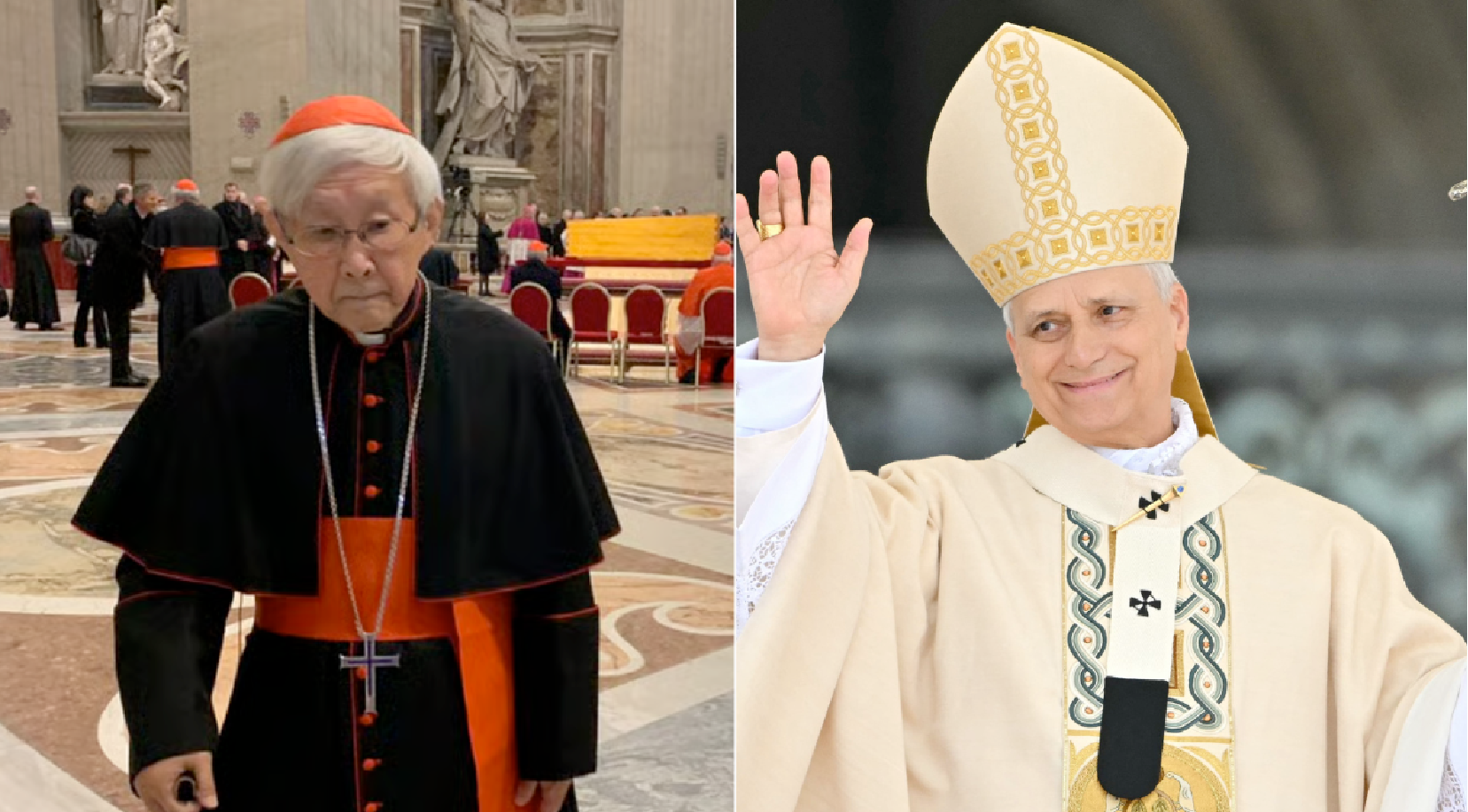
(ZENIT News / Rome, 01.22.2026).- The first extraordinary consistory of Pope Leo XIV, held in early January 2026, was meant to signal a new rhythm of governance after a long and often turbulent pontificate. Instead, it revealed a College of Cardinals still feeling its way forward—carefully balancing continuity with recalibration—while exposing unresolved tensions inherited from the era of Pope Francis.
Few voices captured that unease more sharply than Cardinal Joseph Zen. The 94-year-old emeritus archbishop of Hong Kong emerged as the most outspoken critic of the gathering, describing it as both a welcome opportunity and a deeply flawed exercise. Writing publicly on January 20, Zen said he was “deeply grateful” to Leo XIV for convening the consistory—the first of the new pontificate—but accused allies of the late Pope Francis of effectively hijacking it.
Zen’s frustration centered on the format and substance of the meeting. The two-day gathering, held January 7–8, imposed strict limits on debate: two plenary sessions of just 45 minutes each, with interventions capped at three minutes per cardinal. In practical terms, that meant no more than 15 cardinals could speak per session. For Zen, the structure echoed the Synod of Bishops meeting of 2025, privileging small-group discussions around round tables while marginalizing open, substantive plenary exchange.
The result, he argued, ran counter to Leo XIV’s stated purpose in calling the consistory. “They did everything possible to prevent the cardinals from expressing their opinions,” Zen wrote, casting the situation in what he half-ironically described as a “conspiracy theory.” By his own account, he alone used his allotted three minutes to deliver a blunt critique of the synodal process itself, which he denounced as a form of “rigid manipulation” that weakens episcopal authority, sidelines bishops in favor of selected lay voices, and proceeds toward predetermined conclusions.
Zen acknowledged that many fellow cardinals shared his concerns but chose to speak, if at all, with great restraint. He, by contrast, felt he had crossed an invisible line. “I had the real misfortune of being the only one who misbehaved,” he wrote, noting rolled eyes in the room but also messages of appreciation from like-minded “traditionalist” clergy afterward.
His intervention did not occur in a vacuum. In the days surrounding the consistory, several prominent figures closely associated with Francis’s governing style played visible roles. Cardinal Víctor Manuel Fernández, prefect of the Dicastery for the Doctrine of the Faith; Cardinal Mario Grech, secretary general of the Synod of Bishops; and Cardinal Arthur Roche, prefect of the Dicastery for Divine Worship, each circulated texts. Although liturgy was not formally discussed, Roche nonetheless distributed a document defending the controversial 2021 restrictions on the Traditional Latin Mass. Fernández reiterated the idea that not all doctrinal truths carry the same weight, while Grech emphasized that the synodal process ultimately remains under the authority of the Bishop of Rome.
To Zen, these gestures suggested that the consistory was being treated as an extension of the synodal project rather than a clean slate under a new pope. His private meeting with Leo XIV, held shortly before the gathering, stands in contrast to his public discontent. Zen described the pope as an attentive listener, saying he spoke at length while Leo listened closely—an image of personal openness that differs markedly from Zen’s assessment of the institutional process.
That institutional dynamic was also visible in the four preparatory documents commissioned ahead of the consistory. Each was authored by a cardinal who had played a significant role in the previous pontificate, and each adopted a notably cautious tone. The topics—synodality, Evangelii gaudium, liturgy, and the reform of the Roman Curia under Praedicate Evangelium—were meant to frame the conversation. In the end, the cardinals chose to discuss only two: synodality and Evangelii gaudium, leaving liturgy and curial reform untouched.
The choice itself was revealing. Of the four themes, synodality and Evangelii gaudium were the most open-ended and least likely to force immediate decisions. Pope Leo XIV gave the cardinals latitude to set their own agenda, a move that suggested both trust and an awareness that the body is still coalescing after years of limited collective deliberation. He later announced plans for another two-day consistory at the end of June, with the intention of meeting annually thereafter for longer sessions—already a departure from Francis’s relatively infrequent use of such gatherings.
The documents themselves offer a snapshot of an ecclesial leadership in a holding pattern. Cardinal Fabio Baggio’s paper on curial reform read like a standard policy brief, reiterating familiar Francis-era concepts such as “dual service” to pope and bishops, “healthy decentralization,” and synodality, while offering little clarity on how these principles function bureaucratically. Notably absent was any engagement with the most controversial premise behind Praedicate Evangelium: the claim that governing power in the Church derives from canonical mission rather than from holy orders.
That theory was tested in January 2025 when Francis appointed Sister Simona Brambilla to lead the dicastery overseeing religious life, only to name a cardinal as proprefect whose signature appeared on official acts—an arrangement that left unresolved questions about authority. Baggio’s silence on the issue suggests a recognition that it remains too delicate for open debate, at least for now.
Grech’s contribution on synodality was more restrained than his public advocacy in recent years. While affirming the Synod of Bishops as a “significant institution,” he acknowledged that synodality need not always take institutional form. This emphasis aligns closely with Leo XIV’s own remarks to the synod secretariat in June 2025, when he described synodality less as a structural revolution than as a “style” or ecclesial attitude—a formulation that tempers expectations of radical institutional change.
Fernández’s text on Evangelii gaudium took the form of a careful rereading rather than a reinterpretation. Emphasizing the primacy of the kerygma—the proclamation of the Gospel—he argued for openness to reform while insisting that the programmatic vision of Francis’s 2013 exhortation remains alive. At the same time, his reiteration that doctrinal truths have differing levels of importance revived anxieties among those who felt that, during the last pontificate, settled teachings were suddenly treated as negotiable.
Only Roche’s document on liturgy adopted a combative posture, explicitly defending Traditionis custodes and framing restrictions on older liturgical books as a necessary step toward unity. His selective use of historical sources, particularly Quo primum of 1570, drew criticism for oversimplifying a complex legal and theological tradition. Yet even Roche’s intervention failed to spark debate, as the cardinals deferred the liturgical question entirely.
Taken together, the consistory revealed a College of Cardinals cautious to the point of hesitation. Unresolved issues—curial governance, liturgical diversity, the scope of synodality—were set aside, perhaps intentionally, as Leo XIV consolidates his leadership. In that context, Cardinal Zen’s lone outburst stands less as an anomaly than as a reminder of the depth of dissatisfaction that remains just below the surface.
For now, Leo XIV appears content to listen, to slow the pace, and to allow ideas championed under his predecessor either to mature organically or quietly recede. Whether that strategy will produce clarity—or simply prolong uncertainty—may depend on whether future consistories move beyond cautious dialogue to decisive judgment.
Thank you for reading our content. If you would like to receive ZENIT’s daily e-mail news, you can subscribe for free through this link.

Publicaciones relacionadas:
 Francis’ Successor According to Cardinals’ Statements (Part II)
 Leo XIV: a digital phenomenon and the first Pope influencer. Almost 13 million followers in 72 hours
 4 pastoral coordinates indicated by the Pope to the Church in Italy (which are valid for other places)
 Following complaints from cardinals in pre-Conclave meetings, Pope Leo XIV summons cardinals to Rome for early 2026
