

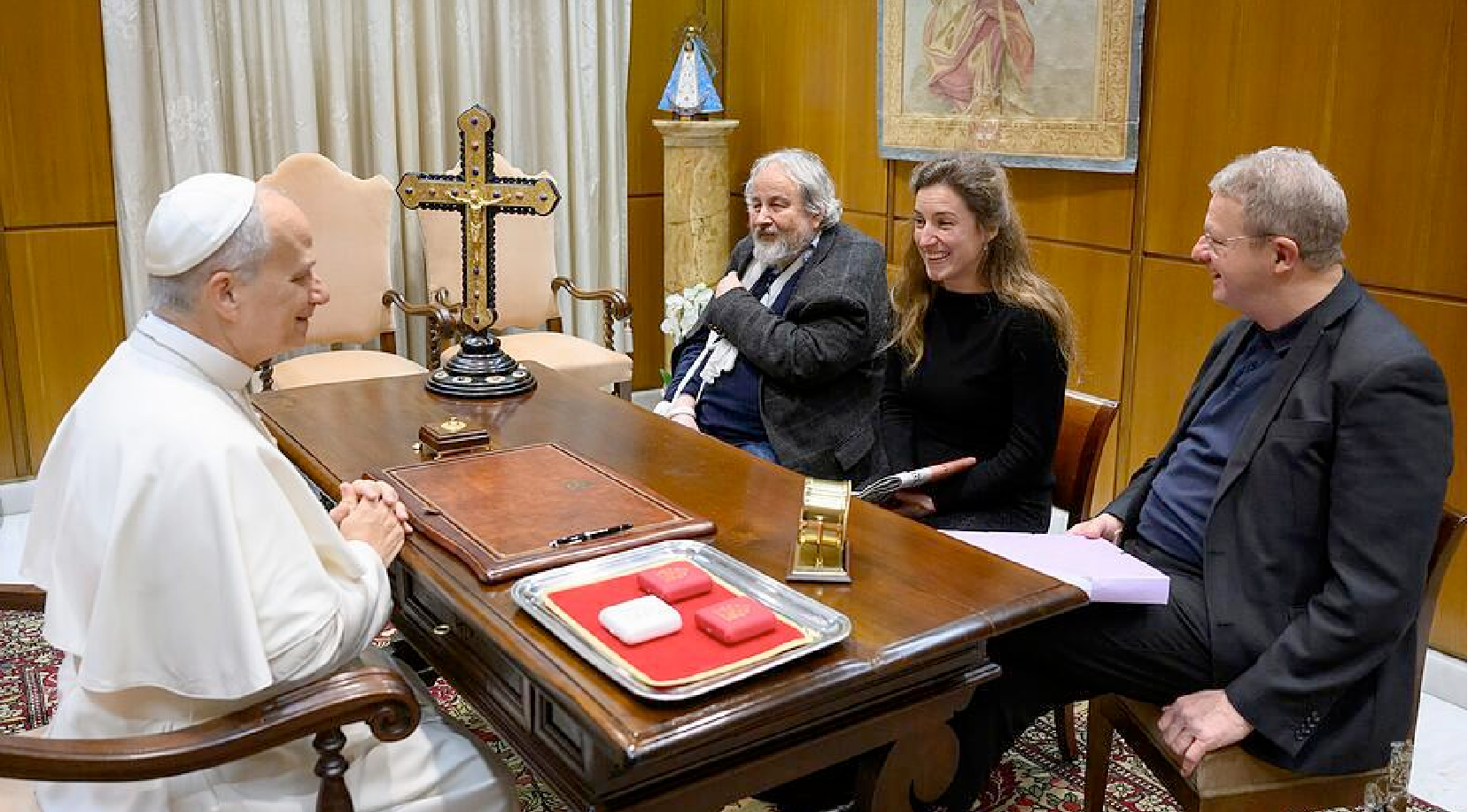
(ZENIT News / Rome, 01.27.2026).- A telling encounter took place in Rome on January 7, 2026—one that sheds light not only on the personal style of Pope Leo XIV, but also on the hidden tensions and unexpected hopes shaping Catholic life in Germany.
Just before his first general audience of the year, the Pope welcomed three German Catholic figures for a private, 20-minute meeting: Bernhard Meuser, founder of the global youth catechesis project Youcat and co-initiator of the reform-minded initiative Neuer Anfang (New Beginning); Martin Brüske, also from Neuer Anfang; and Franziska Harter, editor-in-chief of Die Tagespost. What began as a formal audience quickly became something more personal.
Those present describe Leo XIV as disarmingly approachable. Meuser and Brüske later remarked that everything written about the Pope’s openness and accessibility proved true in person. Within minutes, they said, the conversation shifted to a genuinely human level. The Pope listened attentively, spoke from experience, and offered clear judgments without sharpness—what they called a distinctly “American frankness,” paired with a conciliatory breadth of vision.
At the heart of the meeting was a 20-page document they had brought with them to the Vatican. It contained selected testimonies from German Catholics gathered through a campaign titled “Write to the Pope!”, organized jointly by Neuer Anfang and Die Tagespost. The response exceeded expectations: an avalanche of letters expressing gratitude for the faith, deep attachment to the Church, and growing anxiety over its direction in Germany—especially in relation to the German Synodal Way.
For readers outside Europe, the Synodal Way is a reform process launched by the German bishops and lay representatives in response to the abuse crisis. It addresses issues such as Church governance, sexual morality, priestly life, and women’s roles. While promoted by its leaders as a path toward renewal, critics argue it risks drifting away from Catholic doctrine and universal ecclesial unity.
The letters presented to Pope Leo XIV reflect precisely that unease. According to Harter, they give voice to believers who feel sidelined by official Church structures: Catholics deeply loyal to tradition and doctrine, yet longing for renewal rooted in the Gospel rather than in parliamentary procedures or cultural accommodation.
Harter said it was particularly important for her that the Pope hear from young Catholics passionate about evangelization and troubled by the direction taken by many German bishops. Leo XIV confirmed what he had already stated during a press conference on his return flight from Lebanon: he knows that many Catholics do not feel represented by the Synodal Way and that it does not express what they hope for in the Church.
The Pope’s response was both simple and striking. “Put Jesus Christ at the center,” he told them. “That has been my message from day one. Let us strive together to be missionary disciples of Christ.”
He went further, reminding them that throughout Church history it has often been the laity who carried faith through periods of crisis. Then came a line that deeply moved his visitors: “You can be the future through which the Church moves forward.” Leo XIV added that initiatives like Neuer Anfang, along with platforms such as Die Tagespost and Youcat, give him real hope because they can make a tangible difference.
The delegation explicitly asked the Pope not to abandon these spiritually distressed believers. Leo XIV, who has repeatedly emphasized listening to unheard voices, assured them of his concern. Harter noted how encouraged she felt when the Pope stressed the importance of independent Catholic media continuing to speak openly.
The meeting was part of a broader pilgrimage to Rome involving around 100 participants from Neuer Anfang and Die Tagespost, who see the audience as a sign of hope for faithful German Catholics navigating an increasingly polarized ecclesial landscape.
Yet this Roman moment coincides with fresh sociological data that complicates the familiar narrative of inexorable secular decline.
A newly released survey on Christian life in Germany, conducted by the INSA polling institute on behalf of Die Tagespost, Neuer Anfang, and the Evangelical news agency Idea, reveals unexpected undercurrents. While church membership continues to fall, 8% of Germans say they could imagine joining—or rejoining—a Christian church. Among young adults aged 18 to 29, that figure doubles to 16, meaning roughly one in six is open to Christian affiliation. Even more striking: about one in seven Muslims surveyed said they could envision entering a Christian church.
The poll questioned 2,000 people, a standard sample size for nationally representative surveys in Germany. Although Catholics still report high exit intentions—around 24% say they are considering leaving—the novelty lies in asking non-Christians and former church members whether they might move in the opposite direction.
Harter urges caution in interpreting the Muslim data without deeper, targeted studies. Still, she notes that Germany appears to mirror trends seen elsewhere: younger generations show renewed interest in spirituality. More than half of Germans aged 18 to 29 say they believe in God, even if that belief does not always align with traditional Christian categories.
What distinguishes today’s young Christians, she explains, is intentionality. When asked whether their faith is visible in daily life, younger respondents answered yes more often than older generations. In other words, those who remain Christian tend to do so by personal conviction rather than inherited habit.
Digital culture plays a decisive role. Among under-30s, 61% report actively searching for religious content online or on social media. Muslims stand out in this digital religious engagement as well. Comparable studies in France show that nearly 80% of adult converts cite online content as decisive in their journey—suggesting similar dynamics may be unfolding quietly in Germany.
The survey also uncovered a phenomenon of “cultural Christians”: nearly one in five self-identified Christians says they do not believe in God but stay in the Church for its social, charitable, and cultural contributions. This attitude is more common among older generations. Younger people, by contrast, tend to draw sharper lines—either committing fully or leaving altogether—contributing to a growing polarization.
As for the Synodal Way, two-thirds of Germans, including Catholics, either do not know what it is or decline to express an opinion. Only 21% of Catholics view it positively, while 19% judge it negatively. The majority simply feels disconnected. For Harter, this confirms that the process does not represent most Catholics, despite claims to speak on their behalf.
Taken together, the Rome audience and the INSA survey sketch a paradoxical moment: institutional Christianity continues to weaken, yet beneath the surface there are signs of spiritual searching—especially among the young—and even among those outside the Church.
Pope Leo XIV’s message to his German visitors resonates in this context. Renewal, he suggested, will not come primarily through structural engineering but through missionary discipleship—and through lay believers willing to carry the faith forward.
Thank you for reading our content. If you would like to receive ZENIT’s daily e-mail news, you can subscribe for free through this link.

Publicaciones relacionadas:
 Leo XIV, China and attention to communities suffering for their faith
 One in three Mexican bishops will be replaced by Pope Leo XIV between 2026 and 2027
 The Middle East, the spread of war, and the position of the Pope and the Catholic Church
 Religion and Elections in the USA: Pew Research Reveals How Each Candidate Is Supported
