

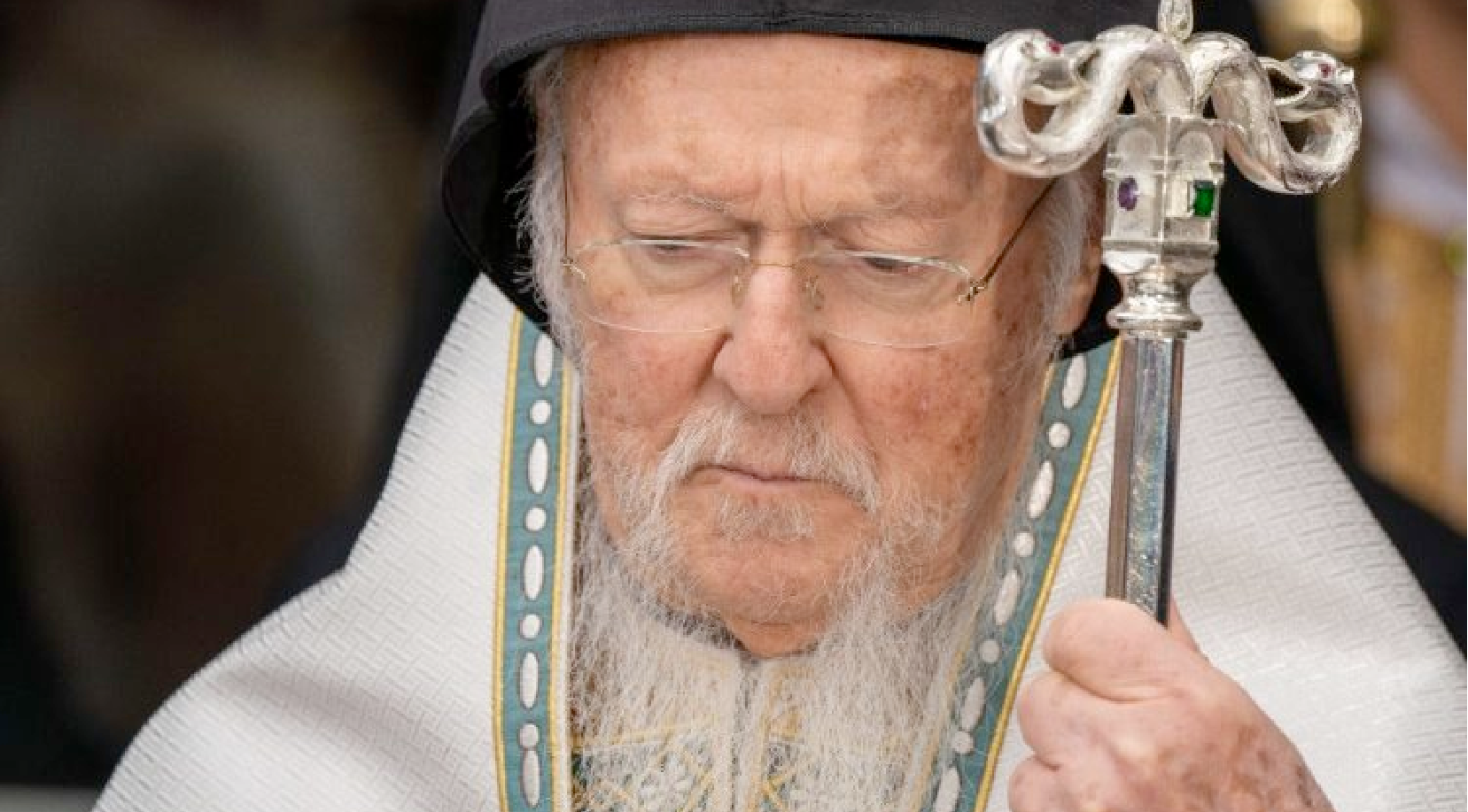
(ZENIT News / Moscow, 01.16.2026).- For decades, tensions between Moscow and Constantinople have simmered beneath the surface of the Orthodox Christian world. However, that long-running dispute crossed a threshold few observers thought possible. Russia’s Foreign Intelligence Service (SVR) issued a statement of extraordinary severity against Bartholomew I, Ecumenical Patriarch of Constantinople, accusing him not only of ecclesial sabotage but of acting as a geopolitical instrument backed by British intelligence.
The communiqué, published on the SVR’s official website, represents a rare and striking intervention by a state intelligence agency into explicitly theological territory. In language without precedent for a document of this kind, the Patriarch is branded the “Antichrist of Constantinople,” a term laden with doctrinal meaning and normally confined to polemical religious discourse, not the output of a modern security service.
At the heart of the SVR’s accusation lies the claim that Bartholomew is deliberately undermining Orthodox unity in order to weaken the Moscow Patriarchate. According to the Russian agency, this campaign began in Ukraine, where Constantinople granted autocephaly in 2019 to a new Orthodox Church independent of Moscow. Autocephaly, the right of a church to govern itself without external oversight, is one of the most sensitive issues in Orthodox canon law. Moscow has long argued that Constantinople overstepped its authority in Ukraine, while the Ecumenical Patriarchate maintains that it acted within its historical prerogatives.
The SVR now alleges that Ukraine was only the first stage. The statement claims that Bartholomew has shifted his focus to the Baltic states, specifically Lithuania, Latvia, and Estonia, where Orthodox communities have historically been linked to Moscow. According to the Russian narrative, Constantinople is seeking to detach these churches from Russian jurisdiction and replace them with new ecclesial structures dependent on the Fanar, the Istanbul district that houses the Ecumenical Patriarchate.
In unusually inflammatory language, the SVR asserts that this effort is being carried out with the help of local political forces, which it labels “nationalists” and “neo-Nazis.” The agency accuses Constantinople of enticing priests and faithful to abandon Moscow-aligned jurisdictions in favor of what it calls “artificially created puppet religious structures.” Such rhetoric closely mirrors the vocabulary Moscow has used in recent years to describe governments and movements in Eastern Europe that distance themselves from Russian influence.
The communiqué opens yet another front by alleging that Bartholomew intends to recognize the autocephaly of the Orthodox Church of Montenegro. That body is not recognized as canonical by the wider Orthodox world, and any move in its favor would directly challenge the Serbian Orthodox Church, a traditional ally of Moscow and a major religious presence in the Balkans. If realized, such a decision would deepen existing fractures in a region where church affiliation, national identity, and post-Yugoslav politics remain tightly intertwined.
What makes the SVR statement particularly remarkable is not only its content but its tone. The document concludes by returning to explicitly religious imagery, accusing the Ecumenical Patriarch of “tearing apart the living body of the Church” and likening him to “false prophets who come in sheep’s clothing, but inwardly are ravenous wolves.” The blending of intelligence analysis, political accusation, and biblical metaphor underscores how thoroughly the dispute has escaped the confines of internal church debate.
For seasoned observers of Orthodox affairs, the escalation confirms what has long been evident: the conflict between Moscow and Constantinople is no longer merely about canonical borders or historical privileges. It has become a proxy battleground for broader struggles over national sovereignty, cultural influence, and geopolitical alignment, particularly in Eastern Europe and the post-Soviet space.
That a state intelligence service would adopt theological language to denounce a senior Christian leader signals a profound breakdown in the traditional separation between ecclesial disagreement and statecraft. Whether intended as a warning, a propaganda exercise, or a calculated act of intimidation, the SVR’s intervention illustrates how deeply entangled religion and geopolitics have become in the Orthodox world—and how far the confrontation between Moscow and Constantinople is willing to go.
Thank you for reading our content. If you would like to receive ZENIT’s daily e-mail news, you can subscribe for free through this link.

Publicaciones relacionadas:
 South Korea: statistics show vitality of Catholicism, 11.3% of the population
 Pope receives Siro Malabar in audience at Vatican: addresses schism issue and calls for unity
 Brazilian police arrest woman who digitally harassed a priest: she created and distributed false material
 Legal dispute over Rio de Janeiro’s Christ the Redeemer statue: this is the solution proposed by the Senate
