

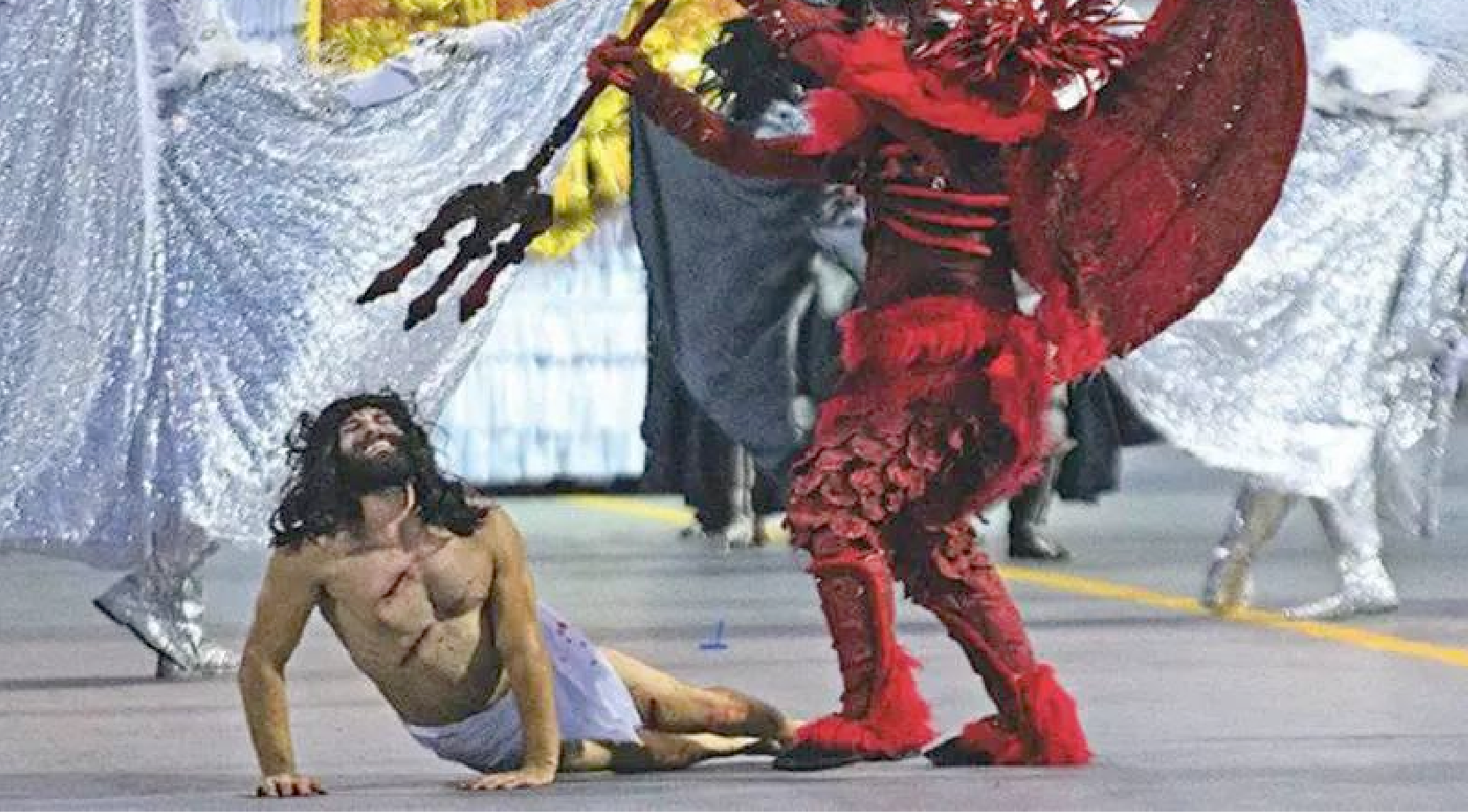
(ZENIT News / Salvador de Bahia, 02,.09.2026) – The Salvador de Bahia City Council in Brazil approved a bill on January 24, proposed by councilman Cezar Leite, establishing sanctions for those who dress up as nuns or Jesus Christ during Carnival celebrations.
The new law prohibits any form of direct or indirect, implicit or explicit attack against symbols of the Christian religion throughout the city. Its purpose is to curb actions against the Christian faith through the Program to Combat Christianophobia.
Educational activities that promote the rejection of the Christian faith are considered illegal, as are alliances with public bodies or civil and religious organizations that work to discredit Christian values. The law also encourages the creation of channels to report cases of Christianophobia, ensuring attention and support for victims.
The text of the law also prohibits artists or entities convicted of crimes of religious intolerance, with particular emphasis on Christianophobia, from being hired with public funds from the city of Salvador.
Councilman Cezar Leite commented after the approval: «The culture and expression of the Christian faith must be respected. The law will hold accountable and punish those who attack the Christian community, and those who use the image of Jesus or Christian symbols in a sensual, derogatory, or disrespectful manner, especially at events like Carnival.»
The approved bill received 35 votes in favour and only four against. The project now goes to the City Council and should be approved by Mayor Bruno Reis.
In recent years, similar bills have been introduced in several Brazilian cities. In Lauro de Freitas city, a similar measure was approved on January 21; in São Paulo, the law was passed in March 2025; in Maceió, Alagoas State, the measure came into effect in June 2024; and in Sete Lagoas, Minas Gerais, it was enacted in May 2025. The aim is to establish a Municipal Day to Combat Christianophobia. In Belo Horizonte, the capital of Minas Gerais, the Municipal Day to Combat Christianophobia was created in September 2025. None of these laws mention Carnival.
Pablo Almeida, of the Liberal Party, argued that there is a «growing wave of abuses and attacks against the Christian faith.» He described a video posted on social media by the city government during the 2025 Carnival that showed two attendees kissing: one dressed as Jesus and the other as the devil. He also mentioned a Carnival performance in which a participant allegedly impersonated Jesus wearing only underwear.
Cezar Leite also commented that Christianophobia is «a growing problem» and that Evangelicals, in particular, «have been the target of insults and discrimination in different social spheres.»
Father Lázaro Muniz, a longtime promoter of interfaith dialogue in Salvador de Bahia, asserts that a law against Christianophobia is unnecessary, given that 70% of the Salvadoran population identifies as Christian: «It’s not as if all Christians were being attacked.» He argues that an educational campaign to promote respect for all religious symbols would be a better approach, because «people need to use common sense. If a reveller shouldn’t dress up as an orisha (spirits of the Yoruba religion of West Africa) during a Carnival celebration, then costumes with Christian symbols should be avoided equally.» He added: «But the problem is that the backdrop for such actions is a revelry marked by obscenities. It’s an unfavourable context for the inclusion of any religious symbol.»
Father Muniz acknowledged that addressing these situations is not always easy: «Our biggest concern is the scandal. Some people might see someone dressed as a nun or priest during a Carnival parade who could be drinking alcohol or publicly kissing someone and… think that person is a real religious leader.» Bishop Vicente Ferreira of the Diocese of Livramento de Nossa Senhora, in Bahia, pointed out that Christians should be concerned about other types of abuse. «Instead of laws like these, intended to combat Christianophobia, we should be concerned about what truly wounds the Body of Christ, namely, the grave social injustice and environmental devastation caused by a system that puts profit before life.»

Publicaciones relacionadas:
 Mozambique: Famine, disease and thirst predicted due to Islamist terrorism
 Brazilian Supreme Court Allows Religious Dress in Official Document Photos
 Catholic Church Sues American Government: Goes to Court for Restrictions on Visas to Priests
 Nicaragua will be left without nuns and religious: government expels them all and sets date for their departure
