

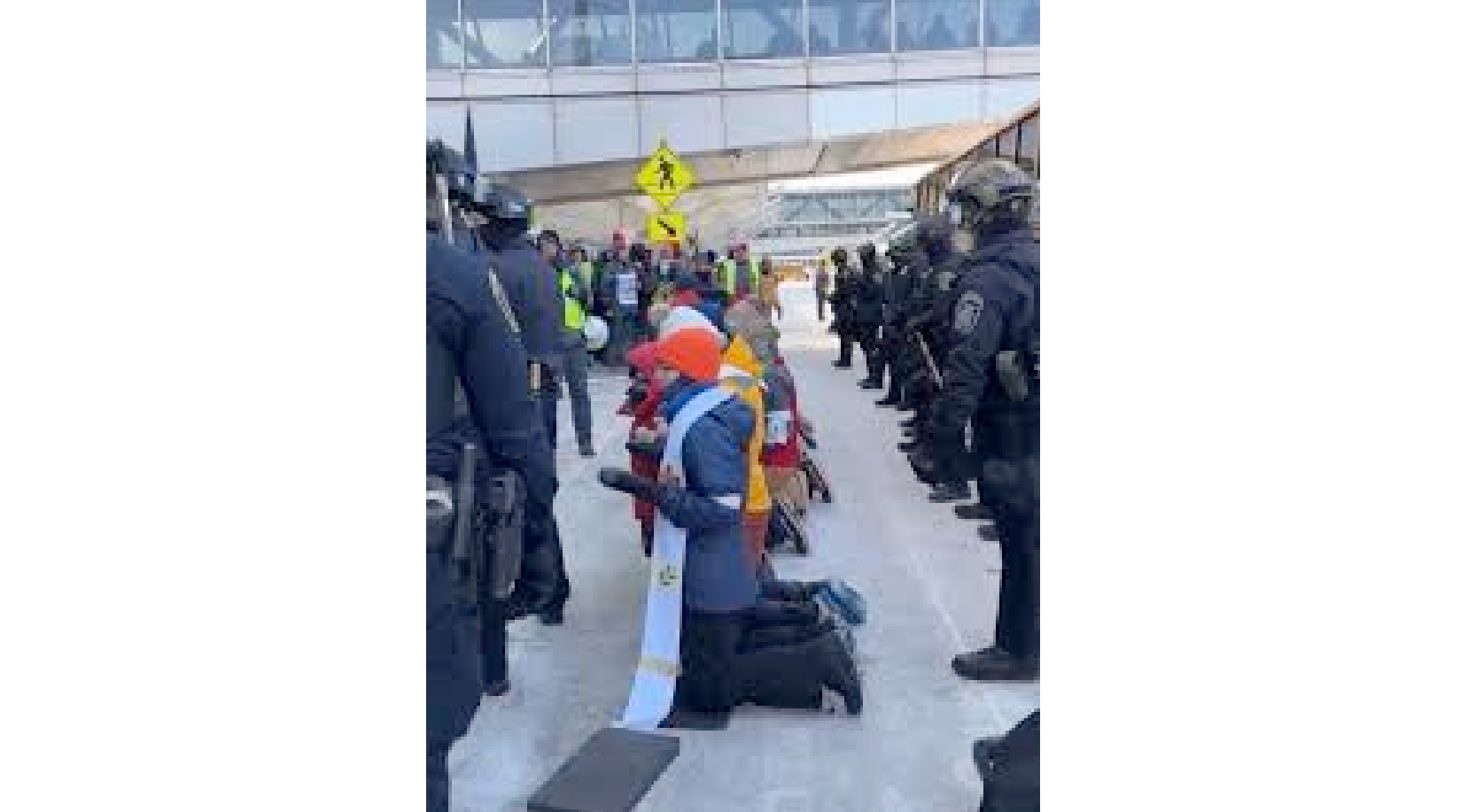
(ZENIT News / Minneapolis, 01.29.2026).- Kneeling on frozen pavement, singing hymns and reciting the Lord’s Prayer in subzero temperatures, nearly 100 members of the clergy allowed themselves to be handcuffed and led away at Minneapolis–St. Paul International Airport. For many of them, it was a deliberate act of conscience — a public line drawn against what they see as a brutal escalation of immigration enforcement under President Donald Trump.
The arrests came during a day of coordinated protest across Minnesota dubbed the “Day of Truth and Freedom,” a grassroots mobilization urging residents to boycott work, school, and shopping in response to intensified Immigration and Customs Enforcement (ICE) operations. Thousands took to the streets despite Arctic cold, while hundreds of businesses in Minneapolis and St. Paul closed in solidarity.
Religious leaders — largely Christian pastors and ministers — gathered outside the airport terminal after alleging that planes were being used to deport detained migrants. According to organizers, the demonstrators knelt in prayer before police intervened. Airport officials later said the group exceeded the boundaries of its permit and disrupted operations, prompting arrests.
Among those present was Rev. Elizabeth Barish Browne, a Unitarian Universalist minister who traveled from Wyoming. “What’s happening here is plainly immoral,” she said. “Yes, it’s cold — but the most dangerous ice isn’t the weather.”
Her words captured a broader mood spreading across Minnesota: a mix of anger, fear, and moral urgency.
A general strike atmosphere
Minneapolis has become the epicenter of a widening confrontation between federal immigration authorities and local communities. Protesters marching under the slogan “ICE Out” flooded downtown streets, defying temperatures below minus 20 degrees Celsius. The demonstrations intensified after the January 7 killing of 37-year-old Renee Nicole Good during an ICE operation — followed weeks later by the death of Alex Pretti in another enforcement action.
These incidents have deepened outrage over what critics describe as increasingly aggressive tactics by federal agents. Reports of children being detained — including a five-year-old boy whose deportation was later blocked by a federal judge — have further inflamed public sentiment. Ecuador’s government formally requested information about one detained child through diplomatic channels, seeking assurances for his safety and well-being.
The U.S. House of Representatives has meanwhile approved a $64.4 billion funding package for the Department of Homeland Security, including $10 billion earmarked for ICE, in a narrow 220–207 vote. Seven Democrats joined Republicans in backing the measure.
At the same time, legal scholars are sounding alarms over an internal ICE directive reportedly authorizing agents to enter homes without judicial warrants — a move they argue violates Fourth Amendment protections and centuries-old prohibitions against warrantless searches on private property.
Even within an administration known for expanding executive power, experts say this guidance represents a striking departure from constitutional norms.
Churches under surveillance
The ripple effects extend far beyond protest lines.
Bishop Patrick Neary of Saint Cloud, whose diocese lies about 60 kilometers northwest of Minneapolis, says ICE activity has become a constant presence in parish life. “Agents are showing up near churches and knocking on doors in communities with large Latino populations,” he told Vatican media. “People are terrified of being arrested, handcuffed, and separated from their families.”
Saint Cloud, a city of about 70,000 residents, is home to a significant Somali population — roughly 13 percent. According to Bishop Neary, even migrant families whose children were born in the United States are being targeted. He describes confrontations during arrests and reports that community members have been labeled as culturally undesirable.
The consequences are immediate and tangible: people no longer going to work, skipping medical appointments, and staying away from worship services. Without income, many cannot pay rent or utilities. “They are in real distress,” the bishop said.
🇺🇸 ICE detiene a sacerdotes católicos que defienden a migrantes…
Entre los detenidos también están ministros de culto de otras confesiones cristianas pic.twitter.com/5MDjyOHDq6
— P. Jorge Enrique Mújica, LC (@web_pastor) January 26, 2026
Neary also warned that ICE agents now appear able to enter churches, schools, and private homes with administrative orders rather than court-issued warrants. “This represents a violation of freedoms we have long taken for granted,” he said, adding that many fear a broader collapse of the rule of law.
Still, he acknowledges a divided public. Some residents believe ICE is simply doing its job. But Neary cautions against viewing all migrants as criminals. “The United States has the right to defend its borders,” he said. “But people fleeing extreme poverty or violence also have the right to seek a better life. There must be balance.”
A city living in fear — and solidarity
That balance feels distant in Minneapolis, where Archbishop Bernard A. Hebda says daily life has been upended. In interviews with Catholic media, Hebda described how images of arrests and violence have driven many migrants — documented and undocumented alike — into hiding.
“They stop going to work, to the doctor, to the grocery store, even to Mass,” he said. Attendance in Latino parishes has dropped sharply, and some parents are keeping children home from school.
Yet alongside fear, Hebda sees compassion at work: neighbors delivering food, volunteers escorting children to class, priests and deacons bringing Communion to families afraid to leave their homes. Archdiocesan staff are working to educate parishioners about their legal rights while parishes organize practical support networks.
Hebda has also joined Minnesota’s six Catholic bishops in pressing lawmakers for solutions that go beyond enforcement. Through the Minnesota Catholic Conference, they are advocating for legal pathways for long-settled undocumented migrants, protections against family separation, and comprehensive immigration reform.
“Only by working together,” Hebda said, “can we restore genuine calm.”
Political pressure mounts
The crisis has now reached national political levels. After an armed assailant attacked Democratic Congresswoman Ilhan Omar during a public meeting on January 27 — reportedly using a syringe — questions intensified about security and the consequences of deploying large numbers of federal agents in urban neighborhoods.
Trump adviser Stephen Miller has acknowledged that federal authorities are reviewing whether ICE agents are complying with operational protocols.
But for many in Minnesota’s churches, the debate is no longer abstract.
From airport tarmacs to parish pews, faith leaders are placing their bodies on the line, framing resistance as a spiritual duty. Their message is stark: immigration policy is no longer just a matter of law enforcement — it has become a moral crisis playing out in sanctuaries, schools, and frozen streets.
And in Minneapolis, a city already scarred by past unrest, prayer has become protest — sometimes ending in handcuffs.
Thank you for reading our content. If you would like to receive ZENIT’s daily e-mail news, you can subscribe for free through this link.

Publicaciones relacionadas:
 Victory for children: Court says NY can’t shut down adoption provider for its Christian beliefs
 USA: 20 Prosecutors Against the FBI for Harassment and Prejudice Against Catholics
 Mozambique: Famine, disease and thirst predicted due to Islamist terrorism
 Archdiocese of Washington to lay off employees to address financial crisis stemming (in part) from McCarrick case
