

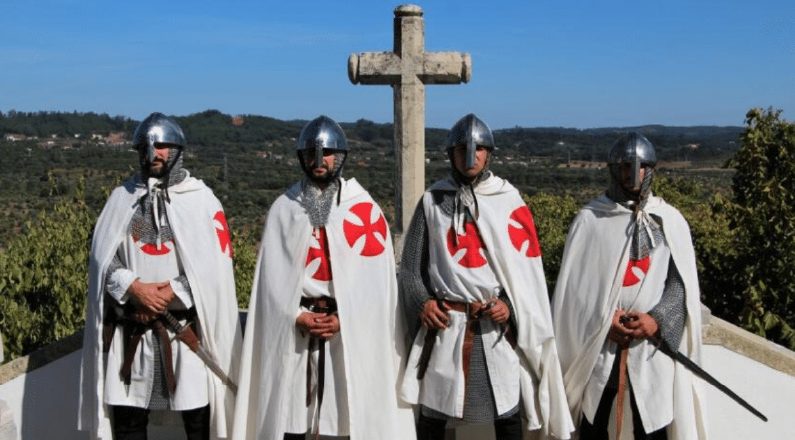
(ZENIT News / Madrid, 08.18.2026).- More than seven centuries after the Knights Templar disappeared from the medieval map of Europe, their name has resurfaced in an unlikely setting: the Spanish courts, where a modern association claiming to continue the historic order has initiated a legal move directed at Pope Leo XIV.
The Sovereign Order of the Temple of Christ, an organization not recognized by the Catholic Church, has filed a request for conciliation concerning the Pope through the Apostolic Nunciature in Spain and the Spanish Ministry of Foreign Affairs. Its objective is nothing less than a revision of the historical fate of the medieval Knights Templar and the restoration of what the organization considers to be rights lost with the order’s suppression.
The initiative is remarkable not because the Catholic Church has reopened the Templar question, but because the association is attempting to use contemporary legal mechanisms to bring a dispute originating in the Middle Ages into dialogue with the Holy See.
The document, dated October 27, 2025, initially puts the financial claim at €1,000, while expressly leaving open a subsequent determination of the amount. The monetary figure, however, is almost incidental beside the wider demands contained in the petition.
At the center of the case is the suppression of the Order of the Poor Knights of Christ and of the Temple of Solomon. The modern organization presents itself as its heir and argues that Pope Clement V’s decision in 1312 was illegitimate, maintaining that the suppression took place under political pressure from King Philip IV of France.
The association wants the Catholic Church to revisit that decision and, among other consequences, recognize Templars who were persecuted or executed as martyrs of the faith. Its claim specifically includes Jacques de Molay, the order’s last Grand Master, whose execution has become one of the most enduring episodes in the history and mythology surrounding the Templars.
But the petition does not stop with historical recognition.
If its demands were accepted, the consequences would reach into the contemporary structure of the Catholic Church. The organization asks that a restored Templar order be placed directly under the Pope as a personal prelature. It also requests a private audience with Leo XIV, the convocation of a council to examine outstanding questions and access to Vatican archives concerning the medieval order.
Other requests are even more ambitious. The association seeks the return of the Church of the Vera Cruz in Segovia, the creation of a joint Church-organization commission to examine possible economic and moral compensation, recognition of a so-called Templar priesthood and authorization to establish oratories and chapels.
In other words, this is not simply a petition asking the Church to acknowledge a historical injustice. It seeks the reconstitution of an institutional presence within Catholicism.
That distinction is essential for understanding the significance of the case.
The medieval Knights Templar were a religious military order whose history belongs to a very different ecclesial and political world from today’s Catholic Church. Their suppression in the early fourteenth century followed years of conflict, accusations and political pressure. The modern association’s claim that it is the continuation of that order is, however, its own institutional position; the supplied material does not indicate that the Catholic Church recognizes such continuity.
The organization’s legal history also predates the current initiative. According to its own account, it has pursued various proceedings since 2005, including conciliation attempts and ordinary litigation in courts in Madrid, followed by additional appeals and lawsuits in 2023 and 2024.
The latest move is therefore being presented as the next stage in a campaign that has lasted more than two decades, rather than as an isolated gesture.
There is an intriguing irony in the strategy. The Templars were destroyed in a world in which royal power, ecclesiastical authority and legal jurisdiction operated according to very different rules. Their modern successors are attempting to revive the question through the institutions of the contemporary state: Spanish courts, the Foreign Ministry and the Apostolic Nunciature.
The legal terminology may be modern, but the historical claim is medieval.
The association also portrays its present-day mission as extending beyond the Templar dispute. In its August 2026 statement, it says it wants to place its institutional activity at the service of peace and civilians affected by current conflicts, specifically referring to the Palestinian population.
Whether that broader mission has any bearing on the historical claim is another question. The petition itself is fundamentally concerned with recognition, restitution and institutional rehabilitation.
And here lies the greatest obstacle to its ambitions: recognition by a secular registry is not the same as recognition by the Catholic Church.
The organization is legally constituted as an association and registered in Spain’s National Register of Associations under the Ministry of the Interior. That establishes its existence as a civil association, but it does not establish ecclesial recognition, canonical succession or continuity with a medieval religious order.
That distinction matters particularly in requests involving a personal prelature, priesthood, chapels or other structures within the Church. Such matters belong to the Church’s own canonical and institutional sphere and cannot be created simply through civil litigation.
For Leo XIV, therefore, the challenge is less about settling a medieval balance sheet than about determining whether there is any contemporary ecclesial question to adjudicate at all.
The petition nonetheless succeeds in doing something unusual: it has brought the memory of the Knights Templar back into a formal legal setting, with a modern organization asking the Pope to reopen a chapter closed more than 700 years ago.
Its initial claim may be only €1,000. Its historical ambitions are vastly larger.
Thank you for reading our content. If you would like to receive ZENIT’s daily e-mail news, you can subscribe for free through this link.

Publicaciones relacionadas:
 Are you or do you know someone who is having suicidal thoughts? Here is what Pope Leo XIV has to say about it
 Here you can watch the new documentary about Pope Leo XIV released by the Vatican for free
 Pope Leo XIV opens the Vatican to Hollywood with an audience attended by these actors and actresses
 Mystical Phenomena and Holiness Explained by Pope Leo XIV
