

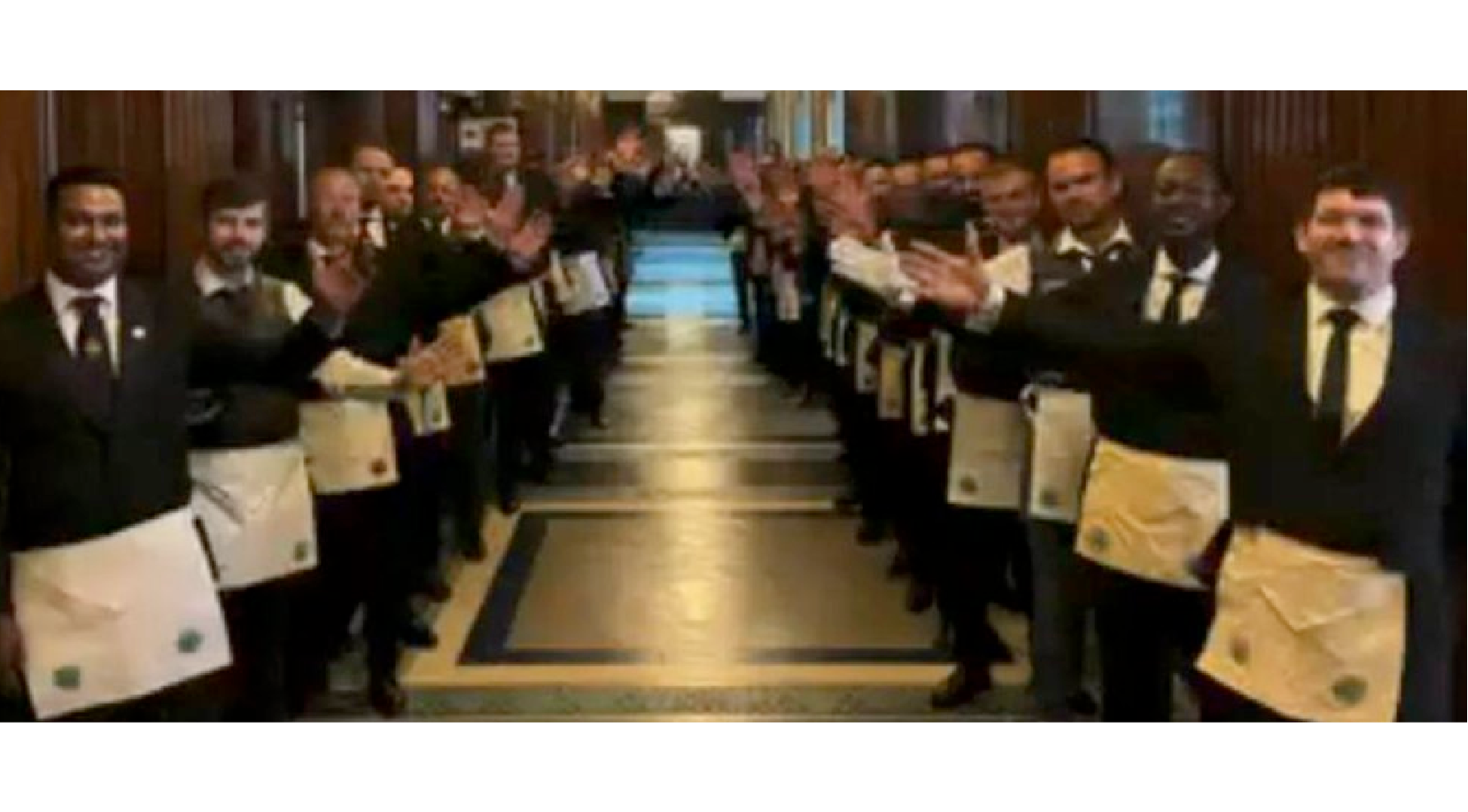
(ZENIT News / London, 01.27.2026).- For more than three centuries, Freemasonry cultivated its appeal through discretion, ritual, and selective invitation. In England and Wales, joining a lodge traditionally meant being noticed, vetted, and quietly ushered in by existing members. Today, that world is fading fast—and the numbers tell the story.
Membership has fallen from around 225,000 in 2008 to roughly 170,000 today. In less than two decades, nearly a quarter of British Freemasons have disappeared. Faced with this steady erosion, the United Grand Lodge of England (UGLE) has begun doing something that would have scandalized earlier generations: advertising.
Since 2021, recruitment campaigns on Facebook have become part of the organization’s survival strategy. That first digital experiment brought in about 1,000 new members and temporarily halted the downward slide. Encouraged by the results, UGLE repeated the initiative the following year—and has now launched another round, with at least eight lodges across different regions paying for online ads since early December, according to a recent report in The Telegraph.
The tone of the messaging marks a radical departure from Masonic custom.
Instead of waiting for a discreet approach, prospective candidates are now invited to knock themselves. A lodge in Buckinghamshire declares, “The door is open… don’t wait to be asked.” Others are even more direct: “Join the Freemasons,” “Be something incredible,” “Become part of a brotherhood.” One lodge in West Sussex pitches itself like a social club: “Looking for a new circle of friends? Fiscian Lodge would love to meet you.”
Adrian Marsh, secretary of the United Grand Lodge of England, describes the goal as reframing Freemasonry for a skeptical public. Speaking to The Telegraph, he said the campaigns aim to present it as “pleasant, traditional, fun,” and uniquely capable of offering “a completely inclusive, non-political and secular environment where individuals are treated equally regardless of race, religion, sexuality, or social background.”
Yet the obvious question remains: if Freemasonry is all this, why is it shrinking so dramatically?
Part of the answer lies in broader social trends. Across the Western world, voluntary associations—from churches to sports clubs—are struggling to attract long-term commitment. Younger generations are less inclined to join formal organizations, especially those demanding regular attendance and lifelong loyalty.
But Freemasonry faces an additional, more specific problem: the collapse of secrecy.
For centuries, the promise of hidden knowledge and privileged networks gave the lodges their mystique. That aura has largely evaporated in the age of Google. Historian John Dickie, author of a major study on Freemasonry’s influence on modern history, told NPR that secrecy has “lost much of its aura.” When anyone can learn the basics of Masonic rituals online in minutes, the sense of initiation into a guarded world fades.
A striking example emerged in late 2023, when a covertly filmed Masonic initiation ceremony in Arizona went viral. At the same time, memoirs by former Freemasons—such as Serge Abad-Gallardo (Why I Left Freemasonry) and Maurice Caillet (I Was a Freemason)—have found wide audiences. Both describe being drawn in by the idea of elite knowledge and discreet mutual support, only to discover that the “secret” often amounted to something far more prosaic: understanding who holds influence over whom.
That hidden network is now under unprecedented scrutiny in Britain.
In December, London’s Metropolitan Police instructed officers and staff to declare any past or present membership in organizations that are hierarchical, confidential, and require mutual support among members—a description widely understood to target Freemasonry. The directive follows years of internal controversy over alleged favoritism in promotions and claims that certain investigations were stalled or redirected under opaque pressures.
So far, 316 members of the Met have disclosed lodge affiliations.
The United Grand Lodge of England is attempting to block the policy through legal action, arguing that Freemasons have never objected to voluntary disclosure and that compulsory declarations violate human rights conventions. But critics counter that without transparency, public trust in law enforcement cannot be restored.
For some observers, this development cuts to the heart of Freemasonry’s recruitment crisis. If secrecy no longer protects influence—or even invites suspicion—then one of the traditional incentives for joining quietly disappears.
Against this backdrop, the Catholic Church’s longstanding opposition to Freemasonry offers a striking contrast of continuity.
Since 1738, when Pope Clement XII issued In eminenti apostolatus, Catholics have been forbidden to join Masonic lodges. Subsequent popes reaffirmed the ban, notably Leo XIII in Humanum Genus (1884), which warned that Freemasonry sought to undermine the Christian foundations of social order, and Benedict XIV in Providas Romanorum (1751), which criticized its secrecy and binding oaths.
The modern formulation came in 1983, when the Congregation for the Doctrine of the Faith—then led by Cardinal Joseph Ratzinger, later Pope Benedict XVI—declared that the Church’s negative judgment of Freemasonry “remains unchanged.” Catholics who join Masonic associations, the document stated, are in a state of grave sin and may not receive Holy Communion.
That position was reaffirmed as recently as November 15, 2023, when the Dicastery for the Doctrine of the Faith again insisted that Catholics cannot be Freemasons and urged pastors to respond to a perceived rise in Masonic interest among the faithful.
In other words, while Freemasonry experiments with Facebook ads and open-door slogans, the Church maintains a doctrinal line that has held firm for nearly three centuries.
The irony is hard to miss. An organization once defined by silence and selective initiation now competes in the digital marketplace of attention, pitching brotherhood like any other lifestyle choice. Whether this reinvention can reverse a 25 percent membership decline remains uncertain.
What is clear is that Freemasonry in Britain is no longer operating in the shadows. And in stepping into the light, it may be discovering that its greatest asset—mystery—has become its hardest thing to sell.
Thank you for reading our content. If you would like to receive ZENIT’s daily e-mail news, you can subscribe for free through this link.

Publicaciones relacionadas:
 Pope Francis to visit Verona, Italy, in 2024
 USA: Jews and Muslims support Catholics against LGBT law that imposes indoctrination in parish and school
 Pope’s Secretary of State Vindicates Value of Celibacy to 600 French Seminarians
 Bethlehem, Town of Jesus’ Birth, Will Not Be Celebrating Christmas: Here Is the Reason Why
