

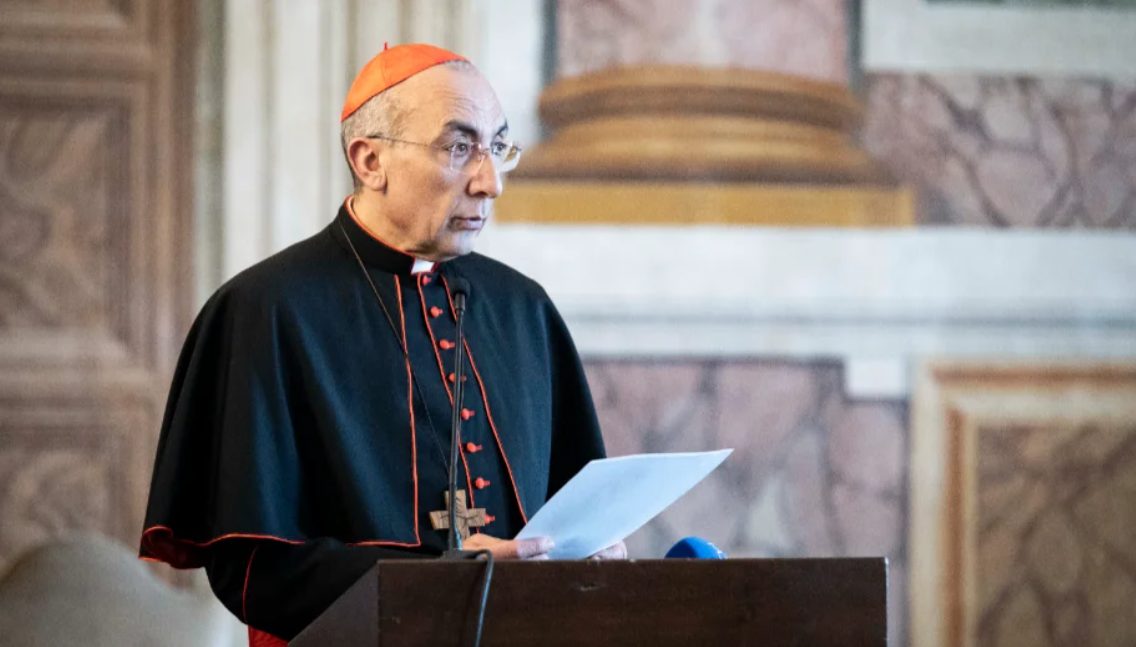
(ZENIT News / Rome, 08.15.2026).- Cardinal Baldassare Reina, the Pope’s Vicar for the Diocese of Rome, denied a funeral Mass for Bruno Battisti D’Amario, a guitarist long associated with musician Ennio Morricone and a former leader within the Grand Orient of Italy Masonic group. Elsewhere in Italy, the Bishop of Ventimiglia-Sanremo, Antonio Suetta, halted the funeral of Mario Tarducci, the Worshipful Master of a local lodge. The refusal to celebrate Catholic rites for Freemasons reflects Church discipline regarding ecclesiastical funerals, a discipline that is not clearly understood by everyone.
The family of Bruno Battisti D’Amario, who passed away on August 5 at the age of 88, requested that his funeral be held at the Basilica of Santa Maria in Montesanto, the traditional «Artists’ Church» located in the central Piazza del Popolo. Church officials were unaware of the deceased’s Masonic background and agreed to host the service.
The Grand Orient of Italy publicly acknowledged the guitarist’s membership in the press release announcing his death, declaring the «passing to the Eternal Orient of our dearly beloved brother and Master, Bruno Battisti D’Amario.» They also noted that Battisti D’Amario was a founder of the Grand Orient, had twice served as president of the Regional College of Worshipful Masters of Lazio, and had been a councilor of the Order.
The details that came to light led Monsignor Antonio Staglianò, Rector of Santa Maria di Montesanto, to consult Cardinal Baldassare Reina. Subsequently, the church’s Rector stated: «We verified the facts, including by speaking with the daughter, who unfortunately told us she knew nothing about this matter, but her father, as revealed by the Grand Orient of Italy, was a high-ranking Mason.»
In accordance with Cardinal Reina’s decision, only a simple prayer was offered, led by a priest not wearing liturgical vestments and attended by family members, to commend the deceased’s soul to God’s mercy. Staglianò clarified that the refusal to hold a funeral does not preclude the subsequent offering of Masses for the repose of the deceased’s soul.
In the Diocese of Ventimiglia-Sanremo in northern Italy, Bishop Antonio Suetta suspended the scheduled ecclesiastical funeral rites for Mario Tarducci at the parish church of San Marco in Camporosso, after it was revealed that Tarducci had belonged to a local Masonic lodge, where he had served as Worshipful Master.
The diocesan Bishop held talks with the parish priest and the deceased’s family before issuing a statement: «In light of a similar case that arose simultaneously in the Diocese of Rome, and sharing the same indicatiions given thhere by the Vicar of His Holiness me directives issued there by the Vicar of His Holiness, Cardinal Reina, the Bishop, in accordance with Canon 1184, has ruled that the scheduled ecclesiastical funeral rites shall not be celebrated.»
Canon 1184 of the Code of Canon Law outlines the circumstances under which ecclesiastical funeral rites must be denied. It stipulates that, unless the deceased showed signs of repentance before death, funeral rites must be denied to notorious apostates, heretics, and schismatics, as well as to «other manifest sinners, to whom ecclesiastical funeral rites could not be granted without public scandal to the faithful.»
The Holy See has repeatedly reaffirmed the application of this rule. Thus, in 1983, the Congregation for the Doctrine of the Faith issued a declaration regarding the new Code of Canon Law, which did not explicitly mention Masonic associations, stating: «The Church’s negative judgment regarding Masonic associations remains unchanged, because their principles have always been considered irreconcilable with the doctrine of the Church.»
In November 2023, the Dicastery for the Doctrine of the Faith issued a further statement, with the approval of Pope Francis, affirming that «active membership in Freemasonry by a member of the faithful is prohibited» due to the «irreconcilability between Catholic doctrine and Freemasonry.»

Publicaciones relacionadas:
 Nicaraguan Dictatorship Expels More Nuns: This Time the Religious of the Cross
 United States Bishops Are Preparing to Elect Their New Leadership in Mid-November
 Third Vatican Pronouncement on Apparitions: Negative for “Our Lady of All Nations”
 Plans to build more Catholic churches in Egypt as religious freedom returns
