

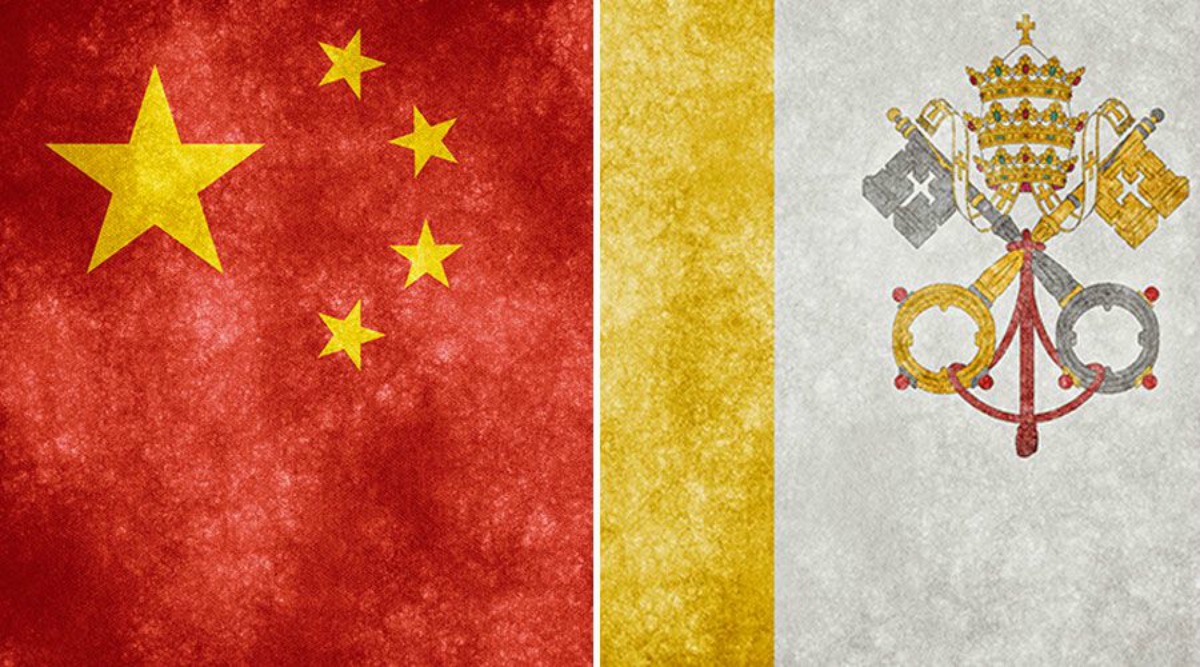
(ZENIT News / Rome, 12.08.2025).- The Vatican’s latest step in its delicate engagement with Beijing has come in the form of a transition that is being read in China’s Catholic communities in two sharply different ways: as a diplomatic success for the Holy See, and as a painful blow to those who have endured decades of clandestine worship under state pressure.
The Holy See announced that it had accepted the resignation of Bishop Joseph Zhang Weizhu, the long-persecuted leader of the Apostolic Prefecture of Xinxiang. His successor, Bishop Francis Li Jianlin, was ordained on 5 December in a ceremony that Bishop Zhang was forbidden by the authorities to attend. For some, the transition symbolizes a rare moment of cooperation between Rome and Beijing. For others, it underscores the vulnerability of the underground Church at a time when the state is tightening control over all religious activity.
Bishop Zhang, secretly ordained with papal approval in 1991 and never acknowledged by Beijing, has been out of public view since his arrest in May 2021. He was detained with several priests and seminarians under accusations of violating registration rules that compel clergy to join the state-controlled religious system. The others were released; Zhang was not. His whereabouts remain unknown.
Against this backdrop, the Vatican accepted his resignation at the age of 69—six years before the customary canonical retirement age. Within hours, Chinese authorities formally recognized him as a bishop, a gesture the Holy See immediately welcomed. Vatican spokesman Matteo Bruni described the government’s civil recognition of Zhang’s episcopal status as “a new and important step” in the Church’s efforts to build communion within the diocese. The Holy See framed the entire episode as a sign that the bilateral dialogue, though tested, continues to function.
The appointment of Bishop Li Jianlin, approved by Pope Leo XIV last August under the terms of the 2018 provisional agreement, reflects the mechanism the two sides have attempted to refine over several years. To date, roughly a dozen bishops have been appointed through this shared process, and Rome has retroactively recognized several others who were ordained without papal mandate but backed by the state. The Vatican insists that the arrangement remains pastoral in nature, seeking unity among China’s roughly ten million Catholics divided between the government-sanctioned hierarchy and the underground communities loyal to Rome.
Yet the handover in Xinxiang provoked anguish among some of those same underground Catholics. An anonymous priest from the prefecture, writing in AsiaNews, argued that the ordination “opens new wounds rather than healing old ones.” His concerns were concrete: the outgoing bishop remained in detention, unable to take part in the consecration, and his family still had no access to him. He accused the authorities of violating “the spirit” of the provisional agreement and lamented what he called a Church “forced into silence and humiliation.”
Such sentiments echo long-standing criticism from figures like Cardinal Joseph Zen, the retired bishop of Hong Kong, who has condemned the agreement as naïve at best and harmful at worst. He argues that it emboldens the government’s pressure on clergy who refuse to register with state religious bodies, while rendering Rome reluctant to speak out against violations of religious freedom. Human-rights organizations have reported a pattern of increased detentions, surveillance and harassment targeting unregistered priests and catechists, especially in regions where local officials seek to demonstrate zeal in enforcing religious policy.
Supporters of the Vatican’s approach counter that the alternative—sustained isolation—offers little hope of easing tensions or unifying a fractured Catholic community. The Holy See has maintained that each successful appointment represents incremental progress toward the broader goal of reconciliation within the Chinese Church, even if the circumstances surrounding those appointments remain fraught and uneven.
The dual reactions to the developments in Xinxiang capture the paradox of the Vatican–China relationship: painstaking diplomatic gains coexist with unresolved suffering on the ground. Bishop Li begins his ministry amid both official approval and underground skepticism; Bishop Zhang, now formally recognized but still unseen, embodies the unresolved burden of a community that has endured arrests, closures and marginalization for decades.
Whether the events of December ultimately strengthen trust or deepen mistrust within China’s Catholic circles will depend on what follows: the transparency of authorities regarding Bishop Zhang’s status, the degree of freedom Bishop Li will have to exercise pastoral leadership, and the willingness of both Beijing and Rome to treat the underground Church not as a security problem, but as part of a single Catholic flock.
Thank you for reading our content. If you would like to receive ZENIT’s daily e-mail news, you can subscribe for free through this link.

Publicaciones relacionadas:
 Attacks by Jewish settlers against our peaceful community must stop in Taybeh: note from Christian leaders in Holy Land
 A Bishop Denounces The Persecution of Catholics in Russian-Occupied Ukraine
 California’s Democratic government removes statue of Saint Junípero Sierra after lying about consulting the Archbishop of San Francisco
 Between Drones, Settlers and Classrooms: How Violence and Administrative Israeli Pressure Are Reshaping Palestinian Life
