

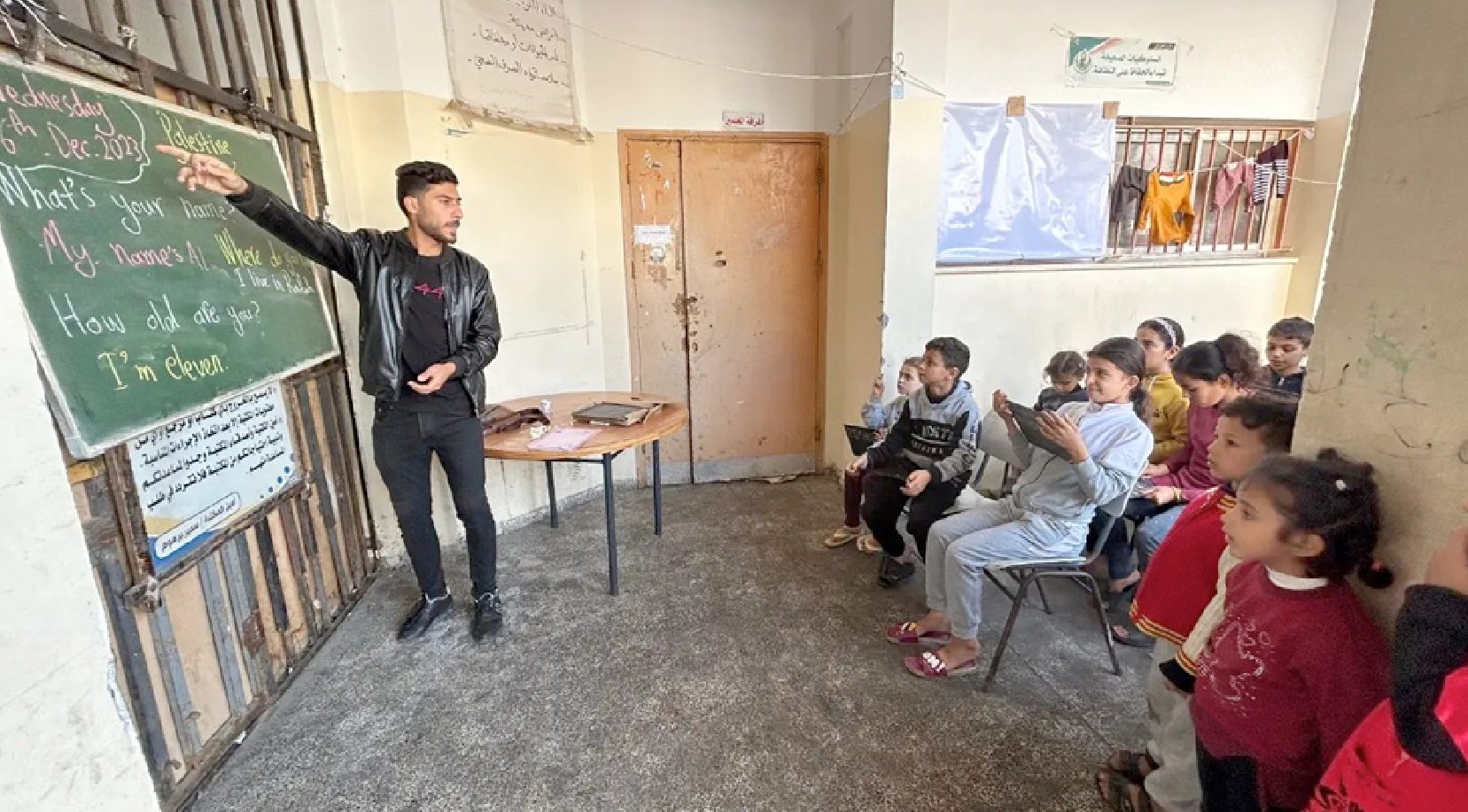
(ZENIT News – TerraSantaNet / Jerusalem, 01.27.2026).- The return to classes in January, after the Christmas holidays, did not happen for the 10,000 students at the Christian Brothers Schools in Jerusalem. Although the second semester was scheduled to begin on January 10, these 12 institutions, among the most prestigious in the Holy City, decided to protest the non-renewal of work permits for 171 of their teachers, who commute from the Occupied Palestinian Territories. The permits in question are temporary authorizations issued by the Jewish State to allow Palestinian residents from the West Bank to enter Israel and work there regularly. The permits are subject to security checks, have a limited duration, and are usually linked to a specific employer or a specific schedule. The vast majority were revoked after October 7, with the sole exception of those issued to teachers and healthcare professionals.
«The problems began last summer,» says Brother Daoud Kassabry, Director of the Christian Brothers Schools (De la Salle), one of Jerusalem’s most prestigious private schools. Israeli authorities revoked teachers’ permits from July 20 to August 20, claiming there were no classes. But the school isn’t operating because there are no students; on the contrary, there are summer camps and maintenance work to manage.
Few Teachers in Jerusalem
After August 20, permits were renewed, but only for a few months, expiring on December 30. «Only a few teachers received new permits, and in some cases, they don’t cover Saturday, which is a school day for us,» sighs Brother Daoud, whose Schools employs 70 teachers, 22 of whom come from the West Bank, especially from Bethlehem. «It’s difficult to find teachers in Jerusalem, so we recruit in Bethlehem, even though we know everything is more complicated.»
Christian Schools are classified by the Israeli Ministry of Education and the corresponding department of the Jerusalem Municipality as «recognized but unofficial institutions.» They are attended by Palestinian students, both Christian and Muslim, and follow the Palestinian curriculum (tawjihi) — with textbooks modified by the Israeli authorities — as well as international curricula.
Following the publication on January 10th of a statement by the General Secretariat of Christian Schools rejecting the arbitrary measures and affirming its inability to guarantee the smooth running of the second semester while these measures remained in place, the Israeli authorities have slightly eased the pressure. The permits for Palestinian teachers have been renewed, but only for five days a week, instead of the usual seven.
However, there are some exceptions. «Our academic coordinator, a sixty-year-old woman, was denied a permit on the grounds that she is not married and needs to renew her electronic identity document, even though it is still valid for six months,» explains Sister Lucy Jadallah, Director of the schools run by the Sisters of the Rosary, which employs 33 teachers from the Palestinian Territories.
Pressure on the School Curriculum
«We never receive explanations justifying these decisions, and we don’t even understand who makes them: the government? the army? the Israeli Ministry of Education?» laments the nun, who says she is considering ceasing to hire teachers from the West Bank. «We know that, ultimately, this is precisely what the Israeli authorities are seeking.» When contacted about the matter, the Ministry of Education has yet to respond.
The difficulties in obtaining permits highlight a long-standing conflict over the education provided to Palestinian students in East Jerusalem. Israel claims that the Palestinian curriculum contains hate speech and denies Israel’s right to exist. As a result, private schools face increasing pressure to adopt the Israeli curriculum (bagrut) as a condition for receiving subsidies, while their budgets are severely impacted by the war.
A bill submitted to the Knesset for consideration in 2025 aims to prohibit the hiring of teachers who have studied in the Palestinian Territories. Given that over 60% of teachers in East Jerusalem hold such qualifications, the measure poses a constant threat to educational institutions. «Our schools convey a message of peace, respect, understanding, and acceptance of others,» emphasizes Sister Lucy Jadallah. «We hope this message will be received with the same spirit and values on the other side.»
Translation of the Italian original into Spanish by ZENIT’s Editorial Director and, into English, by Virginia M. Forrester

Publicaciones relacionadas:
 Israel frees two young Christian women arbitrarily detained by Jewish regime
 Israeli Jesuit David Neuhaus: the plan to remove Palestinians from Gaza feels like a kick in the stomach
 Israel: ‘Netanyahu against NGOs, deadly attack on Israeli society’
 Between Drones, Settlers and Classrooms: How Violence and Administrative Israeli Pressure Are Reshaping Palestinian Life
