

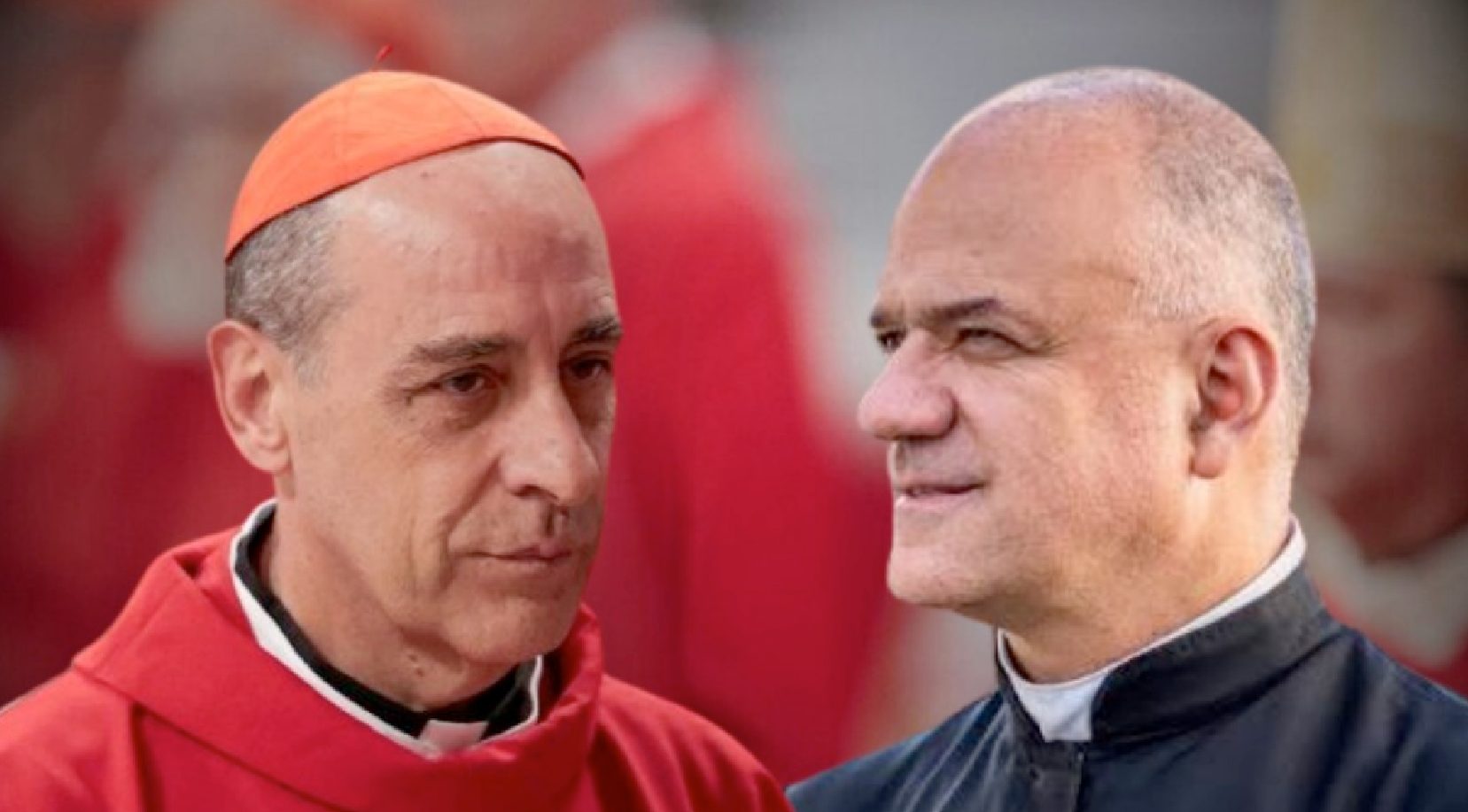
(ZENIT News / Rome, 02.05.2026).- In early February 2026, the Holy See confirmed that Cardinal Víctor Manuel Fernández, Prefect of the Dicastery for the Doctrine of the Faith, is scheduled to meet next week with Father Davide Pagliarani, Superior General of the SSPX. According to Vatican spokesman Matteo Bruni, the encounter is intended as an “informal and personal dialogue,” aimed at identifying concrete paths that might lead to “positive outcomes.”
The timing is anything but accidental.
Just days earlier, on February 2, Pagliarani announced that the Society plans to consecrate new bishops on July 1, 2026, at its International Seminary of Saint John Vianney in Flavigny-sur-Ozerain, France—whether or not Rome grants authorization. Under canon law, such consecrations without a papal mandate would automatically trigger excommunication for both the consecrating bishop and the men ordained, as occurred in 1988 when Archbishop Marcel Lefebvre carried out similar acts.
For the SSPX, however, this is not framed as rebellion but as necessity.
In an extensive interview published the same day, Pagliarani invoked a classic maxim of canon law—suprema lex, salus animarum (“the salvation of souls is the supreme law”)—to justify the decision. He argues that the Society faces what he calls an objective “state of grave necessity”: aging bishops, a growing global apostolate, and what he describes as the widespread collapse of doctrinal clarity and sacramental life in ordinary parishes.
“The faithful no longer find the means necessary for their eternal salvation,” he said, insisting that new bishops are required to guarantee confirmations, ordinations, and pastoral continuity for Catholics attached to traditional liturgy and teaching.
According to Pagliarani, he first wrote to Pope Leo XIV in the summer of 2025 requesting an audience, and followed up months later with a more detailed letter outlining the SSPX’s doctrinal disagreements but also its desire to serve the Church despite its irregular canonical status. A recent reply from Cardinal Fernández, he claims, failed to address the Society’s concrete proposals—chief among them a temporary arrangement allowing the SSPX to continue its ministry for the good of souls.
That response appears to have accelerated the Society’s decision.
At the heart of the conflict lies a theological fault line that dates back more than sixty years: the legacy of the Second Vatican Council (1962–1965). Founded in 1970 by French Archbishop Marcel Lefebvre, the SSPX rejects key conciliar teachings, particularly on religious liberty, ecumenism, collegiality, and the post-conciliar liturgical reform. Lefebvre famously denounced what he saw as the “Protestantization” of Catholicism and positioned his movement as a guardian of unaltered Tradition.
The rupture became public in 1974 with Lefebvre’s manifesto against Vatican II. Two years later, after ordaining priests against papal orders, he was suspended a divinis. The decisive break came in 1988, when he consecrated four bishops without Rome’s approval, incurring automatic excommunication for himself and the ordinands.
Yet even then, the Vatican avoided declaring the SSPX formally schismatic and continued to seek reconciliation.
Under John Paul II, limited concessions were made, including the 1984 indult allowing restricted use of the 1962 Missal. Benedict XVI went further. In 2007, through Summorum Pontificum, he liberalized access to the traditional Mass as an “extraordinary form” of the Roman Rite. Two years later, he lifted the excommunications of the four SSPX bishops, emphasizing that this was a gesture toward individuals—not institutional recognition of the Society, which still lacked canonical status.
Benedict also made clear that the real obstacle was doctrinal, not liturgical, famously stating that “the Church’s magisterium cannot be frozen at 1962.”
Talks continued until 2011, when Rome offered a path to regularization contingent on acceptance of a doctrinal preamble recognizing Vatican II and the legitimacy of the reformed liturgy. The SSPX declined.
Pope Francis adopted a different approach, privileging pastoral gestures over theological agreements. During the Jubilee Year of Mercy in 2015, he granted SSPX priests faculties to hear confessions validly; later he extended permission for them to witness marriages. But no doctrinal breakthrough followed. In 2019, the Pontifical Commission Ecclesia Dei was dissolved and its work absorbed into the Dicastery for the Doctrine of the Faith—an acknowledgment that the impasse was theological at its core.
Pagliarani, elected superior in 2018, has taken a harder line. He has publicly criticized the canonizations of recent popes, viewing them as implicit endorsements of Vatican II, and has sharply attacked synodality, the “kerigmatic” approach to evangelization, and recent pastoral decisions such as blessings for same-sex couples. He also singled out the 2019 Abu Dhabi declaration on religious pluralism, calling it incompatible with Catholic doctrine.
Liturgical tensions further complicate the picture. While Benedict XVI envisioned coexistence between the old and new rites, Francis reversed course in 2021 with Traditionis custodes, severely restricting the traditional Mass. Pagliarani argues that Cardinal Arthur Roche’s current liturgical vision—widely seen as aligned with Pope Leo XIV—treats the Tridentine rite as a temporary concession rather than a living expression of Tradition.
For the SSPX, this confirms that their marginal status is not accidental but structural.
Meanwhile, Rome appears intent on preventing a repeat of 1988. The upcoming meeting between Fernández and Pagliarani signals at least a willingness to keep channels open, even as both sides prepare for confrontation.
Pagliarani insists the Society has no intention of creating a parallel Church or granting jurisdiction to its bishops. He points to Rome’s pragmatic dealings with China—where bishops appointed by the government have been retroactively recognized—as evidence that flexibility is possible when authorities judge it pastorally expedient.
Whether similar tolerance could be extended to the SSPX remains an open question.
What is clear is that July 1, 2026, now looms as a decisive moment. If the consecrations proceed, the Church will face yet another painful chapter in a dispute that has endured for more than half a century—one rooted not merely in liturgical preferences, but in fundamentally different visions of authority, Tradition, and the meaning of Catholic continuity.
For now, Rome speaks of dialogue. The Lefebvrians speak of necessity. Between the two stands a Church still wrestling with the unfinished business of Vatican II.
Thank you for reading our content. If you would like to receive ZENIT’s daily e-mail news, you can subscribe for free through this link.

Publicaciones relacionadas:
 Pope’s Forthcoming and Important Changes in Dioceses Worldwide and in the Roman Curia
 About the Abuse of the Sacraments for Pastoral Motives: A Call to Attention and a Brief Catechesis of the Holy See for Priests
 Communion in the Hand or in the Mouth? Results Are Published of the Largest Survey in the U.S. on the Eucharist
 Vatican approves “Mayan Mass”: it does not change the content of the Mass, but the way of expressing it
