

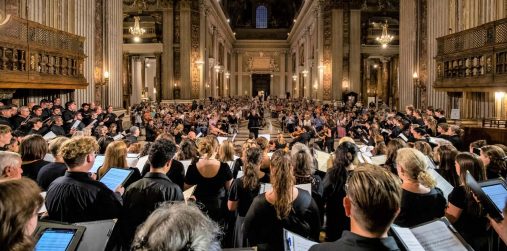
(ZENIT News / Rome, 08.17.2026).- Some arrive in Rome with a backpack, others with a Rosary in their hands, and some pack a musical score in their suitcase. All are pilgrims. In the Eternal City, the summer of 2026 is demonstrating that a pilgrimage can also mean offering one’s own talents, what each person knows how to do, in the service of others.
Music has become one of the expressions of this new way of making a pilgrimage. During the summer, various choral groups have arrived in Rome not only to visit its Basilicas and Holy Sites but also to sing in them and participate in the liturgical life of the Church.
One such example was the Rome International Choral Festival, held in June, which brought together singers and choirs from various locations. The program included participation in a Eucharistic celebration at one of Rome’s four Major Basilicas and a final concert at the Basilica of Santa Maria degli Angeli e dei Martiri.
The experience allows one to view Rome’s great churches in a different light. St. Peter’s, St. John Lateran, St. Mary Major, and St. Paul Outside the Walls are not merely monuments photographed by millions of tourists each year; for pilgrims, they remain places of prayer, celebration, and encounter with the living history of Christianity.
When Singing Is Also a Pilgrimage
The presence of choirs among the pilgrims arriving in Rome is not merely a cultural phenomenon. In June, L’Osservatore Romano noted the presence of the Church of the Assumption Choir from the United States among the groups attending a General Audience with Pope Leo XIV. The list also included pilgrims from Italy, England, Cameroon, Taiwan, the Philippines, Puerto Rico, and various U.S. dioceses.
This scene reflects a reality characteristic of Rome: people from diverse countries and cultures arriving in the same city to unite around a shared faith. For some, the pilgrimage entails passing through a Holy Door; for others, it involves attending Mass, receiving the Pope’s blessing, or praying at an Apostle’s tomb. For a singer, it may also mean using their voice as an act of service.
It is not simply a matter of giving a concert. Sacred music can become a form of prayer and, when integrated into the liturgy, a service to the entire community.
From Choirs to the Encounter with the Pope
The Roman summer also offered a particularly meaningful image of this relationship between music, pilgrimage, and faith.
On July 29, Pope Leo XIV welcomed more than 160 children to the Borgo Laudato Si’ in Castel Gandolfo; they had participated in the «Canticle of Peace» project, an initiative of the Andrea Bocelli Foundation. The young people came from areas marked by vulnerability and conflict, including the Holy Land, Uganda, and Italy.
Alongside Andrea Bocelli, they took part in an experience that transformed music into a language for speaking of peace, fraternity, and reconciliation. The gathering also marked the culmination of ten days of shared living and musical training.
The image is powerful: children and young people from vastly different backgrounds arriving in Rome and finding a common bond through song. Not everyone makes the pilgrimage in the same way, yet everyone has something to offer.
A City That Continues to Bring People Together
Rome remains a prime destination for those seeking to connect with the roots of their faith. Moreover, this summer’s pilgrimages demonstrate that the phenomenon is not limited to large, organized groups.
There are diocesan pilgrimages, parish groups, young people, priests, men religious, families, and even communities that find a way to live out their journey as a spiritual experience through specific activities, such as music.
The very presence of numerous international groups at the Pope’s Audiences reflects this diversity. Rome welcomes pilgrims from various continents, gathering them around the figure of the Successor of Peter.
In an era when travel has often become a form of tourism-based consumption, pilgrimage offers a different approach: it is not merely about arriving at a destination, but about allowing that place to transform the person who arrives.
Perhaps that is why some pilgrims arrive in Rome seeking silence, others seeking answers, and still others simply seeking to sing.
For in the Eternal City, even a voice can become a path.
After all, going on a pilgrimage does not always mean walking for miles. Sometimes, it means placing what we carry within us at the service of God and others. For some pilgrims, that path takes the form of prayer; for others, of service. And for those who arrive with a musical score in hand, it may take the form of song.

Publicaciones relacionadas:
 Order of Malta: Letter to the Pope about the Order’s Reform of Those Who Constitute 90% of the Workforce
 After Misunderstandings, Cardinal Koch and Leader of the German Bishops Meet in Rome
 Cardinal Pietro Parolin’s “Lectio Magistralis” to EWTN on Communication, Truth and Communion
 Pope Francis Goes to the Circus: Photos of a Parish-Pope Among Clowns and Trapeze Artists
