

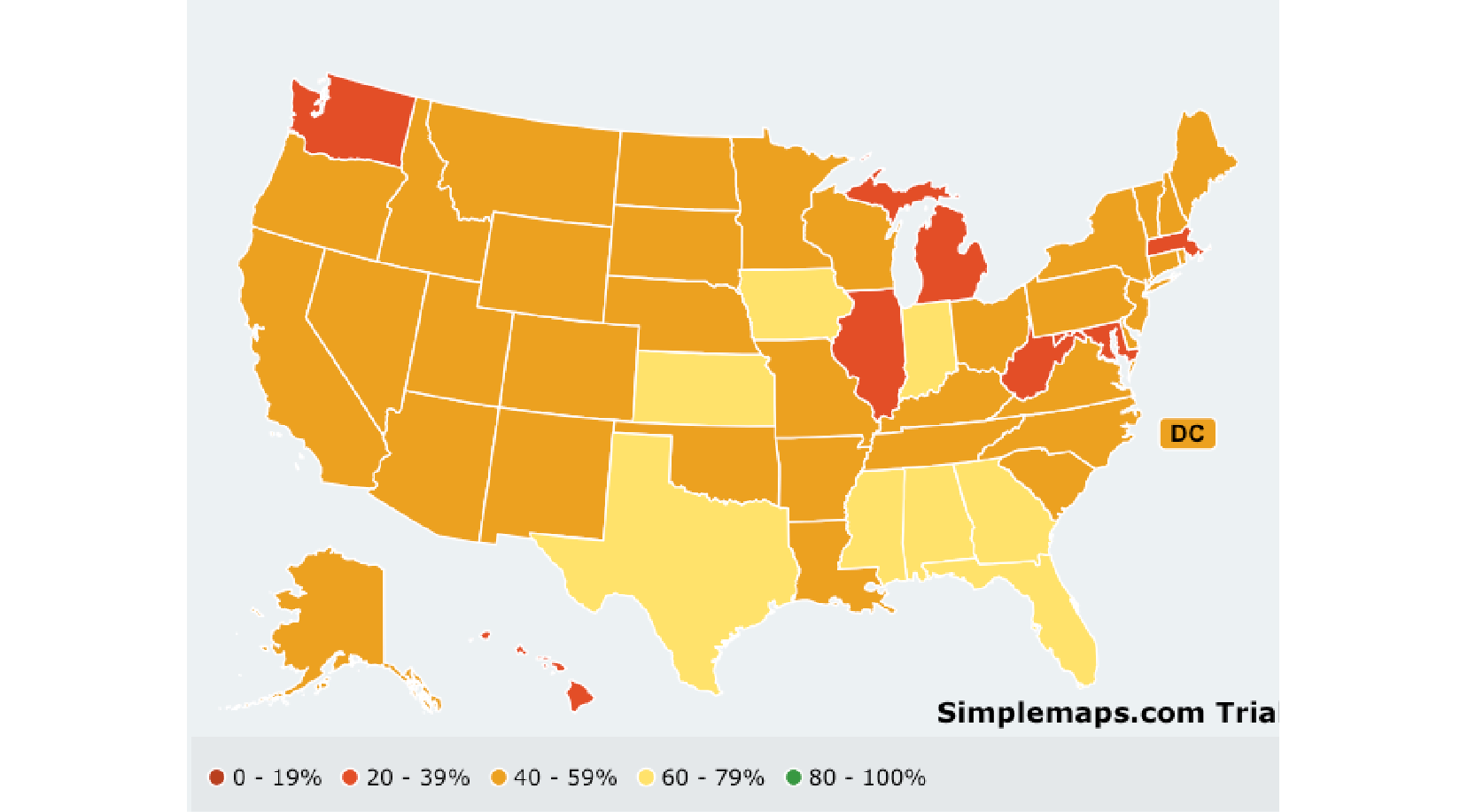
(ZENIT News / Washington, 10.30.2025).- A new national study paints a sobering picture of how the United States, long considered a global symbol of religious liberty, is struggling to uphold that principle at the state level. According to the Napa Legal Institute’s «2025 Faith and Freedom Index«, nearly three-quarters of U.S. states scored below 50 percent on religious freedom protections, signaling a growing disparity between constitutional ideals and everyday realities for faith-based organizations.
The findings, released on October 27, assess how well each state protects the right of religious nonprofits to operate according to their beliefs—an issue that gained renewed urgency during the COVID-19 pandemic, when restrictions on worship brought the balance between public safety and religious liberty into sharp focus.
At the top of the list stands Alabama, which received an 86 percent score and was praised for its robust legal framework safeguarding religious autonomy. Michigan, on the other hand, ranked last with just 22 percent, described by the report as “one of the most difficult environments in the nation for faith-based nonprofits.”
The index evaluates several dimensions of religious liberty: whether states ensure equal access to public funding for religious and secular groups alike, whether they provide legal exemptions from antidiscrimination laws when faith-based convictions are at stake, and whether constitutional or statutory protections extend beyond those guaranteed by the First Amendment. It also considers how states behave during emergencies—such as whether they disproportionately restricted religious services during lockdowns.
The results suggest an uneven national landscape. Six states—among them Michigan, Delaware, Washington, Maryland, Nevada, and Hawaii—scored below 30 percent, while another 19 states, plus the District of Columbia, failed to reach 40 percent. Only two states, Alabama and Kansas (79 percent), broke the 70 percent threshold.
According to Napa Legal, states like Alabama have implemented constitutional amendments explicitly strengthening religious freedom protections. The state also allows faith-based organizations to participate in public programs on equal footing with secular entities. Yet even Alabama is not without challenges: the report points to the lingering effects of “Blaine Amendments,” 19th-century provisions still present in several state constitutions that limit public funding for religious institutions.
By contrast, states at the bottom of the index often impose legal or bureaucratic barriers on faith-based nonprofits. Michigan, for example, provides no clear exemptions for religious employers under state antidiscrimination laws and restricts their eligibility for public grants. Maryland requires religious charities to undergo complex audits to maintain tax-exempt status, while Washington and Delaware show “unequal access” to public programs and funding streams.
“These laws risk excluding religious institutions from the charitable sector and reducing access to essential services for vulnerable populations,” the report warns.
Still, the Napa Index does not merely critique—it also offers a roadmap for reform. Kansas, Mississippi, Georgia, and Florida were highlighted as states that, while imperfect, have developed relatively supportive environments for faith-based groups. Mississippi and Georgia both scored 67 percent, showing significant progress in balancing civil rights protections with religious convictions.
Even in states with comparatively strong traditions of religious culture, the report urges vigilance. “There is always room for improvement,” it notes, emphasizing that protecting faith-based work means ensuring that public policy welcomes—not sidelines—the role of religion in civic life.
The findings arrive amid a national conversation over the boundaries of religious freedom, particularly as courts, legislatures, and advocacy groups grapple with the tension between expanding civil rights and respecting conscience rights. For many religious organizations, the report underscores what they already experience: that the freedom to serve according to faith is increasingly shaped not just by federal law, but by the politics and priorities of individual states.
Thank you for reading our content. If you would like to receive ZENIT’s daily e-mail news, you can subscribe for free through this link.

Publicaciones relacionadas:
 Poignant: Was the Departure of Mother Teresa’s Nuns, Expelled from Nicaragua by Daniel Ortega’s Regime
 Pope’s visit awakens fervor: Rosaries of 4,000 people in Papua New Guinea
 The Other Global Shortage: A Hundred Million Christians Still Waiting for a Bible
 World Jewish Congress Welcomes Pope Leo XIV’s Strong Condemnation of Antisemitism
