

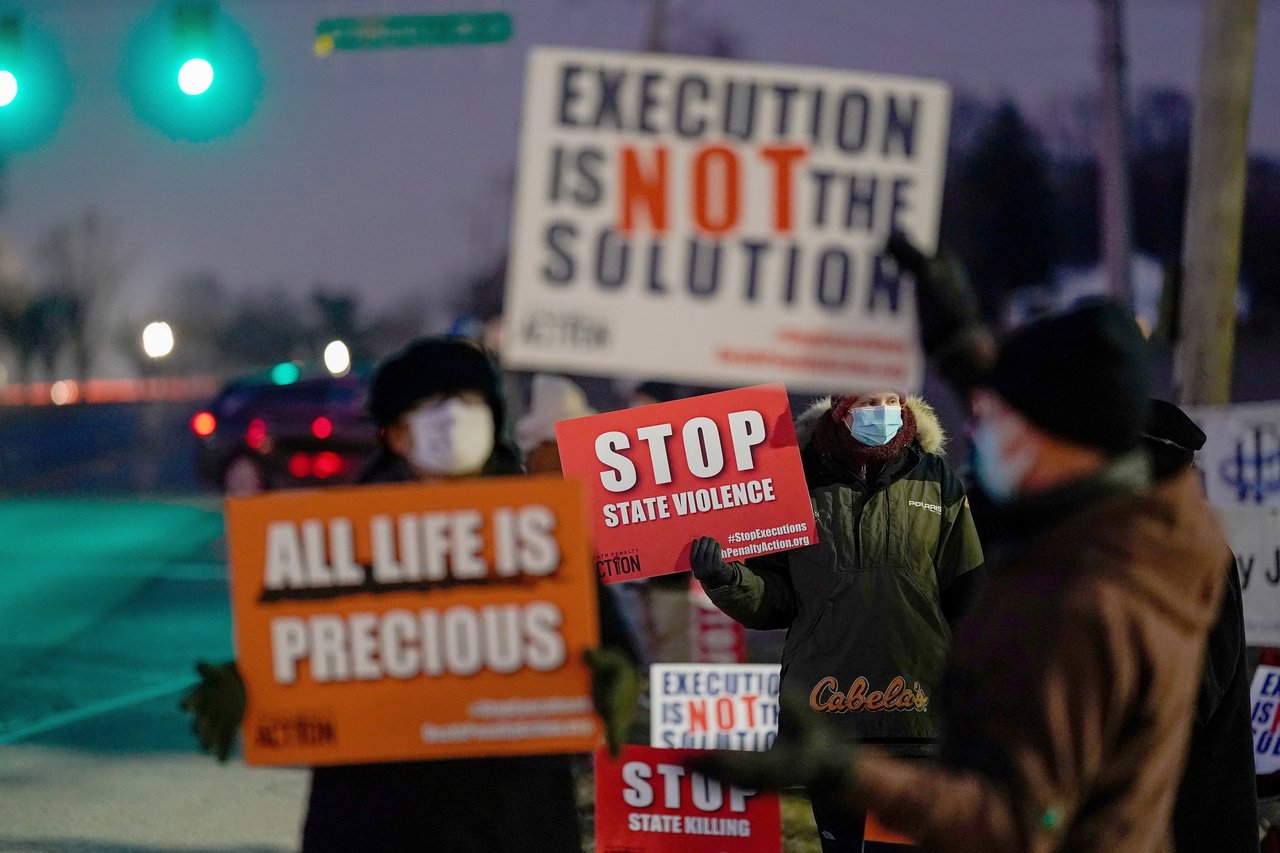
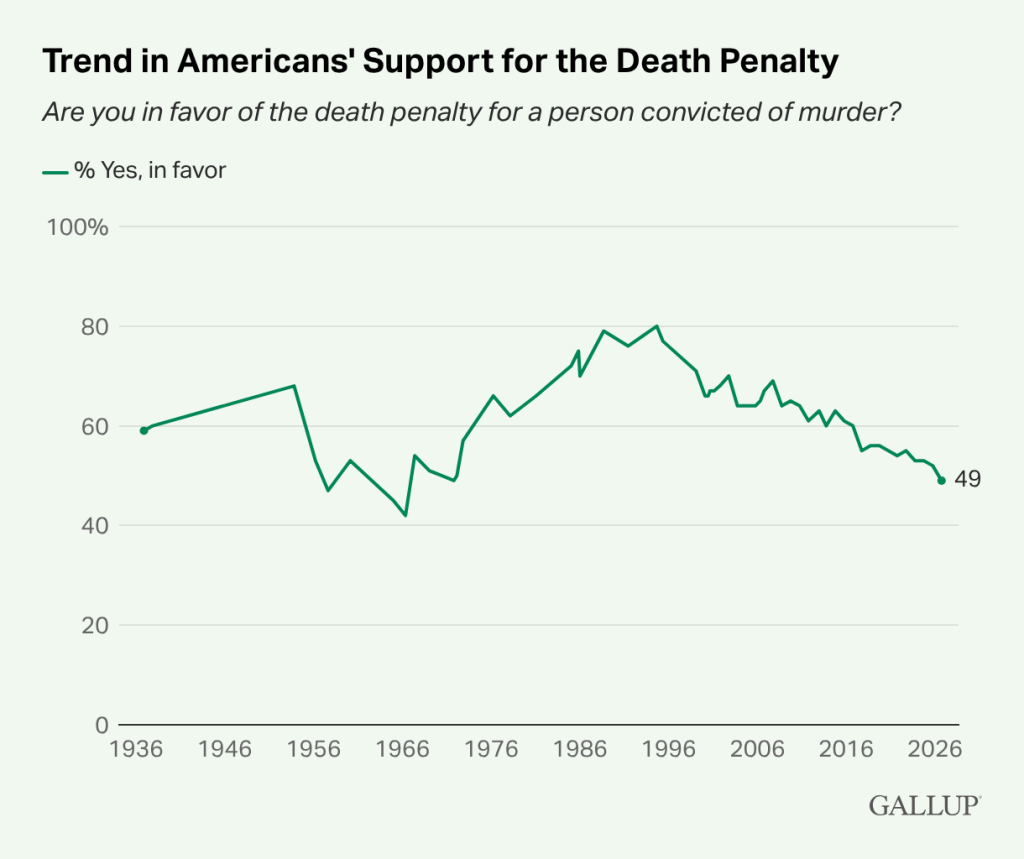
(ZENIT News / Washington, 11.16.2026).- For the first time since 1971, fewer than half of Americans support the death penalty, according to a new Gallup survey marking a significant shift in public attitudes towards capital punishment. The findings suggest that a practice long defended as an instrument of justice is losing ground, even among voters who have traditionally supported it.
The poll, conducted among 1,200 adults between October 1 and 19, found that 49% favour the death penalty for people convicted of murder, while 45% oppose it and 5% expressed no opinion. The margin of error is approximately four percentage points. Although Gallup described the result as statistically similar to last year’s 52% support, it represents the first time since 1971 that backing for capital punishment has fallen below the majority threshold.
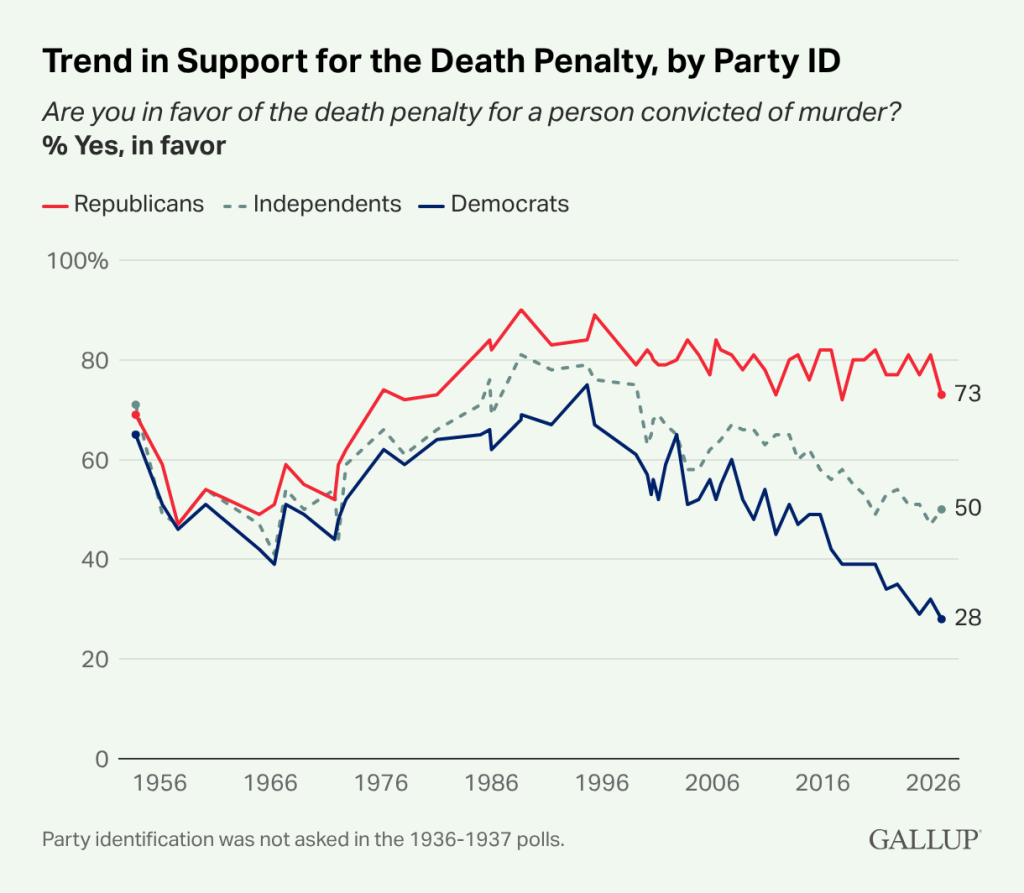
The longer-term trend is striking. Support reached 80% in 1994, but has declined steadily since then. The change is particularly pronounced among Democrats, whose support has fallen from 75% to 28% over the past 32 years. Among independents, it has dropped from 79% to 50%, while Republican support, although still substantially higher, has declined from 84% to 73%.
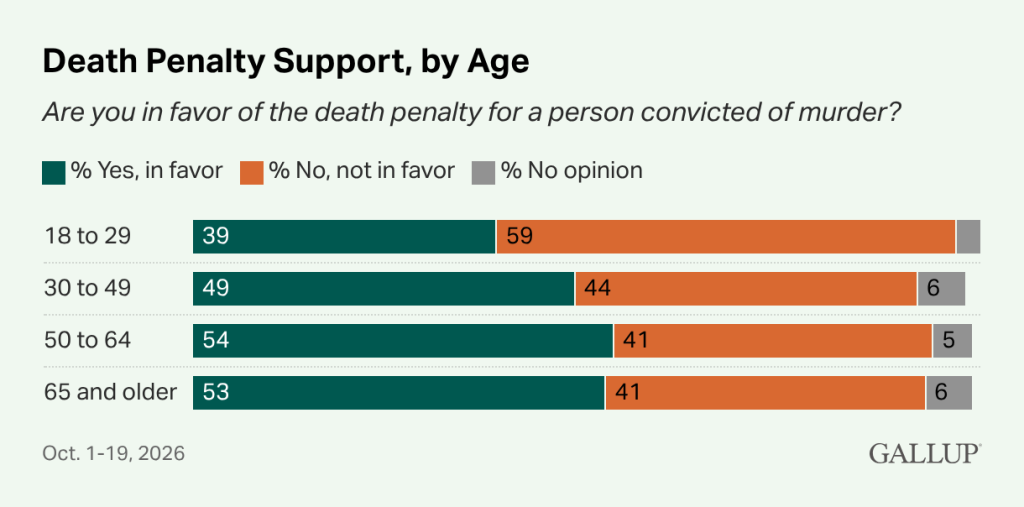
Generational differences are also evident. Only 39% of adults aged 18 to 29 support the death penalty, compared with 49% of those aged 30 to 49, 54% of people between 50 and 64, and 53% of those aged 65 and older. The figures suggest that younger Americans are increasingly reluctant to regard execution as an acceptable response to murder.
The results have been welcomed by Catholic organisations campaigning for abolition. Krisanne Vaillancourt Murphy, executive director of the Catholic Mobilizing Network, which works with the U.S. bishops in opposing capital punishment, described the decline across party lines as particularly encouraging. In comments to Catholic media, she argued that more Americans are questioning claims that executions deter crime or provide consolation to victims’ families.
The survey also comes amid renewed controversy surrounding the administration of the death penalty in the United States. Gallup’s fieldwork began the day after an attempted execution of Christa Pike in Tennessee failed. The state subsequently suspended executions while an investigation is conducted. During the same period, a proposal by Defense Secretary Pete Hegseth to broadcast the planned firing-squad execution of Nidal Malik Hasan, the perpetrator of the Fort Hood shooting, prompted widespread criticism. President Donald Trump ultimately cancelled the plan, which had also drawn objections from American bishops.
These episodes have sharpened questions not only about the morality of capital punishment but also about the way the state exercises its power over life and death. Laura Porter, executive director of the American Campaign to End the Death Penalty, said the latest figures pointed to a possible turning point in public opinion. She cited failed executions, opposition to the proposed live broadcast and the growing number of pardons granted by Republican and Democratic governors as signs of mounting dissatisfaction with the system.
The broader picture, however, is not entirely straightforward. A Pew Research Center survey published in July found that 66% of Americans supported the death penalty for people convicted of murder, including 65% of Catholics. Gallup’s latest figure is considerably lower. The results should not be treated as directly interchangeable without taking account of the questions asked and the timing of the surveys: public attitudes can vary according to how capital punishment is presented and the circumstances surrounding the question.
For the Catholic Church, opposition to the death penalty is not simply a response to changing public sentiment. It rests on the dignity of every human person, including those convicted of grave crimes, and on the conviction that modern societies possess means of protecting their citizens without taking the life of an offender. In 2018, Pope Francis revised the Catechism of the Catholic Church to state that the death penalty is inadmissible because it attacks the inviolability and dignity of the person. The teaching calls for its abolition worldwide while recognising the responsibility of public authorities to defend society and pursue justice.
Pope Leo XIV reaffirmed that position in a message published on October 10, marking the World Day Against the Death Penalty. His intervention placed the issue within the Church’s wider defence of human life, rather than treating it as a matter confined to criminal justice policy.
The Catholic Mobilizing Network argues that the resources and attention devoted to executions would be better directed towards the families of murder victims, whose suffering often continues long after a trial has ended. Such an approach does not diminish the seriousness of murder or the need to hold perpetrators accountable. It asks instead whether justice is best served by another death, particularly when executions can compound trauma and when the possibility of irreversible error remains.
Gallup’s figures do not establish that Americans have embraced the Church’s position. They do, however, reveal a substantial erosion of confidence in capital punishment over three decades. With support now below 50% and opposition approaching it, the debate over whether the state should execute convicted murderers is entering a new phase in American public life.
Thank you for reading our content. If you would like to receive ZENIT’s daily e-mail news, you can subscribe for free through this link.

Publicaciones relacionadas:
 New Survey Reveals Growing Belief Among American Catholics in the Real Presence of Jesus in the Eucharist
 USA Succumbs to Gay Ideology: Data on Acceptance of Same-Sex Unions to 2024
 Vatican II and Dignitas Infinita, the last statement of the Doctrine of the Faith
 Transsexual Lia Thomas Loses Legal Battle: World Aquatics Impedes His Competing in the Women’s Category
