

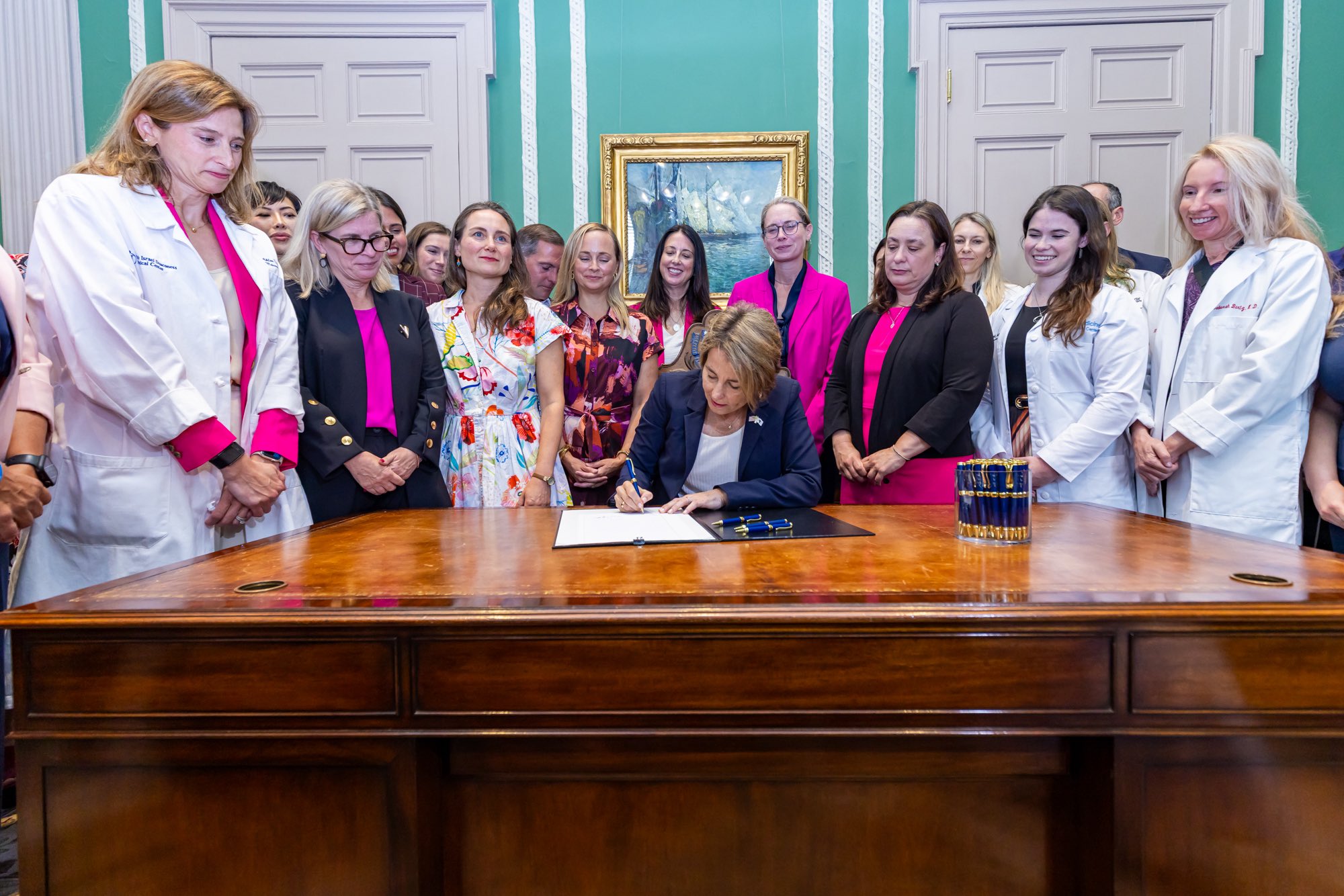
(ZENIT News / Boston, 08.11.2026).- Massachusetts has entered a new phase of America’s abortion debate after Governor Maura Healey signed legislation removing the state’s 24-week gestational limit, a decision that supporters hail as a safeguard for women facing complex pregnancies and that critics denounce as the effective legalization of abortion until birth.
The new measure, titled the Prioritizing Patient Access to Healthcare Act, takes effect on November 8 and fundamentally changes how late-term abortions will be regulated in the state. Under the previous legal framework, abortions after 24 weeks were permitted only under specific circumstances, including threats to the mother’s life or physical and mental health, or in cases involving severe fetal abnormalities or conditions deemed incompatible with life outside the womb.
Those statutory requirements have now been replaced by a standard centered on a physician’s professional judgment. The law also removes the requirement that later abortions be performed in hospitals, allowing qualified physicians to carry out the procedures in other approved healthcare settings.
For Governor Healey and the Democratic lawmakers who backed the reform, the legislation addresses situations in which families receive devastating medical diagnoses late in pregnancy and encounter legal uncertainty or barriers to care. State officials argue that decisions in such circumstances should remain primarily between patients and their doctors rather than legislators.
The governor pointed to cases in which Massachusetts residents had been forced to travel to other states for procedures that local hospitals declined to perform despite existing legal exceptions. One frequently cited example involved a woman who, at 33 weeks of pregnancy, learned that her unborn child had suffered a severe stroke and ultimately traveled outside Massachusetts to obtain an abortion because her case did not clearly fit the previous statutory criteria.
Supporters say the new law offers physicians greater clarity when confronting complicated medical situations. They portray the reform as part of a broader effort to ensure access to what they describe as reproductive healthcare following the 2022 U.S. Supreme Court decision that overturned Roe v. Wade and returned abortion regulation largely to individual states.
As long as I’m Governor, abortion will remain safe, legal and accessible in Massachusetts.
You have my word. pic.twitter.com/0PKw1ufQF5
— Governor Maura Healey (@MassGovernor) August 10, 2026
Yet the implications of the legislation extend far beyond rare medical emergencies, which is precisely why opponents have reacted so strongly. The text of the law does not limit the new standard to exceptional cases involving grave fetal diagnoses or life-threatening complications. Instead, it grants broad discretion to physicians and prevents medical review processes from overriding the judgment of the treating doctor regarding the provision of an abortion under the new framework.
As a consequence, pro-life organizations argue that Massachusetts has effectively authorized abortion throughout pregnancy. Myrna Maloney Flynn, president of Massachusetts Citizens for Life, warned that the legislation allows the termination of viable unborn children based solely on a physician’s determination. Other opponents described the law as one of the most expansive abortion measures enacted anywhere in the United States.
The controversy has also revived a larger international discussion. Advocates of stricter abortion limits frequently note that most European countries impose gestational restrictions well before the final months of pregnancy, even though public debate in the United States often portrays Europe as more socially liberal on abortion issues. Critics of the Massachusetts law contend that the state is moving in a direction increasingly uncommon among advanced democracies.
Statistics frequently cited by both sides illustrate why the issue remains politically charged. While the overwhelming majority of abortions occur during the first trimester, tens of thousands of abortions are still performed annually in the United States after 15 weeks of pregnancy, and several thousand take place during the later stages of gestation. The precise reasons for these later procedures remain the subject of ongoing political and medical dispute.
Beyond public policy, the Massachusetts decision has generated a distinctly Catholic controversy because of Governor Healey’s own religious identification. A baptized Catholic who met Pope Francis during a Vatican conference in 2024, Healey has long been one of the nation’s most prominent defenders of abortion rights.
That contrast has not gone unnoticed among Church leaders. Archbishop Richard Henning of Boston sharply criticized the legislation, calling it a serious offense against the dignity and sanctity of human life. The Massachusetts Catholic Conference had previously urged lawmakers to reject the bill, reiterating the Church’s teaching that every human life possesses inherent worth from conception until natural death.
The dispute highlights a recurring tension within American Catholicism: how the Church should respond when public officials who identify as Catholic actively support policies that directly conflict with Catholic moral teaching. Some Catholics have called for stronger disciplinary measures, while others favor continued pastoral engagement and dialogue. The debate is neither new nor limited to Massachusetts, but the latest legislation has brought it back to the forefront.
Thank you for reading our content. If you would like to receive ZENIT’s daily e-mail news, you can subscribe for free through this link.

Publicaciones relacionadas:
 UN attacks Africa for attitudes towards abortion
 Federal appeals court rules that doctors and hospitals in Texas are not required to perform abortions
 400,000 abortions and $2 billion in revenue: Planned Parenthood’s record year sparks outrage
 Abortion as an Ideological Weapon: The Vatican’s Denouncement
