

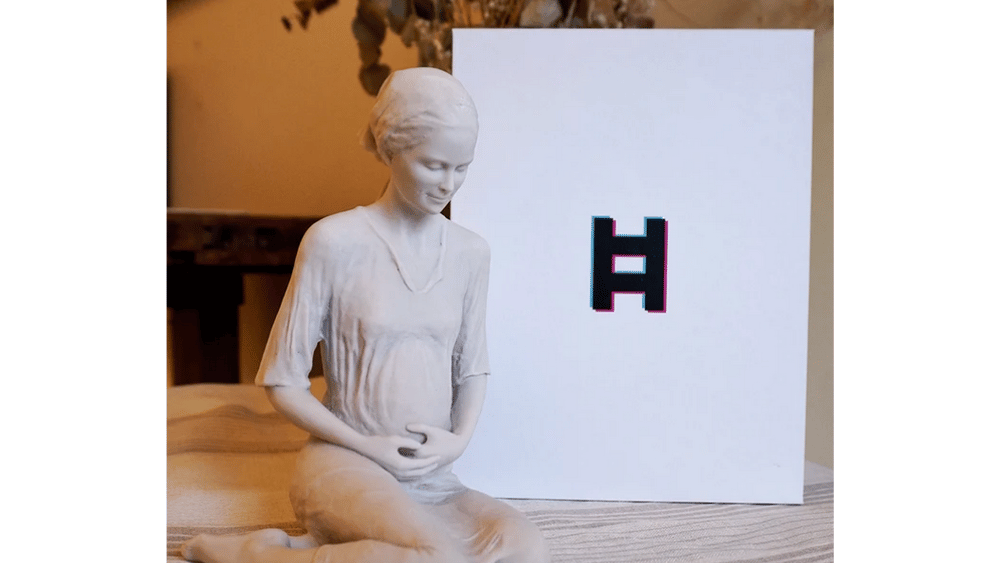
(ZENIT News / Madrid, 10.13.2026).- Spanish sculptor Javier Viver has taken legal action against the Hakuna Revolution Foundation over the copyright to a Marian sculpture, seeking a judicial ruling on the relationship between his original work and a second, similar image commissioned later by the organization. The dispute, which dates back to 2021, raises questions about artistic ownership and the protection of religious art without, Viver insists, challenging the devotion associated with either image.
The disagreement centers on Our Lady of Hakuna, a contemporary representation of the Virgin Mary commissioned by the foundation. Viver depicted Mary pregnant, seated on her heels and embracing her womb in a posture of Eucharistic adoration. The work reflected the spirituality of a movement that has become widely known in Spain for its gatherings and popular Catholic music.
Hakuna stopped selling Viver’s sculpture in 2021 and commissioned another artist, María Elisa Rivera, to create a replacement. The new work, officially titled Mother of Hakuna, also known as Mother of the Embrace, shares elements with the original. Hakuna’s website says the second sculpture was inspired by a painting of the same name by Matoya Martínez Echevarría, which was presented to Pope Francis during a meeting in Rome in 2018.
The central legal question is not simply that two sculptures represent the same religious figure, but whether the relationship between the works and the rights attached to them have been properly respected. Viver says the parties disagree over the connection between the two images and the rights each can claim. After years of discussions and unsuccessful attempts to reach an agreement outside court, he has concluded that a judicial decision is necessary.
For the sculptor, the case concerns a fundamental principle of artistic work: the recognition and protection of authors’ rights. Viver is an internationally recognized artist specializing in contemporary sacred art and has promoted projects including the Way of Art initiative and a proposal to build what its organizers describe as the world’s largest statue of the Sacred Heart of Jesus.
He has nevertheless been careful to separate the legal dispute from the religious significance of the sculptures. Viver says he bears no ill will toward Hakuna and does not intend to harm the foundation or the people involved in the movement. Nor does he want the proceedings to become a religious controversy or interfere with the devotional feelings associated with the image. He says he hopes the courts will clarify the situation fairly and respectfully, and plans to refrain from public comment while the case proceeds unless a response becomes necessary to protect his position or reputation.
Hakuna, for its part, has described the matter to Spanish media as technically complex and said its foundation is handling it. The organization has emphasized that both sculptures express its devotion to the Virgin Mary.
The foundation provides the legal framework for the projects of Hakuna, a private association of the faithful approved in 2017 by Cardinal Carlos Osoro, then archbishop of Madrid. The movement has attracted attention through its music and religious activities, but it has also faced criticism over the commercialization of faith and the lack of public financial reporting on income from merchandise and concerts. The available information does not establish how those criticisms relate to the copyright proceedings.
The current version of Mother of Hakuna is sold through the movement’s online store in several sizes, with prices ranging from €30 for a six-centimeter figure to €2,850 for a sculpture measuring 70 centimeters. Those sales make the question of rights particularly tangible, although the existence of a commercial market does not by itself determine the legal merits of the case.
The proceedings will have to establish the rights of the parties. In a dispute involving sacred art, those issues can easily become entangled: a work may carry deep spiritual meaning for a community while also remaining the product of an individual artist’s creative labor. Viver’s stated aim is to have the latter question resolved through the courts, without turning it into a confrontation over the former.
Thank you for reading our content. If you would like to receive ZENIT’s daily e-mail news, you can subscribe for free through this link.

Publicaciones relacionadas:
 Courage, a Catholic-Orthodox ministry that supports gay people, has filed a complaint against the Vatican Synod for slander and defamation
 UFOs, Demons, and Ecclesial Boundaries: Why Washington’s Archbishop Removed a High-Profile Exorcist
 Lefebvrians challenge excommunications and make Canon Law their new battleground
 Against the Unity Pope Leo XIV Seeks: Gestures and Words from Bishops That Fuel Polarization and Cause Confusion
