

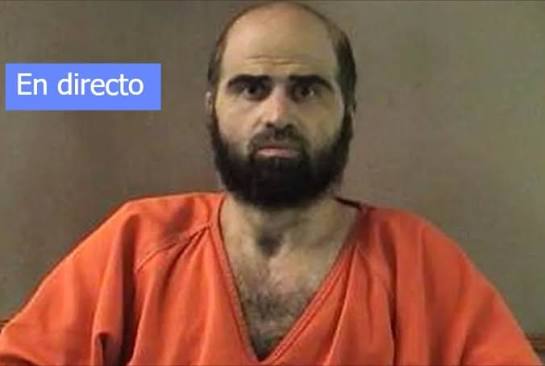
(ZENIT News / Washington, 10.13.2026).- The Pentagon’s plan to broadcast the execution of Nidal Malik Hasan, the former Army psychiatrist convicted of killing 13 people at Fort Hood, Texas, has provoked an unusually broad backlash, including from Catholic leaders who oppose capital punishment and critics who otherwise defend its use. With the firing squad execution scheduled for December 3, 2026, the controversy has expanded beyond the death penalty itself to a more fundamental question: should the state turn a condemned man’s death into a public spectacle?
Defense Secretary Pete Hegseth announced the plan to livestream the execution, arguing that public exposure would demonstrate the consequences of grave crimes. President Donald Trump authorized Hasan’s execution on October 2, following Hegseth’s recommendation. The Army subsequently confirmed the December date. If carried out, it would be the first execution by firing squad in the U.S. military since World War II and the first military execution since 1961, according to the reports cited in the debate. Further legal proceedings could still delay it.
Hasan was convicted in 2013 for the November 2009 attack in which he killed 13 people and wounded at least 31 others, with some accounts putting the number of wounded at 32. A police bullet left him paralyzed. Reports about his radicalization described his opposition to American military operations in Afghanistan and Iraq, his association with the radical imam Anwar al-Awlaki, and his stated desire to become a martyr. Critics of the livestream warn that broadcasting his execution could inadvertently serve that very ambition, turning his death into propaganda for extremists rather than a lesson in the consequences of violence.
The objections have reached the highest levels of the Catholic Church in the United States and the Vatican. On October 10, Pope Leo XIV reaffirmed the Church’s opposition to capital punishment, writing that the death penalty is inadmissible because it violates the dignity of the human person. He argued that public safety and justice can be secured through effective prison systems that protect citizens without entirely closing off the possibility of redemption for offenders.
The previous day, Cardinal Pietro Parolin, the Vatican secretary of state, had called the proposal to broadcast the execution unacceptable. He questioned the purpose of making a death available for public viewing and argued that capital punishment does not deter crime. Cardinal Blase Cupich of Chicago went further in condemning both the death sentence and its proposed transmission, describing the livestream as state-sponsored killing turned into spectacle. He warned that such exposure could encourage imitation, confer a form of martyrdom on Hasan, and reinforce the image of the United States as a violent and vengeful nation.
Archbishop Timothy Broglio, who oversees Catholic pastoral care for U.S. military personnel, issued a particularly consequential warning. After meeting with the Pope, Broglio called on any Catholic assigned to the firing squad to seek exemption from participating, comparing the moral objection to the one a Catholic would raise over involvement in an abortion. His statement also expressed solidarity with the families of Hasan’s victims; Broglio had presided over the funeral of one of those killed in the attack. He urged authorities to prevent young people and other impressionable viewers from seeing the proposed broadcast, questioning whether such a spectacle was compatible with the values the armed forces seek to represent.
Opposition is not confined to Catholic circles or political opponents of the administration. Some Republican lawmakers have raised concerns, while Vice President JD Vance has expressed reservations about the livestream and said he would not watch it if it went ahead. Conservative commentator George F. Will has also condemned the proposal. The controversy has therefore exposed a distinction often obscured in the American debate: support for imposing the death penalty does not necessarily imply support for displaying an execution to a mass audience.
There are also practical obstacles. Major social media platforms restrict graphic depictions of extreme violence, and military rules prohibit minors under 18 from attending executions in person. An online broadcast would make enforcing that age limit difficult. The proposal’s educational rationale is equally contested: showing a killing does not establish that the display will deter future crimes, particularly when the condemned man had expressed a desire for martyrdom.
Public opinion reflects a similar tension. A Pew Research Center survey cited in the debate found that 68% of Americans considered capital punishment morally justified for murder, while 59% believed it had no deterrent effect and 73% acknowledged the risk of executing innocent people, even years after a crime. These findings suggest that acceptance of the death penalty and confidence in its effectiveness are far from identical.
The Catholic argument also has a specific doctrinal history. In 2018, Pope Francis revised paragraph 2267 of the Catechism of the Catholic Church, declaring the death penalty inadmissible because it attacks human dignity and affirming the Church’s commitment to its worldwide abolition. The previous wording had acknowledged that traditional teaching did not exclude capital punishment when it was absolutely necessary, while emphasizing that such cases were extremely rare or practically nonexistent. Leo XIV’s latest statement reiterates the revised teaching, which places the possibility of redemption and the protection of human life at the center of the Church’s position.
The dispute has acquired further significance amid questions about the administration of executions themselves. In Tennessee, Christa Pike, who was sentenced to death for the murder of Colleen Slemmer, survived a lethal-injection attempt on September 30 after two doses of the drug were administered. She was returned to prison in serious condition, and her execution was ruled out until the end of the year. The episode has renewed questions about the methods and consequences of state executions, even as Hasan’s case raises a different issue: the decision to make a killing publicly viewable.
None of these objections diminishes the gravity of the Fort Hood massacre or the suffering of its victims and their families. The central issue is what the state intends to accomplish through punishment, and whether a global audience watching a man die would advance justice or merely normalize violence. The Pentagon’s proposal now confronts a challenge that goes beyond the mechanics of execution: whether a government can defend its moral authority by making death a public
Thank you for reading our content. If you would like to receive ZENIT’s daily e-mail news, you can subscribe for free through this link.

Publicaciones relacionadas:
 Vatican to open home for war widows and single mothers in Ukraine
 Irish Parliament Moves Closer to Legalizing Assisted Dying Despite Heated Debate
 European bishops call for EU Special Envoy for Religious Freedom
 3 cardinals on a prime-time TV show in the U.S.: They discuss Trump, the Pope, just war, and the surge in conversions
