

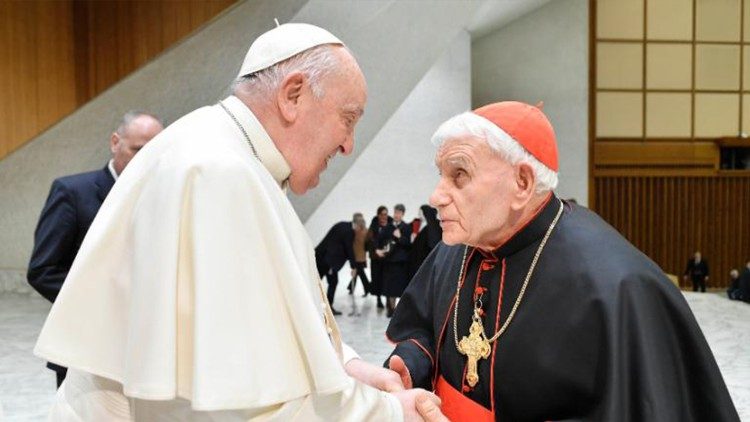
(ZENIT News / Rome, 11.26.2026).- The publication of Pope Francis’ personal diary has brought renewed attention to a subject that is rarely discussed openly in the Catholic Church: the reality of demonic activity and the ministry of exorcism. Among those offering a particularly striking response is Cardinal Ernest Simoni, the 98-year-old Albanian prelate who says he has spent seven decades confronting cases of alleged possession and who discussed the subject with Francis on several occasions.
In an interview with Italian journalist Nico Spuntoni, published by Il Giornale on November 25, Simoni said he was not surprised by the late Pope’s descriptions of encounters with the devil, including a voice he characterized as triumphant and a disturbing vision of what appeared to be the entrance to hell. “I have spent my whole life dealing with episodes like these,” the cardinal remarked, referring to the experiences recorded in Francis’ diary, which was published on November 24 by the Vatican Publishing House and contains personal reflections written between 1992 and 2024.
Simoni also recounted an experience of his own, which he said occurred at night about four years ago. He described seeing eleven condemned souls speaking Albanian and threatening to kill him because of his exorcisms. Among them, he claimed, was the commander of the communist prison camp where he had been held. According to his account, the Virgin Mary appeared and instructed him to invoke St. Pio of Pietrelcina, better known as Padre Pio. Simoni says he followed that instruction and was saved. The episode bears a resemblance to Francis’ account of finding protection by holding tightly to his rosary. For the cardinal, the rosary remains the most powerful spiritual weapon against satanic manifestations.
The revelations also shed light on a relationship between the two men that began well before Simoni received the red hat. They met in Asisi on September 20, 2016, when the then-priest spoke to Francis about his ministry and prayers of liberation. A few weeks later, the Pope announced his decision to make him a cardinal, formally creating him at the consistory of November 19. Francis had already heard Simoni’s testimony during his visit to Albania in September 2014.
Their conversations continued. During an audience in 2018, Simoni gave Francis several interviews with Father Gabriele Amorth, the renowned Italian exorcist who died in 2016. The material dealt with Lucifer. Simoni recalls that the Pope examined the interviews in silence, without commenting. On the same occasion, he also spoke to Francis about a small statue of the Child Jesus in Schio, in northern Italy, which was said to have shed tears. The phenomenon had been associated with claims about the millions of souls in hell.
Simoni further disclosed that the Vatican referred numerous cases of alleged demonic possession to him. The interview does not identify which Vatican offices handled these referrals or when they took place. Nevertheless, the revelation suggests that Francis’ interest in the subject was not confined to private spiritual reflections. It also provides context for the attention he gave to a priest whose experience he clearly respected, even though the Church approaches such claims with caution.
That caution is essential. Catholic teaching recognizes the possibility of demonic influence, but it does not treat every unusual experience, psychological disturbance or apparently inexplicable event as evidence of possession. Under canon 1172 of the Code of Canon Law, an exorcism may be performed only by a priest who has received the express permission of the local bishop or equivalent ordinary. The Church also requires careful discernment, including consideration of possible psychological or medical explanations. Personal visions and private revelations, such as those described by Francis and Simoni, have not been formally assessed by ecclesiastical authorities and do not constitute matters of faith binding on Catholics.
Simoni’s own life helps explain the authority he believes his ministry carries. Born in 1928, he endured persecution under Albania’s communist dictatorship led by Enver Hoxha. After celebrating a Mass for the repose of President John F. Kennedy following his assassination in 1963, he was arrested, sentenced to death and subsequently condemned to forced labour. He spent 27 years in prison and under the regime’s restrictions. Even after his release in 1981, he was branded an enemy of the people and forced to work in the sewers. During his imprisonment, he continued his priestly ministry clandestinely, recalling the words of the Mass from memory and hearing the confessions of fellow prisoners. He continued serving the Church after the communist regime fell in 1990.
Francis frequently referred to him as a “living martyr,” a description that reflects the suffering he endured for his faith. His appointment as cardinal in November 2016 came ten years ago this month, making the timing of these disclosures particularly significant.
The publication of the Pope’s diary has opened a window onto a less familiar dimension of his spiritual life. The accounts do not establish the supernatural nature of the experiences described, nor do they replace the Church’s rigorous procedures for evaluating alleged possession. They do, however, reveal that Francis took the subject seriously in private and that he maintained contact with a cardinal whose life had been marked by both religious persecution and a long involvement in the ministry of exorcism.
Thank you for reading our content. If you would like to receive ZENIT’s daily e-mail news, you can subscribe for free through this link.

Publicaciones relacionadas:
 Cardinal Ambongo: statements on the new colonialisms and Fiducia Supplicans
 “Not in my name”: German bishop turns his back on document full of gender ideology from his country’s episcopate
 The Wonderful Spiritual Testament of Cardinal Camillo Ruini and His Confession of Discomfort with Pope Francis Regarding Reopening Wounds Healed After the Council
 How the Rosary Gave a Bishop the Strength to Overcome Clinical Depression
