

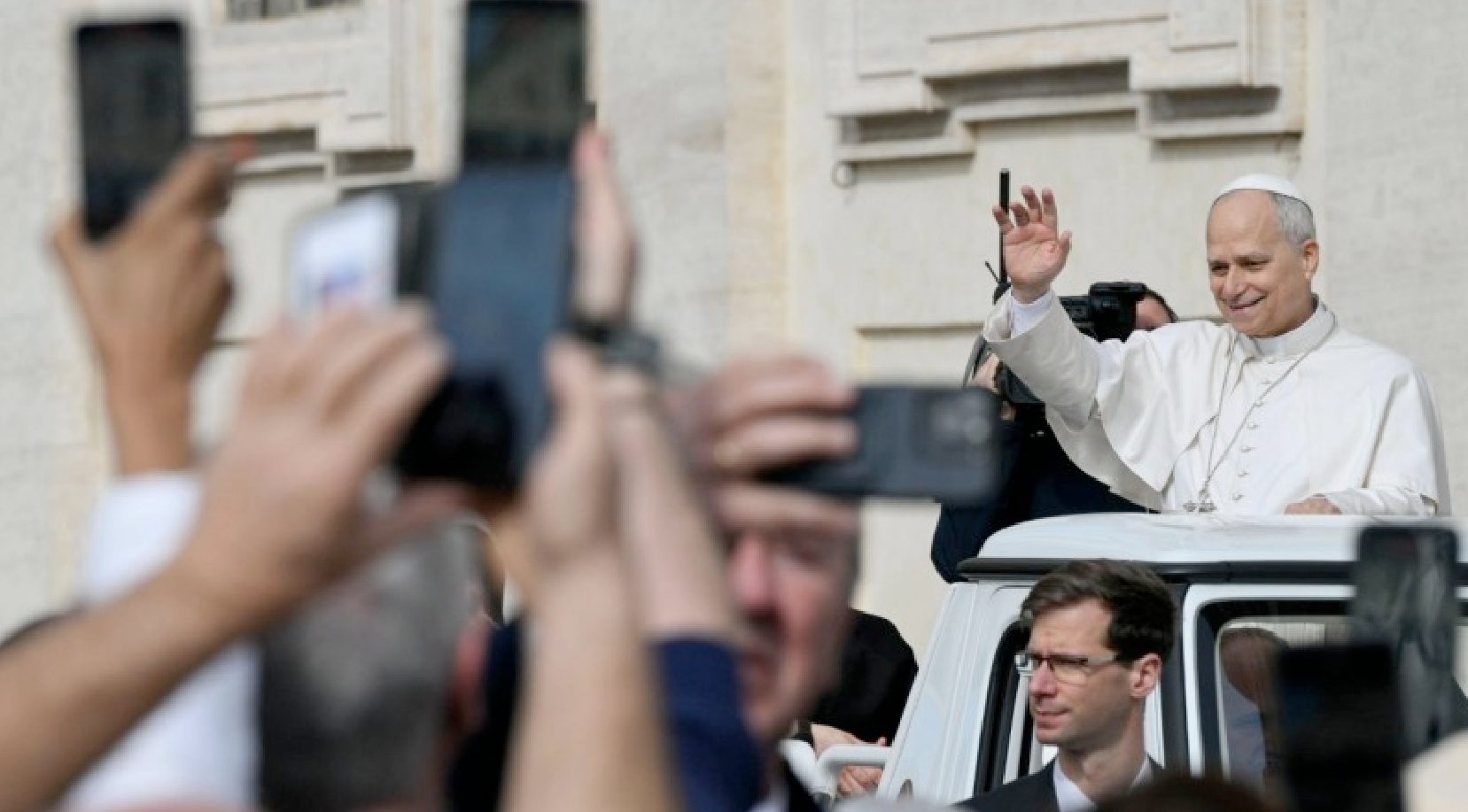
(ZENIT News / Rome, 03.11.2026).- Ten months into his pontificate, Pope Leo XIV appears to enjoy something rare in today’s polarized American public life: broad goodwill across political lines. A new national survey suggests that the first pope born in the United States currently inspires more favorable sentiment among American voters than many of the country’s most recognizable political leaders.
The findings come from a March 2026 poll conducted by NBC News in partnership with Hart Research Associates and Public Opinion Strategies. The survey interviewed 1,000 registered voters across the United States, producing a margin of error of plus or minus 3.1 percentage points.
Asked about their perception of Leo XIV, 42 percent of respondents expressed a favorable view—divided between 23 percent who said they saw him “very positively” and 19 percent who viewed him “somewhat positively.” Only 8 percent described their opinion as negative.
That balance yields a net favorability rating of +34, placing the Chicago-born pontiff ahead of a range of American public figures, from political leaders to media personalities.
More liked than politicians
The comparison is particularly striking in a country where political figures often struggle with deeply polarized public opinion.
According to the survey, the pope’s positive rating slightly exceeded that of Donald Trump by about one percentage point, while his negative rating remained dramatically lower. Trump registered 41 percent positive and 53 percent negative in the same poll, producing a net favorability of –12.
Other political figures also trailed far behind. JD Vance, the current U.S. vice president, scored 38 percent positive and 49 percent negative, while Secretary of State Marco Rubio registered 34 percent positive against 41 percent negative.
The progressive congresswoman Alexandria Ocasio-Cortez, California governor Gavin Newsom and former vice president Kamala Harris also ranked below the pope in net favorability.
Even outside the political sphere, few public figures approached his standing. Comedian and television host Stephen Colbert was among the very few names in the survey to achieve a positive net rating.
Perhaps the most remarkable detail in the poll is that Leo XIV was the only figure measured with a negative rating in the single digits.
Admired—but still little known
Yet the survey also reveals that the pope’s public profile in the United States remains relatively undefined. Roughly half of respondents either expressed no clear opinion or said they were unsure how to evaluate him. About 36 percent reported a neutral view, while 14 percent said they did not know enough about him to answer.
That level of unfamiliarity is not unusual for a pontiff whose role is primarily global rather than national. Unlike American political leaders, the pope rarely intervenes in domestic debates and tends to speak in broader moral or humanitarian terms.
Still, the poll suggests that Leo XIV’s reputation—at least for now—benefits from the relative distance between his office and the partisan battles that dominate American public discourse.
A historic papacy
The pope’s personal story may also contribute to the curiosity surrounding him. Born in the South Side of Chicago, Leo XIV is the first pope in history to hold United States citizenship.
He also has Peruvian citizenship and belongs to the Order of Saint Augustine, making him the first Augustinian pope in the modern era. After Pope Francis, he is the second pontiff from the Americas, reflecting the demographic shift of Catholicism toward the Western Hemisphere and the Global South.
His election marked a significant symbolic moment for the Catholic Church, particularly in the United States, home to one of the largest Catholic populations in the world.
How the numbers compare with earlier popes
Historically, American public opinion toward popes has fluctuated widely depending on global events and the personalities involved.
In surveys cited by NBC, Pope John Paul II achieved an exceptionally high approval rating of 65 percent in 1998, reflecting his global stature during the later years of his pontificate. Pope Francis reached 57 percent shortly after his election in 2013, at the height of the initial enthusiasm surrounding his papacy.
By contrast, Pope Benedict XVI registered a more modest 30 percent rating in early 2013, shortly before his historic resignation.
With 42 percent approval in the current poll, Leo XIV falls somewhere in the middle of that historical spectrum. Analysts note that his relatively recent election—and the fact that many Americans still feel they do not know him well—may explain why the figure has not yet reached the levels once recorded by some of his predecessors.
A rare consensus figure
What the survey ultimately highlights is less about ideology than about tone. In a political culture marked by sharp divisions, a religious figure who speaks in universal moral language can sometimes occupy a space beyond conventional partisan categories.
Whether his favorable standing endures will likely depend on how his pontificate evolves—and how visible his voice becomes in the global debates that increasingly shape both politics and religion in the 21st century.
Thank you for reading our content. If you would like to receive ZENIT’s daily e-mail news, you can subscribe for free through this link.

Publicaciones relacionadas:
 TIME dedicates its cover and a major report to Pope Leo XIV: From US Midwest Roots to the Chair of Peter
 The difference between illusions and preparations: a catechesis by Pope Leo XIV applied to the Eucharist
 Pope Leo XIV visits the Virgin Mary. Where, when, and how? This is how the encounter unfolded
 What is human prosperity? Pope Leo XIV answers based on St. Augustine
