

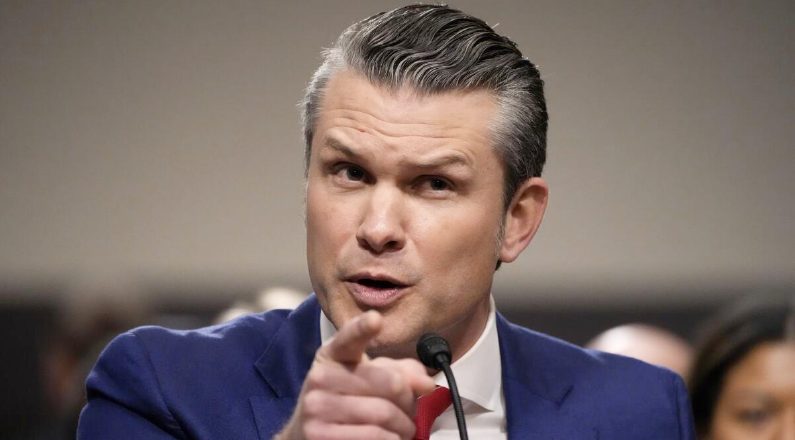
(ZENIT News / Washington, 12.21.2025).- In a decisive move that could reshape the moral and spiritual landscape of the U.S. armed forces, Secretary of the Army Pete Hegseth has announced a comprehensive reform of the Army Chaplain Corps, starting with the elimination of the current Army Spiritual Fitness Guide. In a video statement, Hegseth framed the action as a response to what he described as the erosion of the chaplains’ historic role in the military.
Hegseth argued that in recent decades, chaplains have been increasingly cast not as spiritual leaders but as emotional support officers. “Faith and virtue have been replaced by self-help and self-care,” he said. “In an environment dominated by political correctness and secular humanism, chaplains have been minimized rather than empowered.”
He traced the chaplains’ origin to the Revolutionary War, recalling that General George Washington established the Chaplain Corps in the Continental Army to provide “the blessing and protection of heaven… especially in times of distress and public danger.” For more than 200 years, chaplains have served as moral anchors and spiritual guides, ministering to the emotional and spiritual needs of soldiers in moments of crisis.
The announcement singled out the current Army Spiritual Fitness Guide for criticism. According to Hegseth, the guide makes only a single mention of God and completely omits references to virtue. Instead, it emphasizes concepts associated with New Age thought, framing the “spirit of the soldier” around consciousness, creativity, and connection rather than traditional faith. “The guide’s approach ironically alienates the 82 percent of service members who identify as religious,” Hegseth noted. “It is unacceptable and undermines the mission of the Chaplain Corps. We are discarding it.”
We are going to make the Chaplain Corps great again. pic.twitter.com/xbKZBdbiSR
— Secretary of War Pete Hegseth (@SecWar) December 17, 2025
The reforms, Hegseth said, represent “a cultural reset from the top down,” elevating spiritual health to the same level as physical and mental well-being. Initial steps include removing training materials deemed inconsistent with the mission of the War Department and revising religious affiliation coding practices. Further changes are expected in the coming months.
Hegseth emphasized that chaplains are to be recognized primarily as spiritual leaders, not merely counselors. “Our chaplains are chaplains, not emotional support officers,” he said. Quoting the 1956 Army Chaplain Manual, he reminded audiences that “the chaplain is the pastor and shepherd of the souls entrusted to his care.” The reforms, he said, are intended to restore chaplains’ authority to guide their congregations — soldiers — with freedom and courage.
The announcement signals a broader philosophical shift within the military, affirming that spiritual guidance is not a peripheral concern but a core component of readiness, resilience, and moral cohesion. Hegseth’s initiative has already sparked conversation about the balance between secular professionalism and faith-based leadership in an increasingly pluralistic military.
Observers suggest that these reforms could redefine the role of the Chaplain Corps for a generation, reinforcing the idea that combat readiness is not merely physical or psychological, but also moral and spiritual. For chaplains, it represents both a restoration of authority and a renewed charge: to minister not only to the needs of the body and mind but to the enduring call of conscience and faith.
Thank you for reading our content. If you would like to receive ZENIT’s daily e-mail news, you can subscribe for free through this link.

Publicaciones relacionadas:
 Monumental Statue of Saint Michael Is Built in Brazil
 World’s Largest Statue Dedicated to the Virgin Mary Is Inaugurated in Brazil
 The world’s largest Orthodox cathedral is inaugurated: one of its most important benefactors was Saint John Paul II
 Vatican elevates oldest church on the Arabian Peninsula to basilica status
