

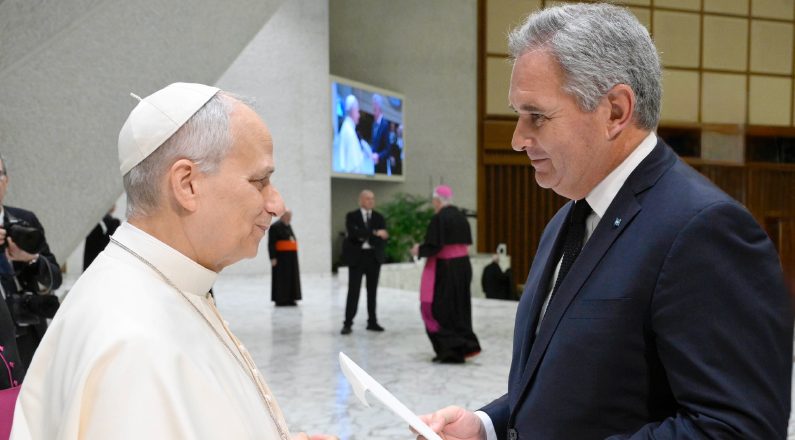
(ZENIT News / Rome, 02.13.2026).- Argentina’s government has taken a decisive diplomatic step toward bringing Pope Leo XIV back to South America—this time not as a missionary bishop, but as the Bishop of Rome. On February 11, the Foreign Ministry confirmed that President Javier Milei signed a formal invitation the pontiff to visit Argentina on a date yet to be determined. The letter was delivered in person at the Vatican by Foreign Minister Pablo Quirno during the general audience on Wednesdays.
The gesture comes at what officials describe as a particularly constructive phase in bilateral relations. In a public statement, the Argentine government underscored what it characterized as a tradition of “frank dialogue” and “constructive cooperation” between Buenos Aires and the Apostolic See—language that situates the invitation within a long-standing diplomatic framework rather than as a purely ceremonial overture.
Quirno reaffirmed Argentina’s willingness to collaborate with the Vatican in promoting peace, international understanding and the peaceful resolution of conflicts. In the lexicon of Holy See diplomacy, such themes are not incidental. The Vatican, though geographically minute, operates as a global actor through its moral authority, network of nuncios and mediation efforts in international disputes. An official papal visit therefore carries not only spiritual symbolism but also the weight of statecraft.
Me reuní con el Secretario de Estado de la Santa Sede, el Cardenal Pietro Parolin.
Dialogamos sobre la excelente relación bilateral entre la Argentina y el Vaticano y le reiteré la invitación al Santo Padre para visitar la Argentina.
También le compartí los avances… pic.twitter.com/6Crpf1X211
— Pablo Quirno (@pabloquirno) February 12, 2026
Sources close to the Argentine executive branch indicate that discussions about a potential papal trip began in 2025, shortly after the transition in the papacy. Pope Leo XIV spent nearly half of his priestly life in Peru, where he was appointed bishop of Chiclayo by his predecessor. He later acquired Peruvian nationality. That deep pastoral immersion in Latin America is widely viewed as a bridge facilitating dialogue with regional governments, including Argentina’s current administration.
While no dates have been confirmed, high-level officials in Buenos Aires privately estimate the probability of a visit at 70 percent or higher, with the final quarter of the year emerging as the most plausible window. The absence of national elections in Argentina, Peru and Uruguay in that period is considered advantageous. Papal journeys are complex undertakings that combine liturgical celebrations, large-scale public events and formal meetings with heads of state. They require months of coordination among civil authorities, security agencies and the Vatican’s Secretariat of State.
Speculation about a broader Latin American itinerary has circulated in recent months. According to well-placed sources, Leo XIV is considering stops in Peru and in two countries his predecessor never visited during his pontificate: Argentina and Uruguay. For Argentina in particular, such a visit would carry symbolic resonance. It would mark the first time Leo XIV sets foot in the country as pope and could reset a relationship that, in recent years, has been shaped as much by political friction as by shared religious heritage.
The current diplomatic outreach unfolds against a backdrop of domestic tensions involving Church and state. In recent weeks, the Argentine bishops’ commissions for Social Pastoral Care, Prison Ministry and Caritas Argentina issued an open letter urging lawmakers to conduct a “serious and responsible” debate on proposed reforms to the juvenile penal regime advanced by the ruling coalition. The letter criticized what it described as a political climate in which social suffering risks being instrumentalized for media impact, and warned against oversimplified solutions.
The interplay between ecclesial advocacy and governmental reform is not new in Argentina, a country where Catholicism has historically shaped public life. The last officially recorded meeting between President Milei and the bishop of Archdiocese of Buenos Aires took place toward the end of 2024. Both figures were most recently present in the same setting during the May 25, 2025 Te Deum ceremony, when the archbishop delivered a homily urging greater dialogue among political factions and attention to the elderly and marginalized.
At the Vatican, Leo XIV has already signaled a measured but deliberate approach to international travel. Late last year he undertook a five-day journey to Turkey and Lebanon, marking his first visits outside Italy. The Holy See’s press office confirmed this week that Monaco is under consideration as another destination. Algeria is also being studied, reportedly with the dual aim of honoring sites linked to Saint Augustine and promoting Christian-Muslim dialogue. Possible African stops include Equatorial Guinea, Cameroon and Angola.
— Cancillería Argentina 🇦🇷 (@Cancilleria_Ar) February 11, 2026
Notably, Vatican spokespersons have clarified that the pope will not travel to the United States—his country of birth—this year, citing the upcoming midterm elections and the desire to avoid any perception of political endorsement. That decision underscores the Holy See’s sensitivity to the optics of timing, a factor equally relevant to any potential Argentine trip.
The Foreign Ministry’s announcement was swiftly amplified by President Milei through social media, signaling executive backing at the highest level. Quirno’s visit to Rome, accompanied by Undersecretary for Worship and Civilization Agustín Caulo, had already suggested a strong ecclesiastical component to the diplomatic agenda. The leadership of the Secretariat for Worship remains in transition after its previous head, Nahuel Sotelo, assumed a seat in the Buenos Aires provincial legislature, with Caulo serving in an interim capacity.
For Argentina, a papal visit would represent more than a ceremonial milestone. It would unfold at a moment of economic strain, social debate and political realignment. For the Vatican, it would offer an opportunity to engage a nation whose Catholic roots remain deep, even as secularization advances.
Thank you for reading our content. If you would like to receive ZENIT’s daily e-mail news, you can subscribe for free through this link.

Publicaciones relacionadas:
 Pope Leo’s visit to Argentina unofficially confirmed after audience with President Milei
 This is the first YouTube video message from Pope Leo XIV to USA
 Pope Leo XIV receives documented report on religious persecution in Nicaragua
 Ireland: After 500 years, Pope Leo XIV could solve the problem of Dublin’s lack of a cathedral
