

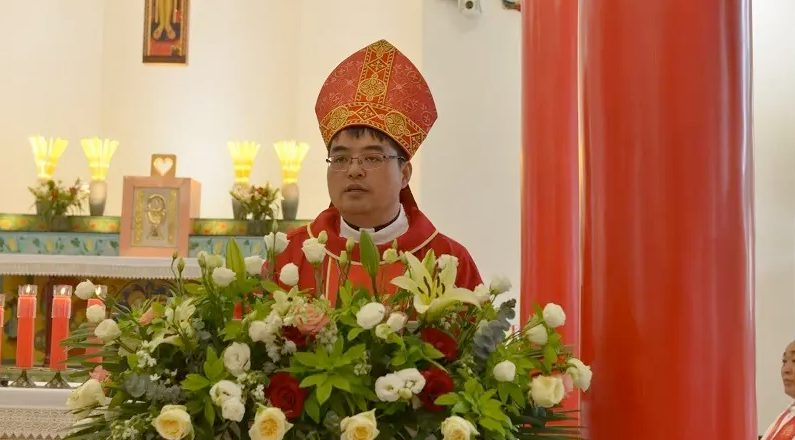
(ZENIT News – Asia News / Beijingn, 07.23.2026).- A new episcopal ordination was announced on the morning of July 22 under the Provisional Agreement between the Holy See and the People’s Republic of China on the appointment of bishops. Chang Yanfeng, 42, becomes the new bishop of Chifeng, in the Inner Mongolia Autonomous Region, a see that had been vacant for 20 years.
As indicated in the bulletin of the Holy See Press Office, the ordination comes after “the Holy Father, on 15 June 2026, appointed him bishop, having approved his candidacy within the framework of the Provisional Agreement between the Holy See and the People’s Republic of China.”
This is the first appointment of a Chinese bishop in 2026, following the last two ordinations, that of Mgr Ignatius Wu Jianlin as auxiliary bishop of Shanghai, in October 2025; and that of Francis Li Jianlin, as bishop of the Apostolic Prefecture of Xinxiang, Henan Province, in December 2025 (the two prelates were “elected” during the period of sede vacante between the death of Pope Francis and the election of Pope Leo). Another episcopal ordination ceremony is set to take place in China next week.
The ceremony took place at the Catholic Church in Hongshan District, Chifeng City, led by Bishop Meng Qinglu of Hohhot, who is also deputy chairman of the Chinese Catholic Patriotic Association (CCPA); the other two consecrators were Bishop Pei Junmin, deputy chairman of the Chinese Catholic Bishops’ Conference (the collegial body not officially recognised by the Holy See), and Bishop Yao Shun of Ulanqab.
Approximately 400 people attended the event, according to official sources, including priests, nuns, and representatives of the faithful.
Bishop Chang Yanfeng, whose baptismal name is Joseph, was born on 4 April 1984, in Weichang County, Chengde, Hebei Province. From 2000 to 2006, he studied philosophy and theology at the Shenyang Catholic Theological Seminary and was ordained a priest in November 2010.
From 2007 to 2010, he pursued his studies at Daejeon Catholic University, South Korea, earning a Master’s Degree in Biblical Theology. Hitherto, he served as director of the Chifeng Catholic Patriotic Association, effectively the head of the local Church.
Based on the Communist Party’s «self-government» mechanisms, his election as bishop-designate of Chifeng took place on 20 March 2026.
Christianity’s presence in this part of China goes back two hundred years. The first to arrive were the priests of the Missions étrangères de Paris around 1835, followed by the Belgian missionaries of Scheut, who carried out their ministry among the local Mongolian population for a long time before they were expelled by Mao’s regime.
In Chifeng the Church re-emerged in the 1980s after the suffering of the Cultural Revolution. In 1990, Father Andreas Zhu Wenyu was ordained bishop without a papal mandate, but later, like other Chinese bishops, he requested and was granted re-entry into communion with Rome. He died in 2006.
Today the Catholic Church of Chifeng has around 50,000 members, with some 30 priests and 20 nuns dedicated to their pastoral care.
The appointment of the bishop of Chifeng is also significant for another reason. The Inner Mongolia Autonomous Region is one of the areas particularly impacted by China’s Law on Promoting Ethnic Unity and Progress, which seeks to impose sinicisation at the expense of minority languages and cultures. Approved in March, it came into effect on 1 July.
Due to the massive immigration of Han Chinese settlers in recent decades, ethnic Mongols now represent less than 20 per cent of Inner Mongolia’s 25 million inhabitants, and Mandarin Chinese is replacing the local language in schools.
Chifeng is a highly significant frontier city of about 4.6 million people (80 per cent Han), located in the southeastern part of the region, known in Mongolian as Ulanhad (meaning «red peak»), its rural areas (banners)[*] are home to significant nomadic populations, including the prominent banners of Aohan and Hexigten.
The region’s close connection to Mongolian history dates back to the Liao Dynasty (916–1125), when the nomadic Khitan established their capital here.
It is understandable how the relationship between the Han and indigenous Mongols is a sensitive issue in Chifeng.
It should be noted that, on the eve of his ordination, the new bishop insisted on the need to faithfully follow the instructions coming from Beijing on this issue.
The CCPA in fact recently reported on the meetings that Father Chang Yanfeng had with diocesan consultants and the heads of other official Church bodies.
In the article, a passage is specifically dedicated to the entry into force of the Law on Promoting Ethnic Unity and Progress, along with the usual emphasis on the importance of “strictly adher[ing] to discipline and rules”, a mantra repeatedly found in the CCPA’s documents.
“Through intensive study and exchange, all participants gained a deep understanding of the significant legal and practical implications of the law,” reads the article.
“They unanimously agreed that it is essential to always prioritise strengthening the sense of community of the Chinese nation, consciously respect, learn, abide by, and apply the law, and deeply integrate legal thinking and concepts into the entire process of daily evangelisation work.”
Hence, the Catholic community in Chifeng City is committed to “proactively align with the requirements of ethnic and religious work in the new era, regularly conduct publicity and education on ethnic unity and progress and legal learning, firmly uphold correct beliefs and practices, unite the strength of the vast number of believers with a strict discipline, and safeguard the unity, harmony, stability, and order within the Catholic community through legal norms.”
Thank you for reading our content. If you would like to receive ZENIT’s daily e-mail news, you can subscribe for free through this link.

Publicaciones relacionadas:
 7 out of 10 Spanish citizens believe that Leo XIV’s papacy will be good or better than that of Pope Francis
 Pope Leo XVI to visit Spain: here’s everything we know so far
 Pope Leo XIV to Equatorial Guinea: video captures the Holy Father’s travel coordinator visiting the country ahead of a papal trip
 The Pope to Young Iraqi Christians: Your Mission Is to Be Light in the Darkness
