

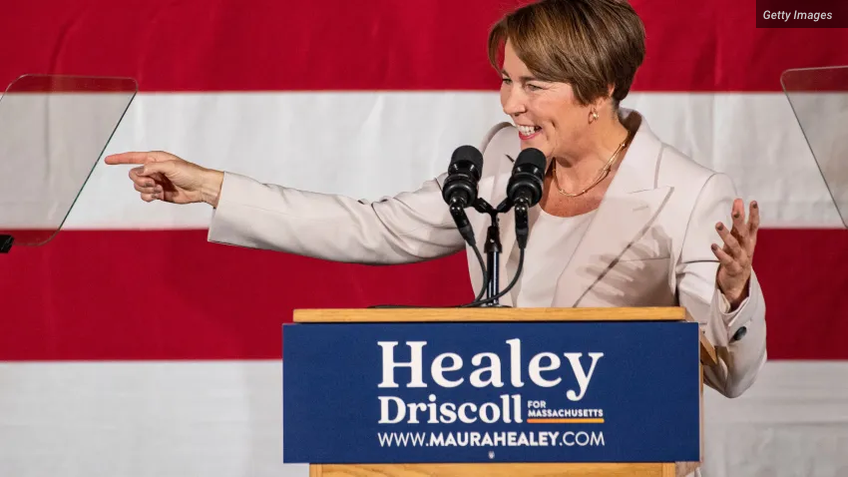
(ZENIT News / Boston, 11.11.2026).- A political confrontation over abortion in Massachusetts has taken an extraordinary turn after Governor Maura Healey invoked emergency powers to bring into immediate effect legislation removing the state’s remaining restrictions on late-term abortions. The decision, announced on November 6, has also prevented opponents from temporarily blocking the measure through a citizens’ petition, despite their claim to have gathered more than 112,000 signatures in a matter of weeks.
The controversy has drawn a forceful response from the state’s Catholic bishops, who have challenged not only the substance of the new law but also Healey’s attempt to justify it on the basis of her Catholic faith. At stake is a fundamental question: whether the protection of unborn life can be set aside in the name of individual choice and medical discretion, and whether the governor’s intervention has effectively sidelined a significant popular challenge to the legislation.
The law, known as Chapter 188, was signed by Healey on August 10. Until her emergency declaration, however, a petition campaign seeking its suspension had the potential to prevent it from taking effect while the question proceeded towards a statewide referendum. Pro-life organisers say they collected approximately 112,000 signatures from registered voters — more than twice the number required to suspend the measure and nearly three times the threshold for placing it on the November 2028 ballot.
By attaching an emergency preamble to the legislation, Healey made it effective immediately, overriding the mechanism that could otherwise have delayed its implementation. The Secretary of State’s office said that certification of the signatures could take one to two weeks. The referendum effort may therefore continue, but the law will remain in force in the meantime.
The change is substantial. Under the previous legislation, amended in 2020, abortion was permitted up to 24 weeks of pregnancy, with later abortions allowed in specified circumstances involving the mother’s life or physical or mental health, or when the fetus was not compatible with sustained life outside the womb. Chapter 188 removes those restrictions and provides that an abortion at any stage of pregnancy may be performed by a physician according to that doctor’s professional judgment.
Healey defended her decision by arguing that the previous exceptions were too narrowly defined to address the full range of serious complications that can arise in later pregnancy. In a letter accompanying the emergency preamble, she said that uncertainty over the law’s clinical interpretation, as well as differing approaches among hospitals and their legal advisers, could delay treatment and endanger patients. She described the new measure as necessary to remove barriers to essential medical care.
In a separate article published on Substack, the governor also invoked her Catholic identity. She wrote that her faith had shaped her understanding of service, responsibility, compassion and human dignity, while insisting that, as governor, she had a duty to respect the deeply personal medical decisions of families with different beliefs and values.
That argument prompted an unusually direct response from all four Catholic bishops leading dioceses in Massachusetts. In a statement on November 7, Archbishop Richard Henning of Boston, Bishop Robert McManus of Worcester, Bishop Edgar da Cunha of Fall River and Bishop William Byrne of Springfield rejected the characterization of abortion as healthcare. They also disputed the existence of an emergency warranting the expansion of a law they already regard as radically permissive.
The bishops grounded their criticism in the Church’s consistent defence of unborn human life, pointing in particular to recent remarks by Pope Leo XIV to Uruguayan leaders. The Pope had stressed that unborn children already belong to the human family and that their dependence on their mothers does not diminish either their dignity or the protection they deserve.
The bishops urged lawmakers and the wider public to reconsider what they described as an increasingly utilitarian approach to human life, warning that the same logic threatens the elderly, the sick and other vulnerable people. Their appeal went beyond the immediate legislative dispute: a society’s commitment to human dignity, they argued, must be measured by how it treats those least able to defend themselves.
The political dimension is equally significant. Healey was re-elected on November 3, defeating Republican challenger Mike Minogue by 62% to 35%. Yet the petition campaign suggests that the abortion legislation has generated opposition extending beyond the ordinary electoral contest. Myrna Maloney Flynn, president of Massachusetts Citizens for Life, accused the governor of disregarding the concerns of more than 100,000 constituents and argued that no genuine emergency had been demonstrated to justify bypassing the suspension process.
Healey, for her part, has maintained that the referendum campaign can continue and that the state will respect the voters’ decision if they ultimately reject the law. But that assurance does not resolve the immediate controversy: voters may eventually have their say, while the new abortion regime is already in effect.
Whether Massachusetts voters will overturn Chapter 188 in 2028 remains uncertain. For now, the law has taken effect, the referendum campaign faces a longer road, and the state’s Catholic leadership has made clear that it considers the expansion of abortion access not an advance in human dignity, but a grave failure to protect it.
Thank you for reading our content. If you would like to receive ZENIT’s daily e-mail news, you can subscribe for free through this link.

Publicaciones relacionadas:
 Attorneys are suing the New York attorney general for using her power to censor pro-life pregnancy centers
 USA: House of Representatives Approves Law That Prohibits Pentagon from Financing Abortions
 Anglican Leader Reveals Pressures to Abort His Disabled Daughter
 New UN treaty seeks to decriminalize some forms of child pornography
