

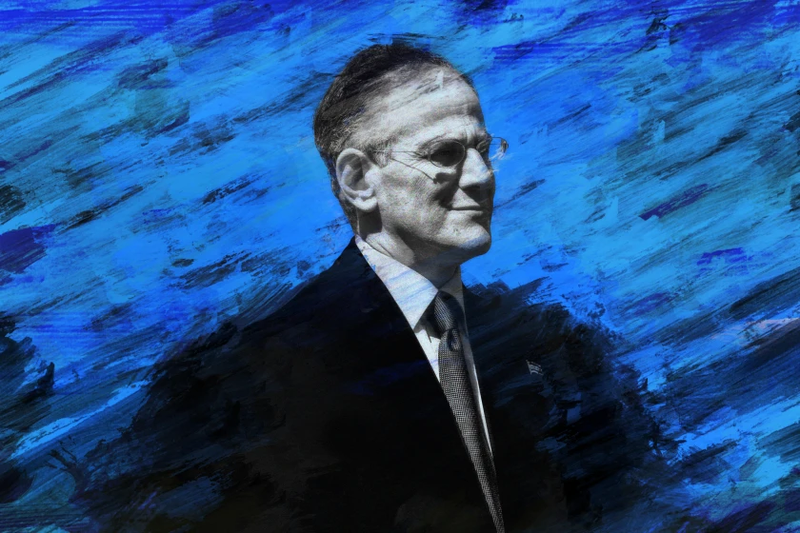
(ZENIT News / Rome, 10.24.2026).- Cardinal Blase Cupich of Chicago is facing renewed questions over the Catholic Church’s approach to public honors after the archdiocese named financier Michael J. Sacks as a recipient of its Nostra Aetate Award, despite his reported contribution of $600,000 to initiatives supporting access to abortion in Illinois. The award will be presented on October 29 during a fundraising gala for priestly formation organized by Mundelein Seminary.
Sacks, chairman and chief executive of investment firm GCM Grosvenor, was identified in a September 29 report by Crain’s Chicago Business as a donor to efforts to strengthen Illinois’ abortion-access infrastructure and offset federal funding cuts affecting reproductive health services. Initiatives associated with this effort have supported organizations including Planned Parenthood of Illinois and the Chicago Abortion Fund. The Prairie State Access Fund, launched with the participation of the Michael Reese Health Trust, announced in March that it was distributing its first $1 million in grants.
The award ceremony is scheduled for Thursday, October 29, at the IBEW Local 134 venue in Chicago. Cupich and Mundelein Seminary rector John Kartje are listed as leading the evening, which is intended to raise funds for the education of future parish priests. The juxtaposition is difficult to ignore: an institution devoted to preparing Catholic clergy will honor a businessman whose financial support has helped expand access to a practice the Church considers gravely immoral.
The Catholic position on abortion is explicit. Paragraph 2271 of the Catechism states that the Church’s teaching against procured abortion has remained unchanged since the earliest centuries of Christianity. The question raised by the award, therefore, is not whether the Church’s moral teaching is clear, but what message a Catholic institution communicates when it publicly honors someone whose actions conflict with that teaching.
The United States Conference of Catholic Bishops addressed this issue in its 2004 document Catholics in Political Life. The bishops said Catholic institutions should not honor individuals who act in defiance of fundamental moral principles when such recognition could be interpreted as approval of their conduct. That guidance makes the decision in Chicago particularly contentious, even if the archdiocese has not publicly explained its reasoning in the material cited here.
The controversy also recalls the dispute over Democratic Senator Dick Durbin, whom the Chicago Archdiocese planned to honor in 2025 for his work on behalf of immigrants. Durbin’s longstanding support for abortion rights prompted objections from several bishops, including Thomas Paprocki of Springfield, Salvatore Cordileone, James Conley and David Ricken. Paprocki had stated that Durbin was not to receive Communion in his diocese. Cupich defended the proposed recognition by pointing to the senator’s work on immigration, but Durbin ultimately withdrew from the award amid the criticism.
Pope Leo XIV was asked about that episode and emphasized the need to consider a politician’s overall record, while also noting that the defense of life encompasses other issues, including opposition to the death penalty and the treatment of immigrants. His remarks raised a broader question about how the Church should evaluate public figures whose records combine positions it considers morally incompatible with positions or actions that serve legitimate human needs.
Sacks has longstanding ties to Democratic politics in Chicago. He served on the economic council of former mayor Rahm Emanuel from 2011 to 2019, was involved with the Obama Foundation from its early days and, with his wife, helped raise more than $200,000 for Barack Obama’s 2012 reelection campaign. He also chaired the 2024 Democratic National Convention in Chicago. In 2016, he travelled to Rome as part of a delegation accompanying Emanuel when Pope Francis elevated Cupich to the College of Cardinals.
Those connections help explain Sacks’ prominence in civic and political life, but they do not by themselves establish why he was selected for the Catholic award. The decisive issue is the meaning of the recognition itself and whether the archdiocese believes Sacks’ other contributions justify honoring him despite his financial support for abortion access.
Thank you for reading our content. If you would like to receive ZENIT’s daily e-mail news, you can subscribe for free through this link.

Publicaciones relacionadas:
 Andorra will approve abortion despite the fact that its head of state is a Catholic bishop
 Controversial Antwerp bishop expands on his idea of ordaining married men and shares his thoughts on women
 Following Controversy at the Basilica of Guadalupe, the Cardinal of Mexico City Announced Reforms Inspired by Rome and Appointed a New Rector
 Biden Receives Pro-Abortion Award as U.S. Bishops Work to Oppose Referendums in Four States That Support the Killing of Babies
