

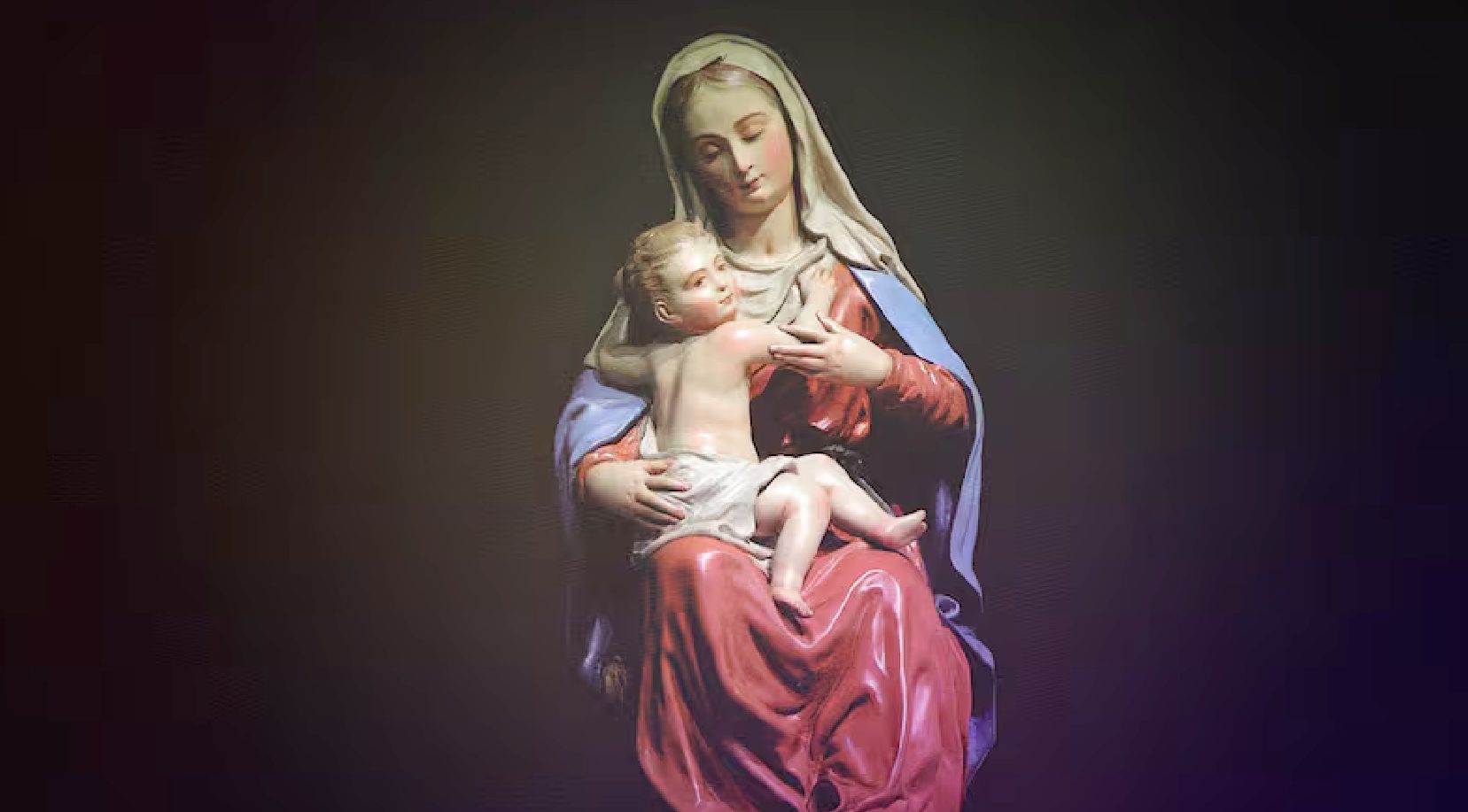
(ZENIT News / Rome, 11.04.2025).- The Vatican’s Dicastery for the Doctrine of the Faith has issued a sweeping doctrinal note titled Mater populi fidelis—“Mother of the Faithful People”—which seeks to clarify the proper theological understanding of certain titles traditionally attributed to the Virgin Mary. Signed by Cardinal Víctor Manuel Fernández and Monsignor Armando Matteo, and approved by Pope Leo XIV on October 7, the 20-page text marks the most comprehensive Vatican reflection on Marian terminology since the Second Vatican Council.
At the heart of the document lies a delicate but decisive correction: the Vatican firmly discourages the use of the title “Co-Redemptrix”, long used by some theologians and popular devotions to express Mary’s cooperation in the redemptive work of Christ. While acknowledging the historical and devotional roots of the expression, Mater populi fidelis argues that it risks creating confusion about the unique and exclusive salvific role of Christ.
“Every grace, every redemption, proceeds entirely from Him,” the document states, citing Scripture’s insistence on Christ as the “one Mediator between God and humanity.” The note warns that “titles which require constant theological explanation to avoid misunderstanding cease to serve the faith of the people and should therefore be avoided.”
The Vatican’s new note is not merely a negative prohibition but an attempt at theological purification—a careful pruning of language to preserve the integrity of devotion. It affirms that while Mary’s participation in salvation history is real, intimate, and maternal, it is always derivative and subordinate. Her greatness, it insists, lies not in standing beside Christ as a second redeemer, but in her total receptivity to divine grace: “She is what she is because of Him.”
The text takes pains to trace the evolution of the disputed title. Emerging in the 15th century as a corrective to the phrase Redemptrix, “Co-Redemptrix” gained traction in devotional and theological circles in the early 20th century. Saint John Paul II used the term on several occasions, though always in a spiritual sense—relating Mary’s union with her Son’s suffering on the Cross to the redemptive value of human suffering offered in faith. Yet the Second Vatican Council, for doctrinal, pastoral, and ecumenical reasons, opted not to use the expression.
In a particularly striking historical recollection, the note recalls a 1996 internal discussion at the then-Congregation for the Doctrine of the Faith, when Cardinal Joseph Ratzinger—later Pope Benedict XVI—rejected calls to define a new Marian dogma of “Co-Redemptrix or Mediatrix of all Graces.” Ratzinger’s argument, quoted in the document, was characteristically precise: “The meaning of the titles is not clear, nor is the doctrine they express sufficiently mature… The term ‘Co-Redemptrix’ departs too far from Scripture and the Fathers, and may obscure the primacy of Christ.”
That same line of theological sobriety continues under Pope Leo XIV, who, like his predecessor Pope Francis, has publicly cautioned against the term. Both see in it the risk of distorting the balance of Christian truths, replacing the central mystery of Christ’s unique mediation with an almost competitive dualism.
The note’s second major focus is on the title “Mediatrix.” Here again, the Vatican counsels restraint. “Strictly speaking,” the text explains, “there can be no other mediation in grace apart from that of the Incarnate Son of God.” However, the concept of “participated mediation”—a term the document embraces—allows for a deeper understanding of Mary’s role. In this view, all believers, and Mary preeminently among them, can be said to share in Christ’s redemptive mission not as rivals but as instruments of His grace.
Such mediation, the note insists, is always relational and subordinate, “an extension of His mercy, not a supplement to His power.” The wedding feast at Cana is offered as a model: Mary’s intercession is maternal and deferential—she perceives a need, presents it to her Son, and directs others to obey His word. It is a “mediating gesture,” yes, but one that magnifies Christ rather than competes with Him.
This insistence on Christocentric clarity carries clear ecumenical implications. Cardinal Fernández, presenting the document, highlighted that Marian devotion must never become a stumbling block for unity among Christians. “We must love Mary as Catholics have always done,” he said, “but in a way that points unmistakably to her Son.” The note, he added, “honors the piety of the faithful without encouraging doctrinal exaggerations that divide.”
The document also engages with the growing phenomenon of informal Marian groups and digital movements advocating new dogmas. While praising the fervor behind such initiatives, it warns that “not every proposal that arises from popular devotion bears the marks of authentic faith.” Some expressions, it notes, have become entangled with ideology or emotional excess, often spread through social media in ways that “confuse the simple faith of the people.”
Beyond controversy, Mater populi fidelis is also a celebration of authentic Marian faith. It warmly endorses titles such as “Mother of Believers,” “Spiritual Mother,” and “Mother of the Faithful,” describing them as rich in scriptural and theological resonance. In these expressions, the Vatican finds a language that deepens love for Mary while preserving theological balance.
The text closes with a gentle pastoral reminder: Mary’s maternal presence never replaces divine mercy, nor does she stand as a “lightning rod” before divine justice. She does not shield humanity from a wrathful God but reveals the tenderness of a God who saves through love.
In that sense, the note returns Mary to her biblical simplicity—the humble woman who receives, cooperates, and magnifies the Lord. As the Dicastery writes, “Her motherhood does not diminish the unique mediation of Christ but manifests its power. Her veneration must not weaken our worship of Him but inflame it.”
By re-centering Marian devotion on its Christological foundation, the Vatican’s new document neither diminishes Mary nor confines her; rather, it anchors her where she has always belonged—in the radiant light of her Son.
Thank you for reading our content. If you would like to receive ZENIT’s daily e-mail news, you can subscribe for free through this link.

Publicaciones relacionadas:
 The Six Possible Conclusions About Marian Apparitions According to the Vatican’s New Norms
 Vatican’s Positive Statement About “Mary Mystical Rose, After Study of Marian Revelations”
 Third Vatican Pronouncement on Apparitions: Negative for “Our Lady of All Nations”
 Vatican to Issue Statement on Apparitions in Medjugorje
