

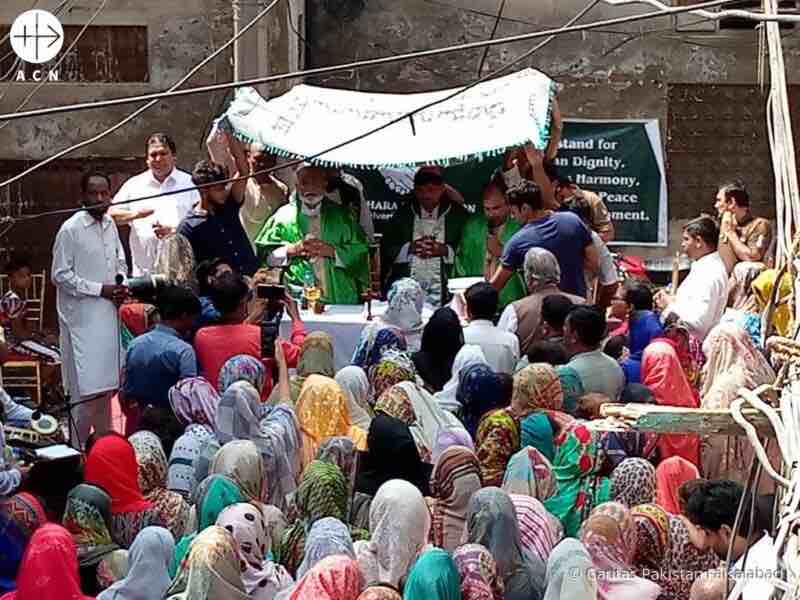
(ZENIT News / Madrid, 10.02.2026).- The National Commission for Justice and Peace (NCJP), a body under the Catholic Bishops’ Conference of Pakistan, has published and submitted a new Report to the Pontifical Foundation Aid to the Church in Need (ACN). The Report highlights numerous human rights violations against minorities in the country during 2025. Spanning dozens of pages, it documents specific cases of persecution against religious minorities, including Christian communities.
The report details the killings of Christians in 2025, including that of Kashif Massih, accused of theft and tortured to death, and Afzal Masih, who was shot dead while traveling to the Christian shrine of Mariamabad.
Most cases are linked to social discrimination. For instance, efforts to clarify the facts and secure justice regarding the 2023 Jaranwala attacks have been hindered, while experts have criticized the presence of a «majoritarian and supremacist mindset» in some educational materials.
The «Blasphemy Law»: A Weapon Against Minorities
Accusations of blasphemy remain a major concern. In 2025, eight Christians were formally charged with blasphemy, while two others were released on bail after having been previously accused. Members of other faiths, including both minorities and Muslims belonging to majority currents, also suffer from the misuse of these laws. ACN has been closely monitoring this issue for many years.
Penalties for blasphemy in Pakistan range from life imprisonment to the death penalty, and the requirements for filing an accusation are relatively low; this turns these laws into a tool used to persecute members of religious minorities or settle personal disputes.
Violence against women remains high. Another particularly concerning area involves violence and crimes committed against women, including girls. This is an issue on which ACN has reported extensively over the years.
The Report details several cases of the abduction of young women and girls from religious minorities, which resulted in forced conversions and marriages. In some of these instances, authorities were complicit in the crimes, siding with the abductors and refusing to accept complaints filed by the minors’ parents.
However, the Report also notes cases where judges refused to hand the minors over to their alleged husbands and ordered their return to their families. Additionally, some perpetrators were convicted by the courts.
Nevertheless, the report cites 35 separate incidents affecting dozens of women and girls from religious minorities in Pakistan during 2025, primarily Christians and Hindus.
Positive Signs
The Report also highlights signs of positive progress. For instance, Punjab’s Minister for Minority Affairs described the role of the Christian community in Pakistan as «exemplary» and stated that ensuring the community’s protection and safety remains a top priority for the provincial government.
Another positive development concerns blasphemy cases. In 2025, eight Christians were acquitted of blasphemy charges, while Federal Minister Azam Nazeer Tarar stated that the government is working to introduce procedural safeguards to prevent the misuse of blasphemy laws and ensure faster, more effective justice. Additionally, in 2025, the country’s High Court expressly banned the use of the phrase «For Christians only» in job advertisements for cleaning and sanitation roles, putting an end to a practice that had persisted for many years.
In his introductory message, Monsignor Samson Shukardin, Bishop of Hyderabad and President of the CNJP, writes: «Pakistan is a nation richly blessed with diverse cultures and a profound religious heritage. Yet, there is a worrying contradiction at its core. Time and again, State officials, politicians, and Muslim religious leaders publicly and unhesitatingly assert that Pakistan is a country of Muslims and for Muslims. In doing so, they render the remaining 3% of the population invisible.»
The Bishop concludes: «This is not merely a rhetorical failure. It is a deliberate denial of Pakistan’s multi-religious reality, and the nation has paid a heavy price for it.»
In the latest edition of its “2025 Report on Religious Freedom in the World,” ACN classifies Pakistan as a country where religious persecution occurs, placing it at the highest level of concern covered by the Report.

Publicaciones relacionadas:
 Persecution of Christians has worsened around the globe, according to new study
 Global Christian Persecution Reaches New Heights Amid Rising Nationalism, Conflict, and Repression
 Christianophobia, a Political and Media Taboo That Fuels Crimes Against Children in the United States
 Major Canadian newspaper acknowledges the falsehood of the allegations regarding mass graves of infants that were leveled against the Catholic Church and led to the burning of churches across the country
