

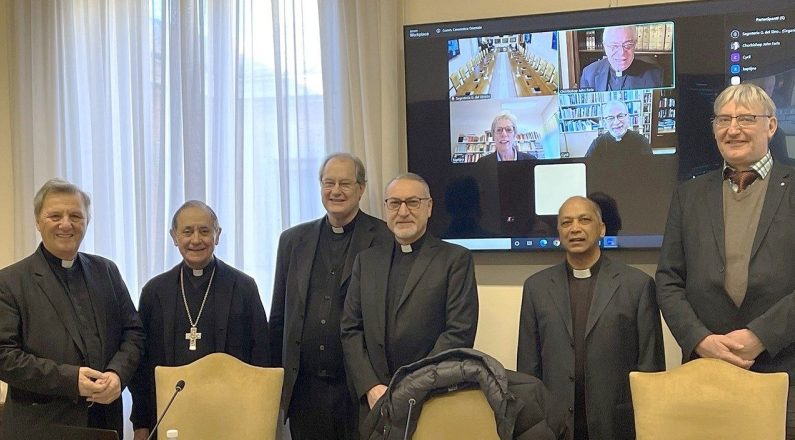
(ZENIT News / Vatican City, 05.23.2026).- To support the implementation phase of the Synod, the General Secretariat of the Synod publishes the document: Towards the Assemblies 2027-2028: stages, criteria, and tools for preparation. The text specifies the calendar, methodology, and criteria through which local Churches throughout the world, together with their national and continental groupings, are invited to share the fruits of the journey undertaken following the Final Document of the 2021–2024 Synod, culminating in the Ecclesial Assembly of October 2028.
The four stages of the journey
The process, which will culminate at each stage in the celebration of an assembly, unfolds in four successive moments, marked by key verbs that highlight their ecclesial and spiritual purpose:
- Recollecting — first semester of 2027. Evaluation Assemblies in Dioceses and Eparchies, called to reread the experience of implementing the Final Document through a narrative report and a letter to the other Churches.
- Interpreting — second semester of 2027. Assemblies of Episcopal Conferences (national or regional), which will prepare a theological-pastoral report and a letter to the other local Churches.
- Orienting — first four months of 2028. Continental Assemblies, from which a perspective report will emerge, capable of identifying shared priorities and orientations.
- Celebrating — October 2028. Ecclesial Assembly of the Church as a whole, in the Vatican, together with the Holy Father: the journey undertaken will be brought into unity and entrusted to the discernment of the whole Church.
At every level, the Assembly does not constitute the final moment of the process, but rather a celebratory moment of assessment, synthesis, and above all renewed impetus for the Church’s synodal conversion.
A common question
To preserve the unity of the process is a common question, which each stage is invited to articulate within its own context:
In light of the journey undertaken after the conclusion of the 2021-2024 Synod, and with a view to offering its fruits as a gift to the other Churches and to the Holy Father: what concrete form of a missionary synodal Church and what new paths of synodality are emerging in your community?
The fruits of each stage: the exchange of gifts among the Churches
The document clarifies that this is not a matter of repeating the Synod consultation, nor of adding further tasks to the ordinary life of communities, but rather of rereading what has already been experienced, recognizing its fruits and difficulties, and making the experience gained available within a logic of exchange of gifts among the Churches.
The first two Assemblies (those at the local and national levels) will produce two complementary texts: a document of rereading — the narrative report for Dioceses and Eparchies, and the theological-pastoral report for Episcopal Conferences — together with a letter to the other local Churches, drafted during the Assembly itself. It is precisely this latter document that constitutes the concrete instrument of the exchange of gifts: each community offers what it has brought to maturity and opens itself to receive what the other Churches offer in turn. The Continental Assemblies, on the other hand, will prepare a perspective report that will contribute to the drafting of the Instrumentum laboris (working document) for the 2028 Ecclesial Assembly.
All materials will be transmitted to the General Secretariat of the Synod according to a precise calendar: by 30 June 2027 for the diocesan and eparchial stage; by 31 December 2027 for the stage of the Episcopal Conferences; and by 30 April 2028 for the continental stage, in preparation for the Ecclesial Assembly of October 2028.
The words of Cardinal Grech
“What we are proposing to the local Churches — states Cardinal Mario Grech, Secretary General of the Synod — is not an additional task, but rather a time of shared discernment and thanksgiving, in which to reread together what the Spirit is causing to grow in the Church and to recognize the steps we are called to take. The Assemblies do not coincide with a sociological consultation or a deliberative process, nor are they a technical assessment. Rather, they are a profound ecclesial and spiritual experience of discernment: a moment of synthesis and renewed impetus for the journey, so that the exchange of gifts among the Churches may become a concrete experience and synodality may increasingly take shape as the ordinary style of ecclesial life at the service of mission.”
Composition of the Assemblies, responsibility, and methodology
The document emphasizes that the composition of the Assemblies must correspond to their purpose. In selecting participants, due attention should be given to the balance between men and women and among different generations, to cultural and ecclesial diversity — including presbyters, deacons, consecrated women and men, members of associations, movements and new communities, as well as faithful not belonging to organized structures — and to the presence of persons living in situations of fragility or marginality. Particular care should be devoted to the involvement of parish priests. Where appropriate, representatives of other Churches and Christian Communions or other religions may also participate. Essential, however, is that those selected be willing to sustain the process even beyond 2028, thereby helping to ensure its continuity.
Responsibility for the process belongs to the diocesan or eparchial bishop for the local Assemblies, to the president of the Episcopal Conference for the national or regional Assemblies, and to those responsible for the continental bodies at that level. Synodal teams, established at every level, are entrusted with the organization and coordination of the work.
As regards methodology, the document encourages maintaining conversation in the Spirit, now widely practiced and adopted, as the privileged methodological reference.
Tools and accompaniment
The document belongs within the implementation phase of the Synod, the third stage of the process outlined in the Apostolic Constitution Episcopalis communio, following the consultation of the People of God (2021–2023) and the celebratory phase, culminating in the two sessions of the XVI Ordinary General Assembly of the Synod of Bishops in October 2023 and October 2024. Opened by Pope Francis with the handing over of the Final Document, this phase has subsequently been confirmed and promoted by Pope Leo XIV. Today’s text gives more concrete form to what had already been anticipated in the Pathways for the implementation phase of the Synod (29 June 2025).
Alongside the Final Document and the Pathways, the journey is also accompanied by the Final Reports of the Study Groups established by Pope Francis after the First Session of the Assembly, progressively published on the website www.synod.va. The General Secretariat of the Synod will also provide additional working materials and organize online formation meetings to support those responsible for the process in the local Churches.
Thank you for reading our content. If you would like to receive ZENIT’s daily e-mail news, you can subscribe for free through this link.

Publicaciones relacionadas:
 Pope Francis to Doctrine of the Faith: sacraments, dignity and faith in understanding the faith in the face of changes that characterize our time
 One thousand experts to Rome to address integral, communitarian and missionary formation of priests at the Vatican
 About the Abuse of the Sacraments for Pastoral Motives: A Call to Attention and a Brief Catechesis of the Holy See for Priests
 Russian Orthodox Church issues formal document condemning Fiducia Supplicans
