

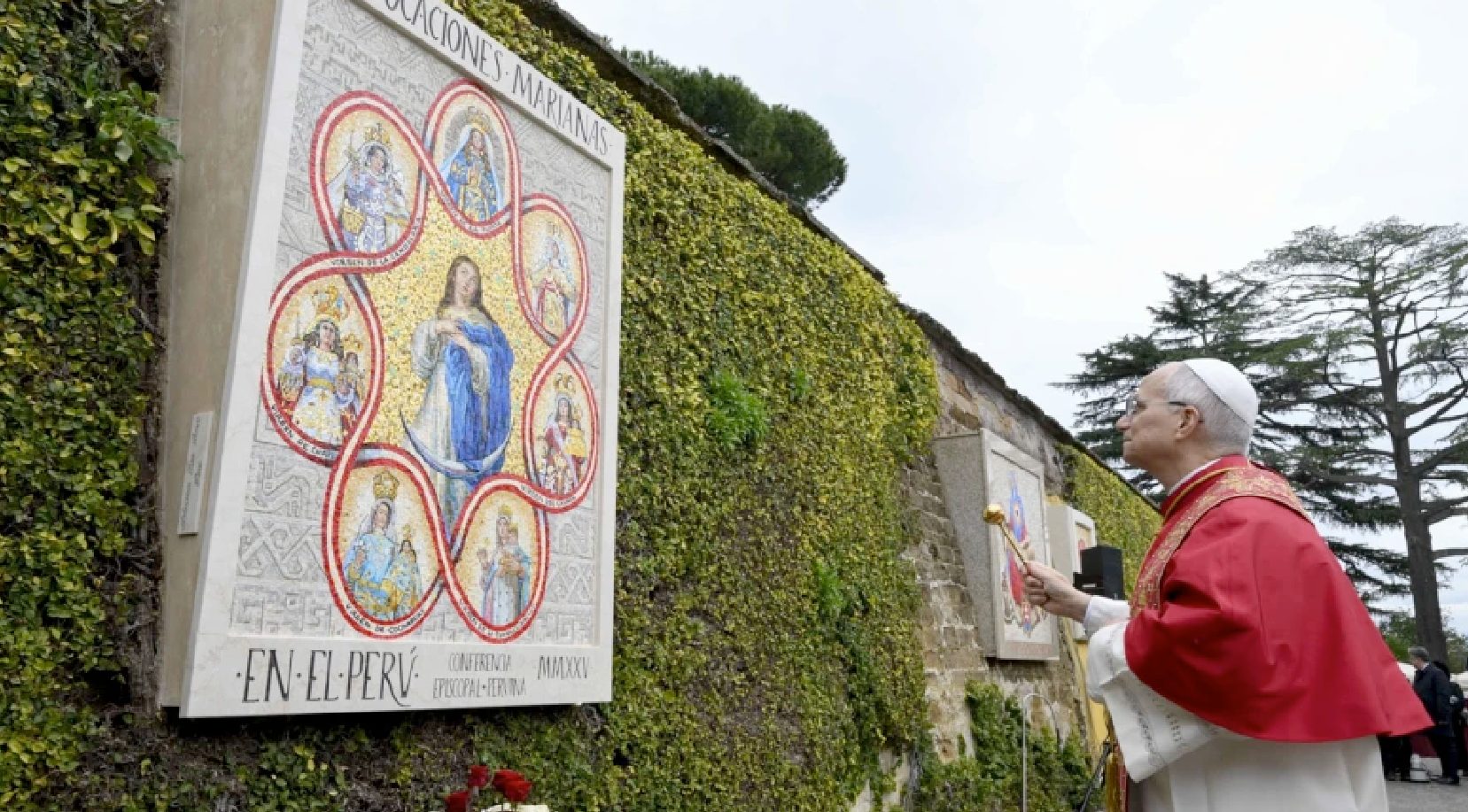
(ZENIT News / Rome, 02.09.2026).- With a significant decree, Pope Leo XIV has reshaped one of the Vatican’s specialized academic institutions, approving new statutes for the Pontifical International Marian Academy (PAMI) and redefining how the Catholic Church studies, teaches and lives devotion to the Virgin Mary in the twenty-first century.
The reform, formalized through a rescript following an audience with Archbishop Edgar Peña Parra, Substitute for General Affairs of the Secretariat of State, entered into force on 2 February 2026 and was made public days later through official Vatican channels. Behind the technical language of statutes and curial competencies lies a broader ecclesial message: Marian devotion, the Pope insists, must be intellectually rigorous, culturally sensitive and spiritually fruitful—never excessive, never diminished.
PAMI occupies a unique place in the Church’s intellectual ecosystem. It is the Holy See’s principal scientific institution dedicated to mariology, the theological study of Mary’s role in the mystery of Christ and the life of the Church. While Marian devotion is widespread among ordinary believers, mariology itself is a highly specialized discipline, intersecting dogmatic theology, biblical studies, liturgy, art history and popular piety. The Academy’s task is to ensure that devotion and doctrine grow together, rather than drifting apart.
Founded in 1946 by the Franciscan Order alongside the Franciscan Marian Commission, the Academy initially aimed to organize Marian studies and promote sound devotion within the Order. Its scope soon widened. In 1950, the Holy See entrusted it with organizing the International Mariological-Marian Congresses, held every four years and bringing together scholars from across the globe. Pope John XXIII gave the institution its definitive profile in 1959, granting it the title “Pontifical” through the motu proprio Maiora in dies and formally establishing it as a permanent point of reference for Marian scholarship worldwide.
The new statutes situate this long tradition within today’s ecclesial and cultural landscape. Their preamble outlines three guiding “paths” for the Academy’s work: truth, beauty and charity. Along the path of truth, PAMI is charged with fostering and coordinating scholarly exchange among mariologists on every continent. Along the path of beauty, it is called to value the artistic, devotional and liturgical expressions through which believers encounter Mary—from pilgrimages and shrines to music, architecture and sacred art. Along the path of charity, the Academy is explicitly warned against allowing Marian devotion to collapse into what the text calls sterile devotionalism, detached from human dignity, social responsibility and care for creation.
This emphasis is not accidental. In recent years, Marian devotion has been the subject of internal Church debate, particularly following doctrinal interventions cautioning against exaggerated titles or claims not formally recognized by the Magisterium. Without reopening those controversies, the new statutes clearly assign PAMI a mediating role: to prevent both maximalism, which risks distorting doctrine through excess, and minimalism, which sidelines Mary’s role in salvation history.
Structurally, the reform also reflects the broader reorganization of the Roman Curia initiated under Pope Francis and now being implemented under Leo XIV. Coordination of the Academy’s activities is formally entrusted to the Dicastery for Culture and Education, while financial oversight is clarified and strengthened under the Secretariat for the Economy. The Academy remains under the doctrinal competence of what is now the Dicastery for the Doctrine of the Faith, particularly in matters touching theology.
Several practical changes accompany this renewed mandate. The number of ordinary members has increased from 80 to a maximum of 90, and residence in Rome is no longer required, underscoring the Academy’s international character. Membership is now open not only to Catholics but also to Christians of other denominations and even to scholars of other religions, a move reflecting both academic practice and the Church’s commitment to dialogue. At the same time, governance has become more centralized: admissions and key appointments, such as Secretary and Treasurer, now require confirmation by the Cardinal Secretary of State, while the President continues to be appointed by the Pope upon the recommendation of the Franciscan Minister General.
The statutes also provide for new committees and a Promotion and Development Office tasked with strengthening institutional relationships worldwide, though without an explicit fundraising mandate. Notably absent is any mention of the Observatory on Marian Apparitions and Mystical Phenomena established in 2023; investigation of alleged supernatural events remains firmly the responsibility of the Dicastery for the Doctrine of the Faith, following norms updated in 2024.
Despite these administrative adjustments, PAMI’s identity remains deeply Franciscan. It continues to be entrusted to the Order of Friars Minor, maintains its historic operational seat at the International College of St. Anthony in Rome, and remains academically linked to the Pontifical Antonianum University, to which it was formally aggregated in 1972. In 2012, it also incorporated the former Pontifical Academy of the Immaculate, further consolidating its role as the Church’s central hub for Marian studies.
Seen as a whole, the reform approved by Pope Leo XIV is less about bureaucratic fine-tuning than about orientation. In an era marked by cultural fragmentation and renewed interest in spirituality, the Vatican is signaling that Marian devotion—so often expressed through popular practices—must be accompanied by careful scholarship, artistic discernment and concrete concern for the human person. For the Church’s Marian Academy, the message is clear: Mary remains a bridge between faith and culture, but only if that bridge is built with balance, depth and wisdom.
Thank you for reading our content. If you would like to receive ZENIT’s daily e-mail news, you can subscribe for free through this link.

Publicaciones relacionadas:
 The norms for discernment of alleged supernatural phenomena explained by the Prefect for the Dicastery of the Faith
 Third Vatican Pronouncement on Apparitions: Negative for “Our Lady of All Nations”
 Media pressure on the Pope? Synod Secretary General releases letter to the Pope
 Leo XIV to the Congregation for the Dicastery of the Faith: transmission of the faith, proclamation without protagonism or particularism, and justice, truth, and charity in accusations of abuse
