

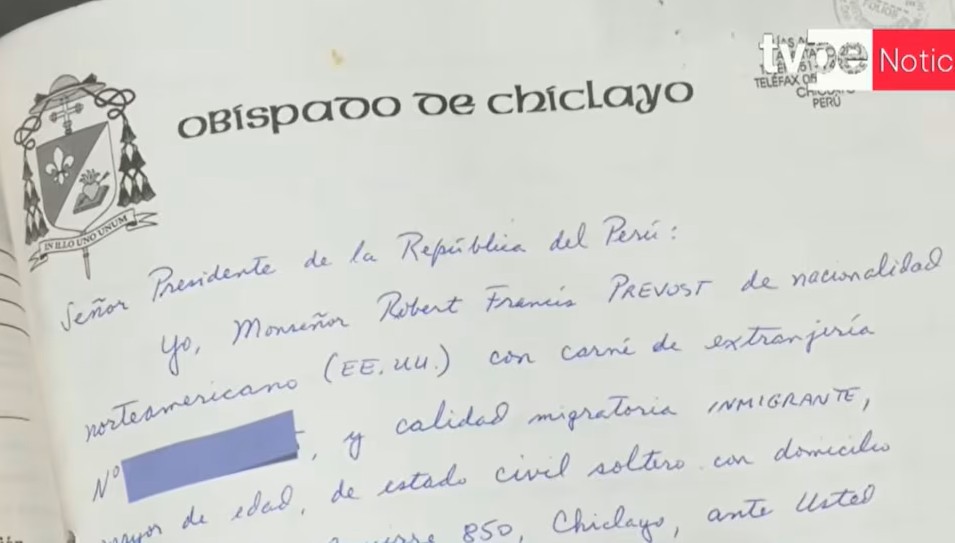
(ZENIT News / Lima, 08.13.2026).- Long before he appeared on the balcony of St. Peter’s Basilica as Pope Leo XIV, Robert Francis Prevost was making a very different declaration of commitment. Newly released documents from Peru’s immigration archives reveal that, when applying for Peruvian citizenship in 2015, the future pontiff wrote to then-President Ollanta Humala expressing his desire to “remain in Peru for the rest of my life.”
The documents, recently uncovered by TV Perú Noticias and preserved by Peru’s National Migration Archive, offer a rare glimpse into the personal convictions of a man who, a decade later, would become Bishop of Rome. They also help explain why Peru occupies such a prominent place in the Pope’s heart and why his upcoming journey to the country in November is being awaited with unusual emotion.
At a time when Pope Leo XIV is preparing to return to Peru as pontiff, the files reveal a chapter of his life that was never merely administrative. His request for citizenship was the culmination of years of missionary and pastoral service among Peruvian communities, particularly in northern Peru, where he would later serve as Bishop of Chiclayo.
The handwritten letter included in his naturalization file stands out not only for its formal purpose but for its tone. Rather than presenting himself as a foreign cleric temporarily assigned to Latin America, Prevost described a relationship with Peru built over many years and made clear his intention to continue living there indefinitely. The statement is particularly striking in retrospect, given that only a few years later Pope Francis would call him to Rome to assume increasingly important responsibilities in the governance of the universal Church.
The naturalization process itself followed the same requirements imposed on other applicants. Records indicate that Prevost completed the examinations on Peruvian history, geography, and culture required at the time. According to Héctor Pérez, a senior official responsible for the migration archives, the future Pope achieved one of the highest scores he has encountered while reviewing citizenship files.
Peruvian nationality was officially granted to Prevost in September 2015, the same year he became Bishop of Chiclayo. He continues to hold both American and Peruvian citizenship, a dual identity that many Peruvians view not as a legal technicality but as evidence of a genuine bond forged through years of shared experiences.
Those experiences were often marked by hardship. During nearly a decade leading the Diocese of Chiclayo, Prevost accompanied local communities through some of the most difficult moments in recent Peruvian history. He was present during the devastating floods associated with the El Niño phenomenon, during the COVID-19 pandemic that struck Peru with exceptional severity, and during the arrival of large numbers of Venezuelan migrants seeking refuge and opportunity.
People who worked alongside him during those years frequently recall a bishop more comfortable among ordinary families than in ecclesiastical ceremonies. That reputation helps explain the spontaneous gesture that surprised many observers on the evening of his election. In his first public appearance as Pope, Leo XIV paused to greet his “beloved Diocese of Chiclayo,” thanking a faithful people who had walked with their bishop and helped build a vibrant local Church.
For many Peruvians, those words transformed a historic papal election into something deeply personal. The new Pope was not simply a former missionary who had worked in the country. He was someone who had chosen Peru, sought its citizenship, and publicly expressed his desire to make it his permanent home.
That background adds special significance to the apostolic journey scheduled for November. Peru will host the final stage of a broader South American tour that will also include Uruguay and Argentina. After arriving in Lima, the Pope is expected to visit Chiclayo, a city that remains closely associated with his episcopal ministry. The itinerary will then continue to Cusco, the historic heart of the former Inca Empire, before concluding in Pucallpa in the Amazon region, where attention is expected to focus on indigenous communities and their challenges.
Ten years after signing the paperwork that made him a Peruvian citizen, Leo XIV returns not as a former bishop revisiting an old assignment, but as the Successor of Peter returning to a country he once believed would be his lifelong home.
Thank you for reading our content. If you would like to receive ZENIT’s daily e-mail news, you can subscribe for free through this link.

Publicaciones relacionadas:
 Pope Leo XIV receives Zelensky: open doors to Russia and Ukraine for negotiations and invitation to visit Ukraine
 The Surprising and Beautiful Story of the Pectoral Cross of Pope Leo XIV with Relics of Several Saints
 PHOTO GALLERY: Pope Leo XIV breaks vacation and makes surprise visit to Poor Clare monastery
 How we will invest the treasure that is our life? Pope Leo XIV responds with a brief reflection
