

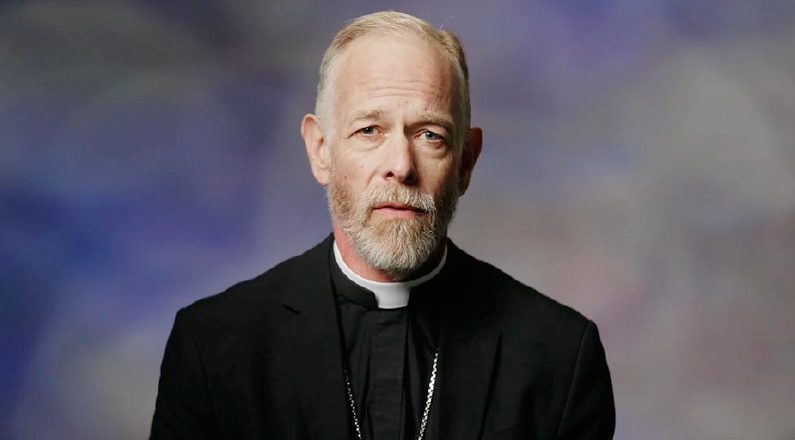
(ZENIT News / Washington, 03.22.2026).- In the days leading up to Holy Week, the United States Conference of Catholic Bishops has chosen to revisit one of the most sensitive fault lines in Christian history: the relationship between the Passion of Christ and the temptation to blame the Jewish people. Through a newly released institutional video, the bishops seek not only to clarify doctrine, but to confront a distortion that has fueled centuries of prejudice.
The message is delivered by Alexander K. Sample, Archbishop of Portland and chairman of the USCCB Committee for Religious Liberty. His intervention anchored in a precise moment of the liturgical calendar: the Easter Triduum, the three-day sequence that commemorates the Passion, death, and Resurrection of Jesus Christ.
At the center of his reflection lies Good Friday, historically one of the most misunderstood—and, at times, misused—moments in Christian devotion. Rather than a day for assigning blame, Sample insists, it is fundamentally an invitation to conversion. “It is not an occasion to accuse others,” he explains, but a call “to return to the Lord in truth, repentance, and love.”
The archbishop’s remarks address a distortion with deep historical roots: the notion of collective Jewish responsibility for the death of Jesus. Drawing on authoritative Church teaching, including the Catechism of the Council of Trent, he underscores that such an interpretation is not only inaccurate but theologically untenable. To attribute collective guilt to the Jewish people, he argues, is to misunderstand the very meaning of the Crucifixion.
As Sample acknowledges, misreadings of the Passion narrative have, at various points in history, contributed to outbreaks of hostility and even violence against Jews—particularly in proximity to Easter celebrations. In this sense, the video situates itself within a long effort by the Catholic Church to correct earlier ambiguities and prevent their recurrence.
The broader doctrinal context is crucial. Since the Second Vatican Council, and especially through the declaration Nostra Aetate, the Church has explicitly rejected antisemitism in all its forms and affirmed the spiritual bond between Christians and Jews. While the video does not revisit these documents in detail, its message clearly stands in continuity with that trajectory: a reaffirmation that theological precision has moral consequences.
Sample goes further, warning against the contemporary resurgence of conspiratorial thinking and misinformation—phenomena that often intersect with antisemitic narratives. Catholics, he says, are called to reject “conspiracies and lies” that lead to harassment or violence against Jewish communities. In doing so, he frames the issue not only as a matter of historical correction, but as a present-day ethical responsibility.
The timing of the video is deliberate. Released just days before Holy Week, it seeks to shape the spiritual disposition with which Catholics approach the central mysteries of their faith. The Passion, in this reading, is not a story about identifying external enemies, but about recognizing universal human sin and the need for redemption.
Implicit in this approach is a shift in emphasis that has been developing in Catholic theology for decades: from a narrative of accusation to one of introspection. The Crucifixion, rather than being attributed to a particular people, is understood as the consequence of sin shared by all humanity—a perspective that leaves no room for ethnic or religious scapegoating.
In a cultural climate where religious language can still be weaponized, the USCCB’s intervention reflects a broader concern within the Church: that liturgical memory must not be detached from moral responsibility. The Passion of Christ, as Sample presents it, demands not only devotion, but discernment.
The video is less a reaction to a single incident than a preventive act: a reminder that the way believers interpret their most sacred narratives continues to shape how they relate to others.
Thank you for reading our content. If you would like to receive ZENIT’s daily e-mail news, you can subscribe for free through this link.

Publicaciones relacionadas:
 Impressive: nearly 2,000 young Iraqi Catholics celebrate faith in the midst of a Muslim community
 Ukrainia: monks staying in Kherson despite misery and devastation
 Vatican sends delegation to India to venerate exposed relics of St. Francis Xavier
 Starting in the second half of 2026, there will be an admission fee to enter Cologne Cathedral
