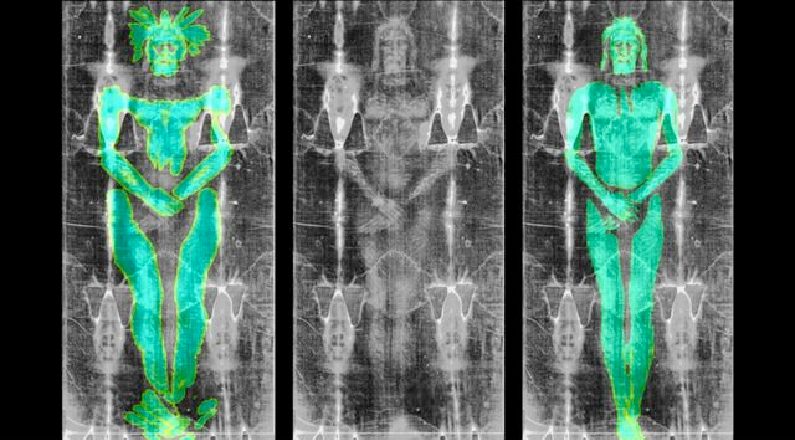
(ZENIT News / Rome, 04.03.2026).- A new genetic analysis is adding an unexpected layer to one of Christianity’s most debated relics. Fresh research on the Shroud of Turin suggests that the linen cloth may have spent significant time in the Middle East, with traces of DNA and microorganisms pointing toward a complex journey across regions, cultures and centuries.
The study, currently available as a pre-print ahead of formal publication, is led by Gianni Barcaccia of the University of Padua, in collaboration with an international team that includes the late Pier Luigi Baima Bollone, a pioneering figure in Shroud studies. Baima Bollone had already stirred debate in the 1980s by identifying what he believed to be human blood of group AB on the cloth—an assertion that remains contested but influential in ongoing research.
What distinguishes the new work is its focus on genetic traces left not only by the original context of the fabric, but by the many individuals who have come into contact with it over time. Earlier findings published by the same research group in 2015 had already revealed that more than 55.6 percent of the detectable DNA on the Shroud could be linked to populations from the Near East, while approximately 38.7 percent corresponded to individuals from the Indian subcontinent. European genetic signatures accounted for less than 5.6 percent.
At first glance, such a distribution might seem surprising. Yet the researchers argue that it aligns with known historical trade networks. Fine linen—referred to in Greek as “sindon,” a term that may be linguistically connected to the region of Sindh—was widely prized in antiquity. Trade routes between the Indian subcontinent and the Mediterranean were active during the Roman era, and some scholars have suggested that high-quality textiles from India were imported and used in religious contexts, including in Jerusalem.
The persistence of this genetic pattern in the new analysis reinforces the hypothesis of a cloth exposed to multiple populations over time, rather than confined to a single geographic origin. The authors go further, identifying the presence of mitochondrial haplogroup H33, a lineage prevalent in the Near East and particularly associated with communities such as the Druze, whose genetic history overlaps with other Levantine populations, including Jews, Palestinians and Syrians.
Beyond human DNA, the investigation ventures into microbiology. The reconstructed microbiome of the Shroud reveals a diverse ecosystem: bacteria commonly found on human skin, fungi including molds, and notably, halophilic archaea—microorganisms that thrive in environments with very high salt concentrations. Their presence is not incidental. According to the researchers, such organisms typically develop in saline conditions, suggesting that the cloth may at some stage have been stored or exposed in an environment of elevated salinity.
This detail has drawn particular attention because it evokes geographic settings such as the region surrounding the Dead Sea, one of the saltiest bodies of water on Earth and an area historically connected to early Jewish burial practices. While the study stops short of making definitive claims, it proposes that these biological markers are consistent with a Middle Eastern context.
For historians and theologians alike, the Shroud occupies a unique space between devotion and scientific scrutiny. Radiocarbon dating carried out in 1988 famously suggested a medieval origin, placing the cloth between 1260 and 1390. Yet critics of that test have argued that contamination or later repairs may have skewed the results, leaving the question of authenticity unresolved.
The new genetic findings do not settle that debate, but they complicate it in meaningful ways. By tracing the biological “footprints” embedded in the fabric, researchers are effectively reconstructing a map of interactions—who touched the cloth, where it may have traveled, and under what conditions it was preserved. In this sense, the Shroud becomes less a static object and more a witness to movement across civilizations.
For the scientific community, the study underscores both the potential and the limits of DNA analysis in historical artifacts. Contamination, by definition, is both a problem and a source of data. The same traces that obscure original material can also reveal the layered history of an object’s use and veneration.
For believers, the implications are more existential than technical. Each new piece of evidence—whether confirming or challenging prior assumptions—feeds into a broader narrative about the relationship between faith and empirical inquiry. The Shroud has long functioned as a point of contact between these domains, inviting scrutiny without ever yielding a final answer.
What emerges from this latest research is not a conclusion, but a trajectory. The cloth appears increasingly connected to a wide Mediterranean and Near Eastern world, shaped by trade, ritual and human contact. Whether that trajectory ultimately supports claims of authenticity remains an open question. But the investigation itself, now extending into the microscopic realm of DNA and extremophile organisms, suggests that the Shroud’s story is far from exhausted.
Thank you for reading our content. If you would like to receive ZENIT’s daily e-mail news, you can subscribe for free through this link.