

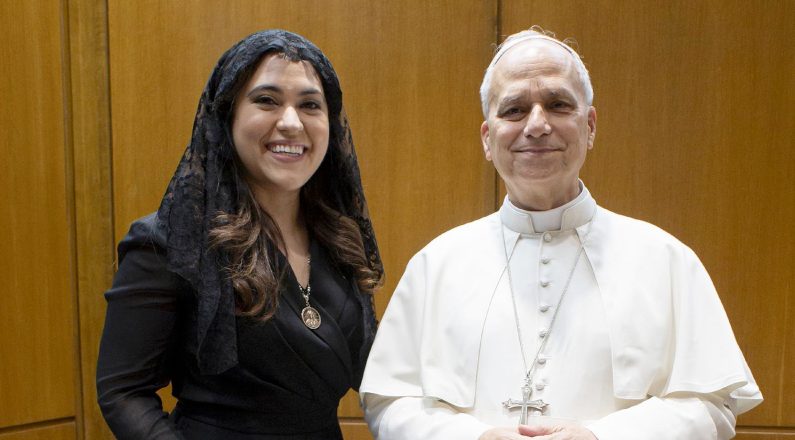
(ZENIT News / Rome, 06.02.2026).- Pope Leo XIV has made one of the most significant appointments of his young pontificate by naming María Montserrat Alvarado, president and chief operating officer of EWTN News, as the next prefect of the Vatican’s Dicastery for Communication. The appointment, which will take effect on November 1, 2026, places a Mexican-born laywoman at the head of one of the Holy See’s most strategically important departments and signals a new chapter in the relationship between the Vatican and one of the most influential Catholic media organizations in the world.
The decision is historic on several levels. Alvarado becomes the first laywoman to lead a Vatican dicastery. Her nomination also continues a process initiated under Pope Francis, who gradually expanded leadership opportunities for lay men and women within the Roman Curia. Yet beyond questions of governance, the appointment carries broader ecclesial significance because of Alvarado’s professional background and the institution from which she comes.
Born in Mexico City and educated at Florida International University and George Washington University, Alvarado built much of her career at the Becket Fund for Religious Liberty, where she spent fourteen years working on issues related to religious freedom and human dignity. Those themes have become increasingly important in a world where Christians continue to face legal restrictions, discrimination, and outright persecution in various regions. Since 2023, she has overseen the global operations of EWTN News, helping guide the network’s expansion across continents, languages, and digital platforms.
The Vatican communications department she will lead was created by Pope Francis in 2015 as part of his broader reform of the Curia. The dicastery consolidated numerous media entities under a single structure, including Vatican News, Vatican Radio, L’Osservatore Romano, Vatican Media, the Holy See Press Office, the Vatican Publishing House, and other communication services. Beyond its technical responsibilities, the department also carries the delicate mission of helping the Church communicate its message effectively in an increasingly fragmented digital culture.
Alvarado succeeds Paolo Ruffini, who in 2018 became the first layperson ever appointed prefect of a Vatican dicastery. As he approaches retirement age, Ruffini has pledged to work closely with his successor during the transition period, emphasizing continuity and the need for the dicastery to remain attentive to the rapidly changing communications landscape.
The appointment has also attracted attention because of EWTN’s unique place within contemporary Catholic life. Founded in 1981 by Mother Angelica, the network grew from a modest American initiative into the largest Catholic media system in the world, reaching millions of people through television, radio, print journalism, digital media, and social platforms. Its influence extends far beyond the United States and has helped shape Catholic discussion for decades.
At the same time, EWTN has not been without controversy. During the pontificate of Pope Francis, some commentators and programs associated with the network voiced concerns about aspects of his pastoral agenda, including debates surrounding synodality, Amoris Laetitia, interreligious dialogue, migration, environmental questions, and other priorities of the late pontiff. Critics accused parts of the network of contributing to polarization within the Church, while EWTN and its supporters defended their work as legitimate Catholic journalism and faithful engagement with important ecclesial debates.
The contrast is striking. Five years ago, Pope Francis publicly lamented what he described as criticism coming from a major Catholic television network (EWTN). Today, under a different pontificate, a senior executive from that same organization has been entrusted with directing the Vatican’s own communications apparatus.
Rather than signaling realignment, however, the appointment may reveal something deeper about Leo XIV’s approach. By selecting a figure respected for managerial competence, international experience, and commitment to Catholic media, the Pope appears to be emphasizing professional excellence while also extending a hand toward sectors of the Catholic world that have not always felt fully aligned with Vatican priorities.
In her first remarks after the announcement, Alvarado expressed gratitude, humility, and a desire to serve both the Pope and the universal Church. Her challenge now will be considerable. She inherits responsibility for communicating the mission of a global Church to audiences increasingly shaped by digital culture, social media, and competing narratives. Yet her appointment also offers an opportunity: to demonstrate that Catholic communication can serve unity without suppressing legitimate diversity, and can foster dialogue while remaining firmly rooted in the Church’s faith and mission.
Thank you for reading our content. If you would like to receive ZENIT’s daily e-mail news, you can subscribe for free through this link.

Publicaciones relacionadas:
 A New Phase in the Leonine Pontificate: Pope Reshapes His Inner Circle with a Surprising Appointment
 Pope Leo XIV to publish new document on Catholic education and declare Newman co-patron of Catholic education
 Mystical Phenomena and Holiness Explained by Pope Leo XIV
 Leo XIV perfects the mission of the Pontifical Academy for Life
